- Vectors in a Plane - Velocity Vectors - Negative Vectors - Complex Numbers - Polar Coordinates in Graphs - Complex Numbers and DeMoivre's Theorem - Complex Numbers in the Plane

|
Criado por Elexali Olayvar
mais de 5 anos atrás
|
|
Fechar
|
|
Criado por Elexali Olayvar
mais de 5 anos atrás
|
|
Vector u has its initial point at (-7, 2) and its terminal point at (11, -5). Vector v has a direction opposite that of vector u, and its magnitude is three times the magnitude of u. What is the component form of vector v?
A.
v = <-54, 63>
B.
v = <-162, -63>
C.
v = <-54, 21>
D.
v = <-162, 21>
Vector u has its initial point at (17, 5) and its terminal point at (9, -12). Vector v has its initial point at (12, 4) and its terminal point at (3, -2). Find ||3u − 2v||. Round your answer to the nearest hundredth.
A.
29.79 units
B.
32.12 units
C.
39.46 units
D.
42.23 units
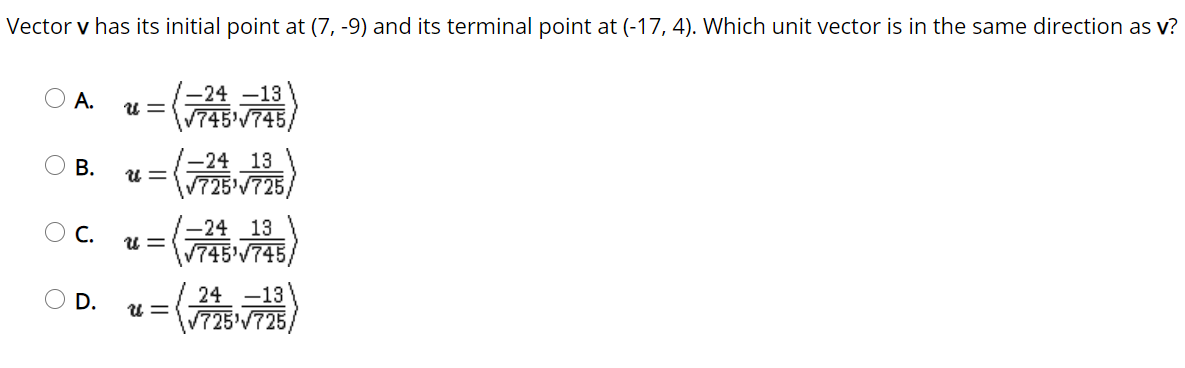
Vector u has its initial point at (14, -6) and its terminal point at (-4, 7). Write the component form of u and find its magnitude.
u = <__, ___>, and ||u|| ≈ ___ units.
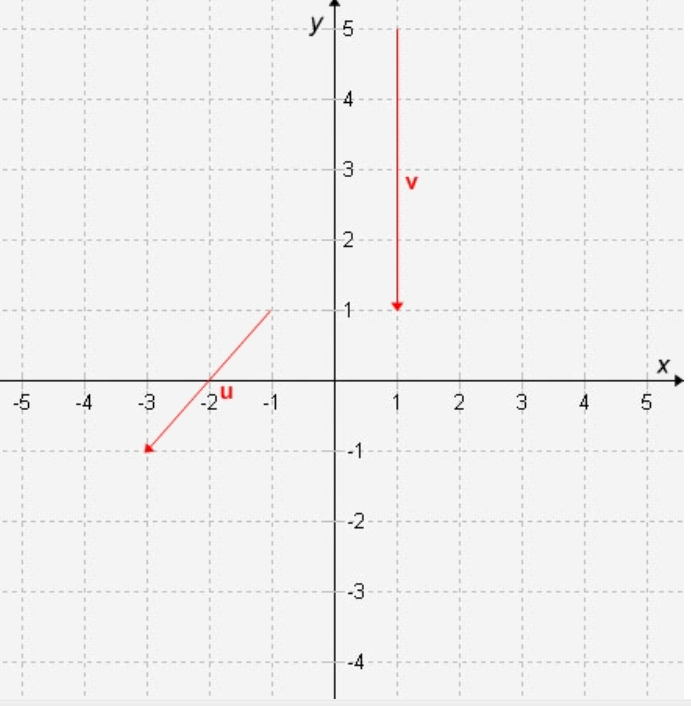
Write the component forms of vectors u and v, shown in the graph, and find v − 2u.
u = __
v = __
v − 2u = __
Vector u has a magnitude of 7 units and a direction angle of 330°. Vector v has magnitude of 8 units and a direction angle of 30°. What is the direction angle of their vector sum?
A.
0°
B.
2.20°
C.
30°
D.
357.80°
Vector u has a magnitude of 5 units, and vector v has a magnitude of 4 units. Which of these values are possible for the magnitude of u + v?
1 unit
9 units
11 units
13 units
Consider the vectors u = <-4, 7> and v = <11,-6>.
u + v = <__, __>
||u + v|| ≈ ___units
Vector u has a magnitude of 5 units and a direction angle of 75°, and vector v has a magnitude of 6 units and a direction angle of 210°. What is the component form of the vector u + v?
A.
< -3.95, 1.83>
B.
< -3.94, 1.89>
C.
< -3.90, 1.89>
D.
< -3.90, 1.83>
If w = <3.5, -6> and z = <-1.5, -4>, what is the resulting vector for 2w − z?
A.
<5, -2>
B.
<10, -4>
C.
<8.5, -8>
D.
<5.5, 12>
Which components are a possible representation of vector u if ||-4u|| ≈ 14.42?
A.
<3, -2>
B.
<-1, 4>
C.
<2, 2>
D.
<-2, -4>
Find the results of the given vector subtractions for u = <-8, 4> and v = <2, 7>.
-u – v = ___
u – v = ___
v – u = ___
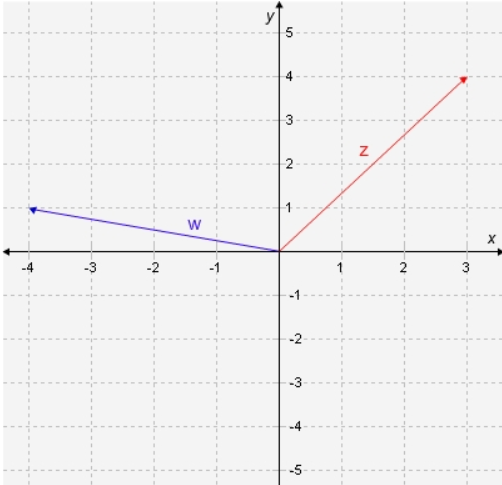
The resulting vector for w – z is <__, __>, and z – w is <__, __>.
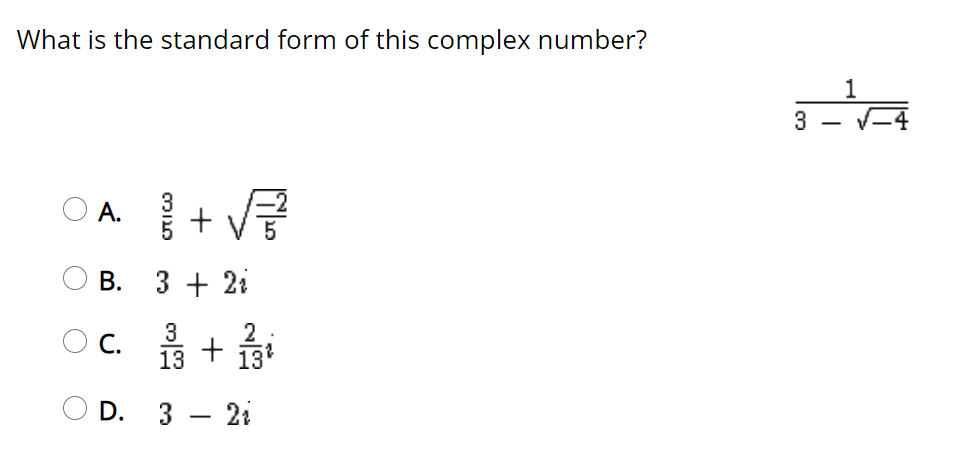
If u = 3 − 4i and v = 3i + 6, what is u − v?
A.
-3 + 7i
B.
-3 − 7i
C.
3 + 7i
D.
3 − 7i
If (2 + 3i)2 + (2 − 3i)2 = a + bi, a = ___and b = __.
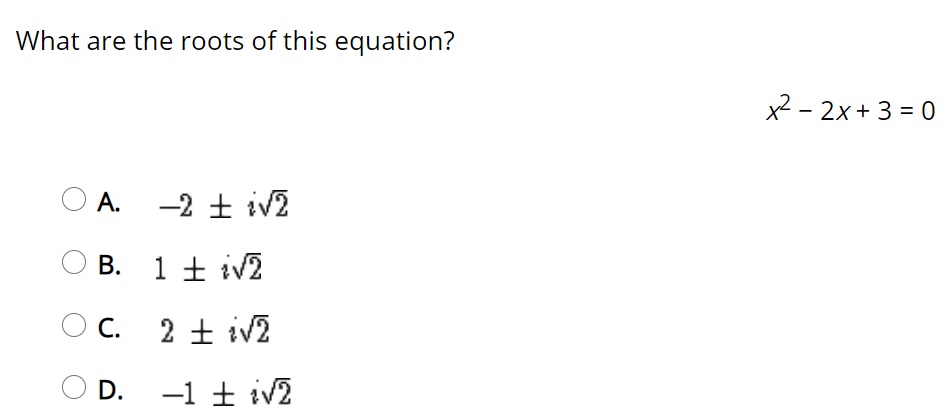
Convert (2, pi) to rectangular form.
A.
(2, 0)
B.
(-2, 0)
C.
(0, 2)
D.
(0, -2)
Convert x^2 + y^2 = 16 to polar form.
A.
r = 16
B.
r = 4
C.
θ = 16
D.
θ = 4
Convert (1, 1) to polar form.
A.
(2, 45°)
B.
(1, 45°)
C.
(2, 225°)
D.
(sqrt 2, 45°)
Convert 3cis 180° to rectangular form.
A.
-3
B.
-3i
C.
3
D.
3i
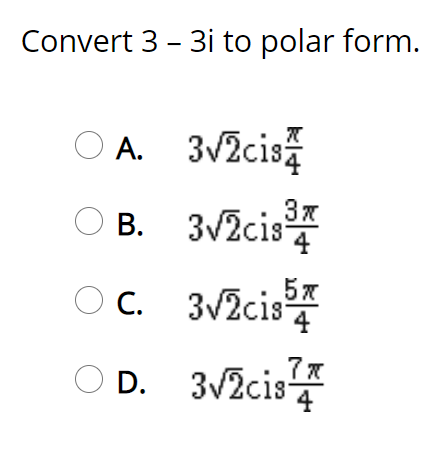
Convert 5cis 270° to rectangular form.
A.
-5
B.
-5i
C.
5
D.
5i
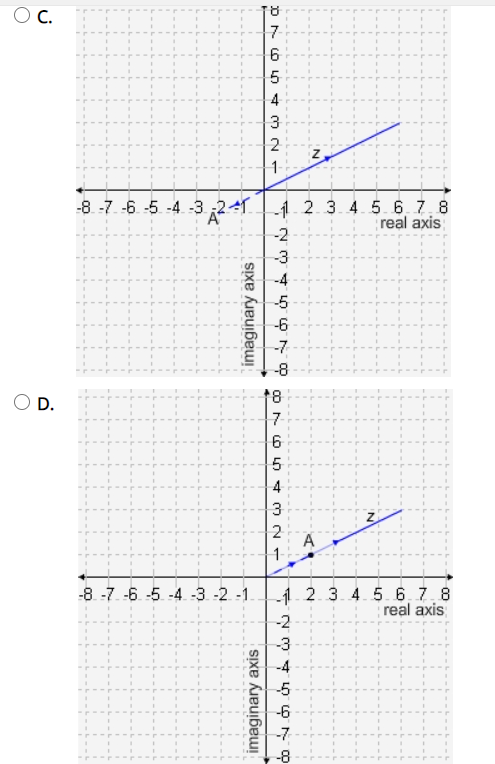
Which graph represents the product of a complex number, z, and the negative real number -1/3 ?
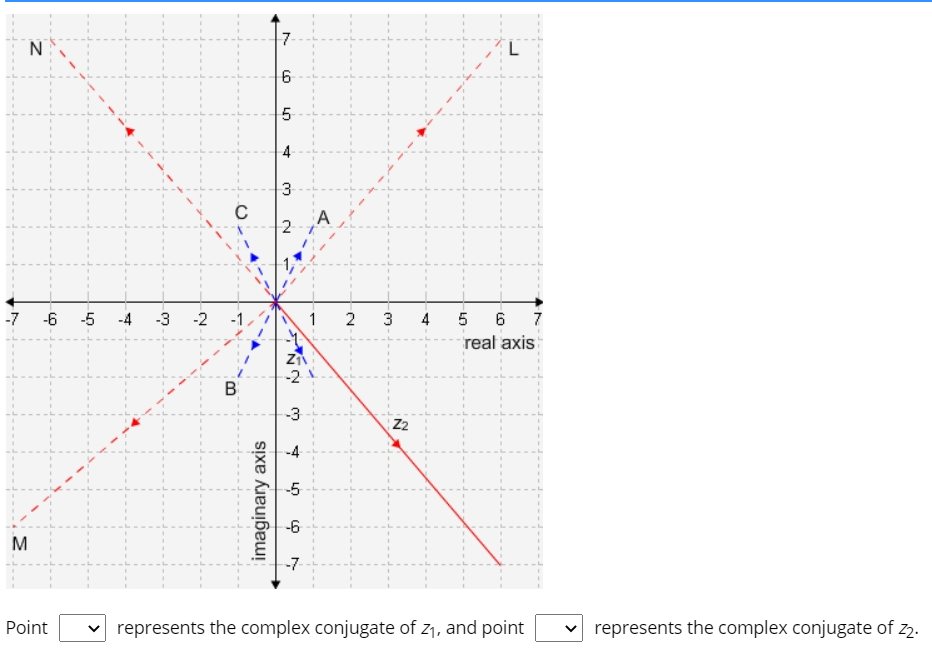
The graph represents two complex numbers, z1 and z2, as solid line vectors. Which points represent their complex conjugates?
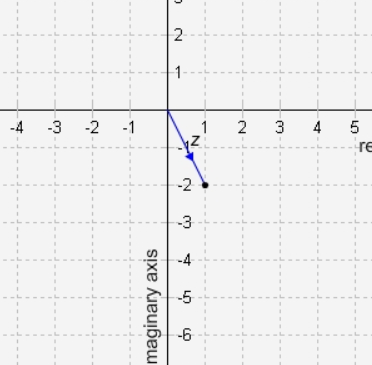
In the graph, z is a complex number represented as a vector from the origin. What is the product of z and its conjugate?
The product of the complex number z and its conjugate is ___
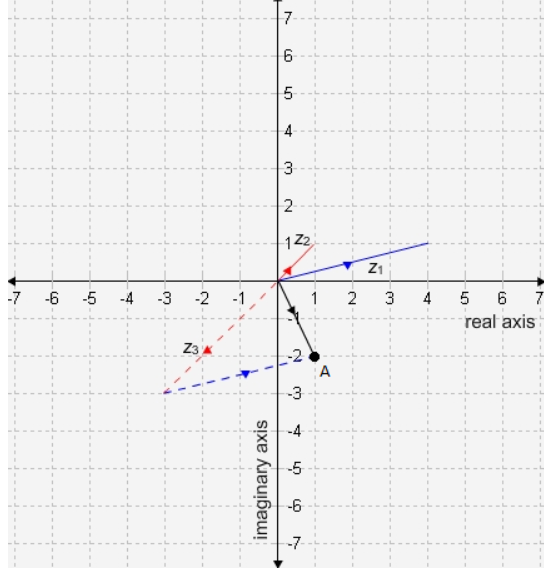
Which operations involving complex numbers have solutions represented by point A on the graph?
(4 + i) + 3(1 + i)
(4 + i) − 3(1 + i)
(4 + i) + (-3 − 3i)
(4 + i) + (3 − 3i)
(4 + i) − (3 + 3i)