
20092375
Descrição

Quiz por Christopher Wysong, atualizado more than 1 year ago

|
Criado por Christopher Wysong
quase 7 anos atrás
|
|
Questão 1
Questão
A nurse caring for a patient who is 2 days post cerebrovascular accident asks the physical therapist for positioning recommendations when the patient lies on the hemiplegic side. The therapist's recommendations should include positioning the:
Responda
-
wrist in a flexed position.
-
elbow in a flexed position.
-
scapula in a protracted position.
-
forearm in a pronated position.
Questão 2
Questão
During a physical therapy examination, a patient reports numbness, burning, and paresthesias in both feet. A neurological examination reveals bilateral loss of pain and temperature sensation in a stocking-and-glove distribution, diminished ankle reflexes, normal knee-jerk reflexes, and decreased strength in the feet and ankles bilaterally. The patient MOST likely has:
Responda
-
L4–L5 nerve root compression.
-
intermittent claudication.
-
peripheral vascular disease.
-
peripheral neuropathy.
Questão 3
Questão
The parent of a child with myelomeningocele at L2 asks a physical therapist to provide information regarding the child's prognosis for walking. The therapist should respond by telling the parent that the child will MOST likely be able to:
Responda
-
walk with ankle-foot orthoses throughout the home and school.
-
walk with knee-ankle-foot orthoses throughout the home and school.
-
walk with knee-ankle-foot orthoses within the home.
-
stand using a parapodium; walking will not be possible.
Questão 4
Questão
A physical therapist is preparing to give instructions in the use of a new standing device to the family of a 3-year-old child who has myelomeningocele. Which of the following actions should the therapist perform FIRST?
Responda
-
Ask the family what problems they would have with using a standing device.
-
Give the family product literature and a video about the standing device.
-
Ask the family what method would be best for them to learn to use the standing device.
-
Show the family how to place the child into the standing device.
Questão 5
Questão
A patient with multiple sclerosis wants to transfer independently. The patient progressed from moderate to minimal assistance for transfers within 3 days; however, no progress has been made in the past 2 weeks. The physical therapist should:
Responda
-
discharge the patient without further intervention.
-
provide the patient with a home program and re-evaluate in 1 month.
-
increase the patient's treatments to 5 times/week for 2 weeks.
-
decrease the patient's treatments to 1 time/week until the goal is achieved.
Questão 6
Questão
A patient recently sustained a cerebrovascular accident, with resulting hemiplegia. A physical therapist is assisting the patient with rolling in bed. The therapist's FIRST consideration should be to:
Responda
-
move the patient only to the uninvolved side.
-
discourage the patient's use of the uninvolved side.
-
keep the head in midline.
-
protect the involved shoulder.
Questão 7
Questão
A patient who has a spinal cord injury has loss of proprioception, two-point discrimination, and vibration sense below the level of the lesion. Which of the following syndromes is MOST likely present?
Responda
-
Central cord
-
Anterior cord
-
Posterior cord
-
Brown-Séquard
Questão 8
Questão
A physical therapist is examining a patient who reports a burning sensation between the 2nd and 3rd metatarsals that spreads across the forefoot. The pain occurs primarily with weight-bearing or pressure on the area, but also at night when the patient is in bed. The MOST likely cause of the pain is:
Responda
-
plantar fasciitis.
-
complex regional pain syndrome.
-
a Morton neuroma.
-
tarsal tunnel syndrome.
Questão 9
Questão
For a patient with a complete T10 spinal cord injury to achieve stability while standing with crutches, the patient should maintain which of the following positions?
Responda
-
Hips posterior to the ankles
-
Shoulders posterior to the hips
-
Ankles plantar flexed
-
Knees hyperextended
Questão 10
Questão
A patient recovering from a traumatic brain injury is unable to correctly state his whereabouts and insists he is staying at a resort. Which of the following is the MOST appropriate action for the physical therapist to take?
Responda
-
Discuss the confusion with the patient's friend.
-
Orient the patient to the correct location.
-
Agree with the patient.
-
Document dementia in the patient's chart.
Questão 11
Questão
A patient reports a 3-month history of sudden, severe vertigo associated with sweating and a feeling of light-headedness. Symptoms increase with forward bending and turning around in bed. The sensations usually stop after 30 seconds in a static position. Which of the following tests is MOST appropriate to determine the cause of the dysfunction?
Responda
-
Gait assessment
-
Dix-Hallpike maneuver
-
Vestibulo-ocular assessment
-
Marching in place with eyes closed
Questão 12
Questão
Which of the following devices is MOST appropriate for testing protective sensation in the feet?
Responda
-
Two-point compass
-
Blunt pin
-
Skin thermometer
-
10-g (5.07) monofilament
Questão 13
Questão
When instructing an individual with intellectual disability, which of the following teaching techniques is MOST appropriate?
Responda
-
Emphasize verbal feedback.
-
Provide instruction using a single method.
-
Practice, review, and facilitate overlearning of concepts and techniques.
-
Practice a series of portions of a task rather than the complete functional task.
Questão 14
Questão
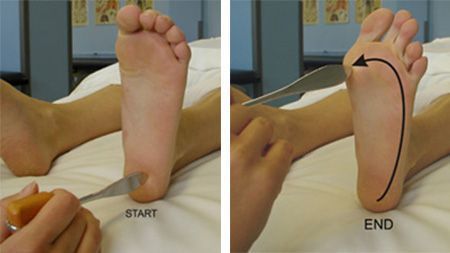
A physical therapist is conducting a reflex text as shown in the photographs. The arrow indicates the path of the applied stimulus. The results of the test are MOST likely to indicate:
Image:
Neuro1 (binary/octet-stream)
Responda
-
a peripheral nerve injury
-
a lesion of the anterior horn cells.
-
a normal response.
-
an injury to the spinal cord.
Questão 15
Questão
A physical therapist is evaluating a patient who has a vascular lesion in the brainstem affecting the oculomotor nerve (CN III). During the cranial nerve examination, which of the following signs would be the MOST significant?
Responda
-
Inability to close the eyelid
-
Medial strabismus
-
Ptosis of the eyelid
-
Difficulty looking inferomedially
Questão 16
Questão
A patient is being evaluated for possible carpal tunnel syndrome, and a nerve conduction velocity test is performed. Which of the following findings would MOST strongly support the diagnosis?
Responda
-
Decreased latency at the elbow
-
Decreased latency at the carpal tunnel
-
Increased latency at the carpal tunnel
-
Increased latency at the forearm
Questão 17
Questão
A patient who has right hemiplegia is unable to avoid obstacles on the right side of the hallway while walking with a walker. During meals, the patient does not eat foods placed on the right side of the plate. Which of the following tests is MOST appropriate to perform?
Responda
-
Patient looks at a fixed target in front while turning the head side to side.
-
Patient detects therapist's fingers from the side while looking straight ahead.
-
Patient shifts gaze from one object to another quickly with the head stationary.
-
Patient tracks therapist's finger moving vertically, horizontally, and diagonally.
Questão 18
Questão
A patient who has a T7 spinal cord injury (ASIA Impairment Scale D) exhibits decreased motor function in the right lower extremity and loss of pain sensation over the left distal trunk and lower extremity. Which of the following syndromes is MOST likely present?
Responda
-
Central cord
-
Anterior cord
-
Posterior cord
-
Brown-Séquard
Questão 19
Questão
When examining a patient with right facial weakness, a physical therapist notes the presence of a right Bell phenomenon. Which of the following additional findings is MOST likely to be present?
Responda
-
Decreased taste sensation on the tongue
-
Abnormal tone of the right limbs
-
Ptosis of the right eyelid
-
Loss of pain and temperature sensation across the lower right jaw
Questão 20
Questão
A physical therapist examines a patient with multiple sclerosis who is in a period of exacerbation. The patient is independent with bed mobility, can sit unassisted at the edge of the bed, and requires physical assistance to stand with a walker. Which of the following interventions would have the HIGHEST priority?
Responda
-
Wheelchair propulsion up a 10-ft (3-m) ramp
-
Wheelchair transfers
-
Walking with an assistive device
-
Tub transfers
Questão 21
Questão
A patient with a severe cerebellar lesion can sit independently, can stand with minimal assistance, and requires moderate assistance of one person to walk safely. The patient wants to transfer independently from a wheelchair to a bed. Which of the following transfer techniques is MOST appropriate for the patient?
Responda
-
Standing pivot
-
Manual pivot
-
Mechanical lift
-
Sliding
Questão 22
Questão
A patient with Parkinson disease has just been admitted to a rehabilitation unit. The patient is dependent in all transfers and requires moderate assistance of one person to walk 30 ft (9.1 m) with a standard walker. To facilitate good carryover for activities, instruction of the family in transfers should occur:
Responda
-
during a home visit after the patient is discharged.
-
just prior to discharging the patient.
-
early in the rehabilitation program.
-
when the family feels ready to take the patient home.
Questão 23
Questão
A patient with a mild closed head injury and bilateral femur fractures requires instruction in a lower extremity exercise program. To plan the most effective teaching methods for this patient, what is MOST critical to assess at the INITIAL visit?
Responda
-
Comprehension of written, verbal, and demonstrated instructions
-
Short-term memory capacity
-
Auditory and visual status
-
Any personality changes compared to the patient's premorbid status
Questão 24
Questão
A patient sustained a gunshot wound to the spine in the area of L1. The patient has weakness of the left lower extremity and inability to move the knee, ankle, or foot. The patient's patellar tendon and Achilles tendon reflexes are increased on the left side. There is also loss of proprioception in the patient's left ankle and knee, a positive Babinski sign on the left side, and diminished sensation to pinprick and temperature changes in the right thigh, leg, and foot. Results of all of the patient's cranial nerve tests are normal. These findings are consistent with which of the following injuries?
Responda
-
Complete severance of the spinal cord
-
Injury to the left anterior horn of the spinal cord
-
Injury to the left side of the spinal cord
-
Injury to the central area of the spinal cord
Questão 25
Questão
Which of the following elements of motor learning contributes MOST to retention of a motor skill?
Responda
-
Mental practice
-
Manual contact to guide the patient
-
Summary knowledge of results
-
Practice of the motor skill
Questão 26
Questão
A patient reports burning medial knee pain that occurs during knee flexion greater than 60°. Resisted knee extension is strong and pain free. The patient denies any popping or instability and there is no history of trauma. There is tenderness to palpation over the anteromedial distal thigh. Which of the following conditions is MOST likely causing the patient's knee pain?
Responda
-
Medial meniscal tear
-
Adductor magnus strain
-
Saphenous nerve impingement
-
Medial collateral ligament tear
Questão 27
Questão
In the INITIAL management of a patient with a partial peripheral nerve injury, the goal of the physical therapy intervention will MOST likely be to prevent which of the following problems?
Responda
-
Nerve degeneration
-
Spasticity and clonus
-
Muscle atrophy
-
Contractures and adhesions
Questão 28
Questão
A patient has sustained a traumatic brain injury and is slow to respond to all stimuli. The patient currently verbalizes and moves away from noxious stimuli and is able to close the eyes 3 of 5 times when asked. What level on the Rancho Los Amigos levels of cognitive functioning scale BEST describes this patient's current status?
Responda
-
Localized response
-
Confused-agitated
-
Generalized response
-
Confused-inappropriate
Questão 29
Questão
A manual muscle test of a patient who sustained a gunshot wound immediately superior to the elbow joint reveals specific muscle weakness from a partial median nerve injury. The physical therapy intervention for the patient should include strengthening activities for wrist flexion, forearm:
Responda
-
pronation, finger flexion, and thumb (1st digit) adduction.
-
pronation, finger flexion, and thumb (1st digit) opposition.
-
supination, finger abduction, and thumb (1st digit) opposition.
-
supination, finger flexion, and thumb (1st digit) extension.
Questão 30
Questão
For an individual with a T12 spinal cord injury to be able to walk, achievement of which of the following ranges of motion is MOST important?
Responda
-
30° of ankle plantar flexion
-
Full hip extension
-
Normal knee flexion
-
110° straight-leg raise
Quer criar seus próprios Quizzes gratuitos com a GoConqr? Saiba mais.