
11734946
Description

Quiz by Daniel Neag, updated more than 1 year ago

|
Created by Daniel Neag
almost 9 years ago
|
|
Question 1
Question
Which of the following is a MAJOR task of evaluating exit criteria and reporting?
Answer
-
A. Writing a test summary report for stakeholders
-
B. Logging the outcome of test execution
-
C. Repeating test activities as a result of action taken for each discrepancy.
-
D. Evaluating testability of the requirements and system
Question 2
Question
What is the USUAL sequence for performing the following activities during the Fundamental Test Process?
a. Analyze the test basis documents.
b. Define the expected results.
c. Create the test execution schedule.
d. Establish the traceability of the test conditions
Answer
-
A. d, a, c, b
-
B. a, d, b, c
-
C. a, b, c, d
-
D. a, b, d, c
Question 3
Question
Which of the following activities would NORMALLY be undertaken during test planning?
a. Scheduling test analysis and design.
b. Designing Test Conditions.
c. Monitoring test progress.
d. Identifying the objectives of testing.
e. Evaluating test tools.
f. Selecting test metrics for monitoring and control.
Answer
-
A. b, c and d
-
B. a, d and f
-
C. a, d and e
-
D. b, c and f
Question 4
Question
A wholesaler sells printer cartridges. The minimum order quantity is 5. There is a 20% discount for orders of 100 or more printer cartridges. You have been asked to prepare test cases using various values for the number of printer cartridges ordered. Which of the following groups contain three test inputs that would be generated using Boundary Value Analysis?
Answer
-
A. 5, 6, 20
-
B. 4, 5, 80
-
C. 4, 5, 99
-
D. 1, 20, 100
Question 5
Question
Which of the following statements describe why exploratory testing is a useful test design technique?
a. It can help derive test cases based on the internal structure of systems.
b. It is useful when there are limited specification documents available.
c. It is useful when there testing is constrained due to time pressures.
d. It is a cheaper alternative to more formal test design techniques.
Answer
-
A. b and c
-
B. a and c
-
C. b and d
-
D. c and d
Question 6
Question
Which of the following statements correctly describes the benefit of fault attacks?
Answer
-
A. They are more effective at finding faults than formal test design techniques
-
B. They are useful when there is limited experience in the test team
-
C. They can evaluate the reliability of a test object by attempting to force specific failures to occur
-
D. They are less structured than other experience-based techniques
Question 7
Question
From the list below, select the recommended principles for introducing a chosen test tool in an organization?
1. Roll the tool out to the entire organization at the same time.
2. Start with a pilot project.
3. Adapt and improve processes to fit the use of the tool.
4. Provide training and coaching for new users.
5. Let each team decide their own standard ways of using the tool.
6. Monitor that costs do not exceed initial acquisition cost.
7. Gather lessons learned from all teams.
Answer
-
A. 1, 2, 3, 5.
-
B. 1, 4, 6, 7.
-
C. 2, 3, 4, 7.
-
D. 3, 4, 5, 6.
Question 8
Question
A deviation from the specified or expected behaviour that is visible to end-users is called:
Answer
-
A. An error
-
B. A fault
-
C. A failure
-
D. A defect
Question 9
Question
Testing throughout the project in a three-dimensional sense refers to the following dimensions:
Answer
-
A. Time, Resources, and Risk
-
B. Verification, Validation, and Defect Reporting
-
C. Time, Organizational, and Cultural
-
D. None of the above
Question 10
Question
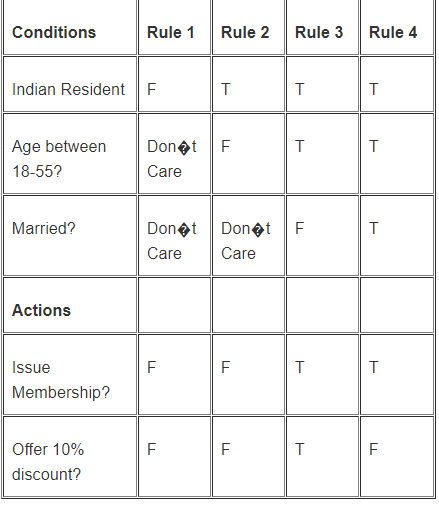
Given this decision table on Card Issue, what is the expected result for the following test cases?
A.TC1: Piyush is a 32 year old married, residing in Mumbai India.
B.TC3: Yogindernath is a 65 year old married person, residing in Colombo.
Answer
-
A. A-Issue membership, 10% discount, B-Issue membership, offer no discount. B
-
B. A-Don't Issue membership, B-Don't offer discount. C
-
C. A-Issue membership, No discount, B-Don't Issue membership.
-
D. Issue membership, No discount, B- Issue membership with 10% discount.
Question 11
Question
Why is tester dependent on configuration management?
Answer
-
A. Because configuration management assures that we know the exact version of the testware and the test object
-
B. Because test execution is not allowed to proceed without the consent of the change control board
-
C. Because changes in the test object are always subject to configuration management
-
D. Because configuration management assures the right configuration of the test tools
Question 12
Question
Why is successful test execution automation difficult?
Answer
-
A. Because the tools for automated testing require too much effort for learning
-
B. Because the maintenance of the test system is difficult
-
C. Because the test robot tools are restricted in their ability to recognize outputs
-
D. Because the test robot needs to be supported by a test management.
Question 13
Question
Why is it necessary to define a Test Strategy?
Answer
-
A. As there are many different ways to test software, thought must be given to decide what will be the most effective way to test the project on hand.
-
B. Starting testing without prior planning leads to chaotic and inefficient test project
-
C. A strategy is needed to inform the project management how the test team will schedule the test-cycles
-
D. Software failure may cause loss of money, time, business reputation, and in extreme cases injury and death. It is therefore critical to have a proper test strategy in place.
Question 14
Question
For the code fragment given below, which answer correctly represents minimum tests required for statement and branch coverage respectively?
Discount rate=1;
Fare = 1000;
If ((person == "senior citizen") and ("travel month = January"))
Bonuspoints = 100+Bonuspoints
If (class=="first")
discountRate = .5;
Fare = fare * discountRate;
Answer
-
A. Statement Coverage = 1, Branch Coverage = 2
-
B. Statement Coverage = 2, Branch Coverage = 2
-
C. Statement Coverage = 1, Branch Coverage = 3
-
D. Statement Coverage = 2, Branch Coverage = 4
Question 15
Question
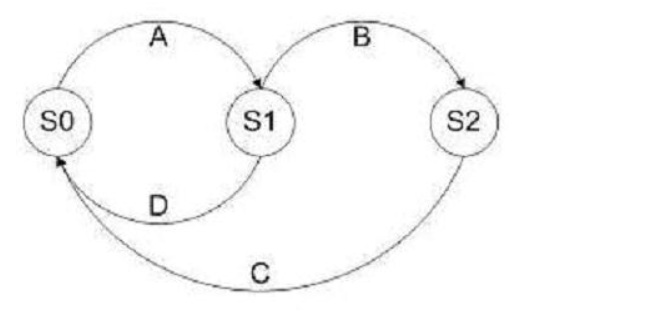
Given the following state transition table Which of the test cases below will cover the following series of state transitions? S1 SO S1 S2 SO
Answer
-
A. D, A, B, C.
-
B. A, B, C, D.
-
C. D, A, B.
-
D. A, B, C.
Question 16
Question
Which of the following is not considered a benefit of testing tools?
Answer
-
A. Ability to detect tiny changes that a human could not
-
B. Easy to implement and maintain
-
C. Test assets are more consistent
-
D. Ease of measurement of software quality
Question 17
Question
Which of the following options is not related to static testing?
Answer
-
A. Test data preparation tools
-
B. Early defect detection
-
C. Scribe
-
D. Compilers
Question 18
Question
Which of the following is not a part of Configuration Management?
Answer
-
A. Controlled library access
-
B. Record of changes to documentation over time
-
C. Auditing conformance to ISO9001
-
D. Identification of test versions
Question 19
Question
Though activities in the Fundamental test process may overlap or occur concurrently, identify the logical sequential process.
(i) Test Implementation and Execution
(ii) Test Closure activities
(iii) Evaluating exit criteria and reporting
(iv) Test Planning and Control
(v) Test Analysis and Design
Answer
-
A. iv - v - iii - ii - i
-
B. v - i - iii - ii - iv
-
C. iv - v - i - iii - ii
-
D. v - ii - iii - i - iv
Question 20
Question
One of the differences between the Modified Condition Decision Coverage and the Condition Coverage is:
Answer
-
A. The Condition Coverage ensures all paths through a module are executed whereas the Modified Condition Decision Coverage ensures each path in a decision can independently affect the outcome.
-
B. The Modified Condition Decision Coverage ensures all alternative paths are executed whereas the Condition Coverage ensure all main paths are executed.
-
C. The Condition Coverage ensures each condition takes all possible outcomes at lease once whereas the Modified Condition Decision Coverage requires both maximum and minimum values within each field.
-
D. The Modified Condition Decision Coverage relies on the tester's skill and past experience whereas the Condition Coverage relies on the way in which the system moves from one condition to another.
Want to create your own Quizzes for free with GoConqr? Learn more.