
12755040
Description

Quiz by Tara McLaughlin, updated more than 1 year ago

|
Created by Tara McLaughlin
almost 8 years ago
|
|
Question 1
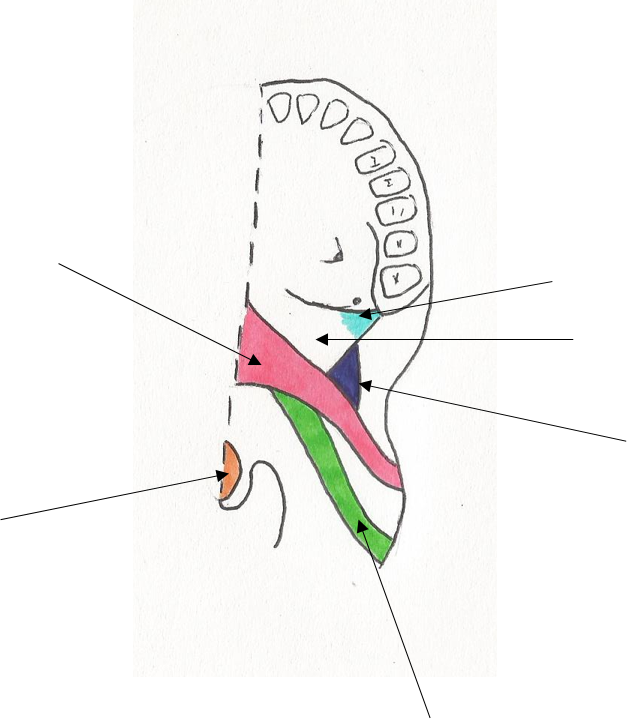
Answer
-
Levator veli palatini
-
Palatoglossus
-
Palatopharyngeus
-
Tensor veli palatini
-
Musculus uvulae
-
Levator veli palatini
-
Tensor veli palatini
-
Musculus uvulae
-
Palatoglossus
-
Palatopharyngeus
-
Tenors veli palatini
-
Levator veli palatini
-
Palatoglossus
-
Palatopharyngeus
-
Musculus uvulae
-
Tensor veli palatini
-
Levator veli palatini
-
Musculus uvulae
-
Palatoglossus
-
Palatopharyngeus
-
Palatoglossus
-
Palatopharyngeus
-
Palatine aponeurosis
-
Tensor veli palatini
-
Levator veli palatini
-
Tenors veli palatini
-
Levator veli palatini
-
Palatine aponeurosis
-
Palatoglossus
-
Musculus uvulae
Question 2
Question
Where does fertilisation occur?
Answer
-
Uterus
-
Ampulla of the uterine tube
-
Ovary
-
Isthmus of the uterine tube
Question 3
Question
The zona pellucida breaks down during fertilisation.
Answer
- True
- False
Question 4
Question
The trophoblast differentiates into the cytotrophoblast.
Answer
- True
- False
Question 5
Question
After gastrulation the three germ layers that form are the hypoblast, mesoderm and endoderm.
Answer
- True
- False
Question 6
Question
The first pharynegeal arch is associated with the [blank_start]Trigeminal[blank_end] nerve. Pharyngeal arch two is associated with the [blank_start]facial[blank_end] nerve. [blank_start]Glossopharyngeal[blank_end] nerve is associated with the third pharyngeal arch and the [blank_start]vagus[blank_end] nerve is associated with the fourth and sixth pharyngeal arches.
Answer
-
trigeminal
-
facial
-
Glossopharyngeal
-
vagus
Question 7
Question
Which pharyngeal arch does the maxillary and mandibular prominence's arise from?
Answer
-
First
-
Second
-
Third
-
Fourth-sixth
-
Fifth
Question 8
Question
The lateral nasal swellings form the intermaxillary segment.
Answer
- True
- False
Question 9
Question
The incisive foramen is the landmark between the primary and secondary palates.
Answer
- True
- False
Question 10
Question
Which of these foramen are found on the hard palate?
Answer
-
greater palatine foramen
-
lesser palatine foramen
-
infraorbital foramen
-
Incisive fossa
-
mental spines
Question 11
Question
The greater palatine foramen can be located near the first molar tooth on either side of the hard palate.
Answer
- True
- False
Question 12
Question
The palatine aponeurosis, which is an expansion of the [blank_start]tensor veli palatini tendons[blank_end], strengthens the soft palate. The palatine aponeurosis is thin posteriorly where it ends in a free margin and thick anteriorly where it attaches to the [blank_start]hard palate[blank_end]. The [blank_start]palatine aponeurosis[blank_end] mainly forms the the anterior part of the soft palate, whereas the posterior part of the soft palate is mainly formed form [blank_start]muscle[blank_end]. The aponeurosis also serves as a site for muscle attachment for the other palatine muscle
Answer
-
tensor veli palatini tendons
-
levator veli palatini tendons
-
musculus uvulae
-
palatopharyngeus tendons
-
pharynx
-
hard palate
-
tongue
-
palatoglossus muscle
-
bone
-
palatine muscles
-
connective tissue
-
palatine aponeurosis
-
muscle
-
palatine aponeurosis
-
bone
-
connective tissue
Question 13
Question
Which muscles are involved in elevating the soft palate?
Answer
-
levator veli palatini
-
musculus uvulae
-
palatoglossus
-
palatopharyngeal
Question 14
Question
Which muscles are involved in depressing the soft palate?
Answer
-
levator veli palatini
-
musculus uvulae
-
palatoglossus
-
palatopharyngeal
Question 15
Question
Which of these muscles are supplied by the vagus nerve?
Answer
-
tensor veli palatini
-
levator veli palatini
-
musculus uvulae
-
palatoglossus
-
palatopharyngeus
Question 16
Question
Which other nerve supplies the soft palate, along with the lesser palatine nerve?
Answer
-
vagus
-
facial
-
glossopharyngeal
-
hypoglossal
Question 17
Question
The greater palatine nerve terminates in the oral cavity?
Answer
- True
- False
Question 18
Question
The [blank_start]soft[blank_end] palate contains taste papillae that are referred to as palate papillae. The palate papillae are morphologically similar to [blank_start]fungiform papillae[blank_end] that are located on the anterior aspect of the tongue. The gustatory function of the soft palate is predominately innervated by the [blank_start]greater petrosal nerve[blank_end]. However, some are innervated by the deep petrosal nerve. The soft palate is most sensitive to [blank_start]sweet[blank_end] sensation.
Answer
-
soft
-
hard
-
filiform papillae
-
fungiform papillae
-
foliate papillae
-
circumvallate papillae
-
lesser palatine nerve
-
greater petrosal nerve
-
greater palatine nerve
-
nasopalatine nerve
-
bitter
-
unami
-
sour
-
sweet
-
salty
Question 19
Question
The transport of food is done by the "squeeze-back" method
Answer
- True
- False
Question 20
Question
The soft palate helps direct air flow?
Answer
- True
- False
Question 21
Question
The soft palate is depressed during oral breathing.
Answer
- True
- False
Question 22
Question
The levator veli palatini muscles are most active during oral breathing.
Answer
- True
- False
Question 23
Question
Individuals with flat palates tend to have an increased vowel production .
Answer
- True
- False
Question 24
Question
Clefts of the primary palate occur posterior to the incisive foramen.
Answer
- True
- False
Question 25
Question
Name the type of cleft palate pointed to by the arrows.
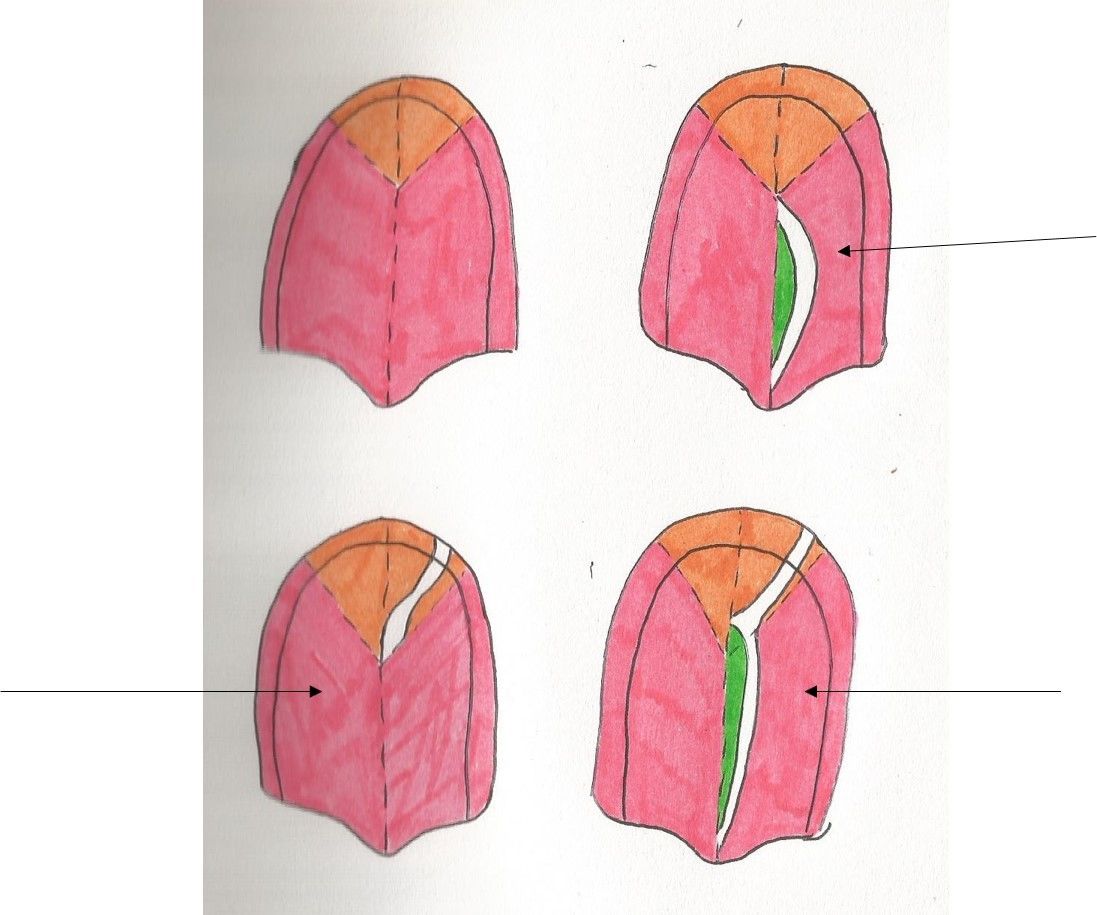
Answer
-
primary cleft palate
-
secondary cleft palate
-
primary + secondary cleft palate
-
primary cleft palate
-
secondary cleft palate
-
primary + secondary cleft palate
-
primary cleft palate
-
secondary cleft palate
-
primary + secondary cleft palate
Question 26
Question
Cleft palates can reduce the nasal airways?
Answer
- True
- False
Question 27
Question
At week six the [blank_start]palatine shelves[blank_end] grow inferiorly on either side of the tongue. In week [blank_start]seven[blank_end] the palatine shelves rotate and move to a [blank_start]horizontal[blank_end] position above the tongue. The palatine shelves will fuse in the midline and continue to fuse anteriorly and posteriorly. The nasal septum will grow [blank_start]inferiorly[blank_end] to fuse with the superior surface of the palate. The fusion of the nasal septum and palate separates the oral cavity and the nasal cavity. Rotation of the shelves is believed to be due to synthesis and hydration of [blank_start]hyaluronic acid[blank_end] within the extracellular matrix of the shelves.
Answer
-
palatine shelves
-
medial nasal prominences
-
lateral nasal prominences
-
nine
-
six
-
seven
-
eight
-
horizontal
-
vertical
-
oblique
-
superiorly
-
inferiorly
-
posteriorly
-
anteriorly
-
hyaluronic acid
-
lactic acid
-
formic acid
-
malic acid
Question 28
Question
The palatine processes of the [blank_start]maxillae[blank_end] and the [blank_start]palatine[blank_end] bone are the main components of the hard palate. The palatine processes of the maxillae makes up the anterior [blank_start]three-quarters[blank_end]. The palatine bones form the posterior [blank_start]one-quarter[blank_end].
Answer
-
maxillae
-
temporal bone
-
sphenoid bone
-
mandibular
-
palatine
-
three-quarters
-
two-thirds
-
one-third
-
one-quarter
Question 29
Question
To reach the palate the greater and lesser palatine nerves descends through the pterygopalatine fossa and [blank_start]palatine canal[blank_end]. The greater palatine nerve supplies the [blank_start]hard palate[blank_end] and gingiva. The lesser palatine nerve, which supplies the [blank_start]soft palate[blank_end], travels through the lesser palatine foramen and passes [blank_start]posteromedially[blank_end].
Answer
-
palatine canal
-
lesser palatine foramen
-
incisive foramen
-
hard palate
-
palatoglossus muscle
-
soft palate
-
palatopharyngeus
-
posteromedially
-
anteromedially
-
anterolaterally
-
posterolaterally
Question 30
Question
During swallowing the soft palate is [blank_start]elevated[blank_end], separating the oral cavity and the nasal cavity, closing the [blank_start]pharyngeal[blank_end] isthmus. The actions allows the transport of food to the pharynx and prevents food entering the nasal cavity. The main muscle involved in elevation of the soft palate is the [blank_start]levator veli palatini[blank_end] muscles. The musculus uvulae will assist in this action.
Answer
-
elevated
-
pharyngeal
-
levator veli palatini
Question 31
Question
The [blank_start]soft[blank_end] palate is lowered and contacts the [blank_start]posterior[blank_end] part of the tongue, closing the [blank_start]oropharyngeal[blank_end] isthmus, during [blank_start]nasal[blank_end] breathing. The [blank_start]palatoglossus[blank_end] is the muscle most active during nasal breathing.
Answer
-
soft
-
hard
-
anterior
-
posterior
-
medial
-
lateral
-
oropharyngeal
-
pharyngeal
-
nasal
-
non-nasal
-
palatopharyngeus
-
palatoglossus
-
levator veli palatini
-
tensor veli palatini
Question 32
Question
The soft palate is elevated during [blank_start]non-nasal[blank_end] sounds so air is expelled only through the [blank_start]mouth[blank_end]. When the soft palate is depressed then this produces [blank_start]nasal[blank_end] sounds. Hypernasal resonance and nasal emissions occur when there is an inadequate closure of the [blank_start]pharyngeal isthmus[blank_end] during speech production. The soft palate is generally elevated by the [blank_start]levator veli palatini[blank_end] muscles during speech. Elevation of the soft palate is [blank_start]lower[blank_end] during speech than it is during swallowing.
Answer
-
non-nasal
-
nasal
-
mouth
-
nose
-
non-nasal
-
nasal
-
pharyngeal isthmus
-
oropharyngeal isthmus
-
tensor veli palatini
-
levator veli palatini
-
palatoglossus
-
palatopharyngeus
-
lower
-
high
Question 33
Question
Problems that can occur in an individual with a cleft palate include weak articulation of consonants. The consonant '[blank_start]s[blank_end]' appears to be the most common articulation difficulty. Cleft palate patients avoid using [blank_start]nasal[blank_end] consonants and instead use [blank_start]non-nasal[blank_end] consonants. For example, using 'm' instead of 'b'. Omission is another speech problem with cleft palates. Omission of speech is where the [blank_start]last[blank_end] consonant is missed to avoid any nasal emission.
Answer
-
s
-
m
-
L
-
nasal
-
non-nasal
-
last
-
middle
-
first
Question 34
Question
If the cleft palate is accompanied by a cleft lip a lip repair is done first and normally occurs around [blank_start]three months[blank_end]. At about [blank_start]six months to one year[blank_end] a cleft palate repair is done. Surgery normally occurs early on to help in feeding and to avoid any speech habits. When the individual is around [blank_start]five[blank_end] years of age they will undergo rhinoplasty.
Answer
-
three months
-
one month
-
ten months
-
six months
-
one month to three months
-
six months to one year
-
one year to two years
-
three months to six months
-
five
-
ten
-
one
-
two
Want to create your own Quizzes for free with GoConqr? Learn more.