
12814238
Description

Quiz by Katie Aldred, updated more than 1 year ago

|
Created by Katie Aldred
almost 8 years ago
|
|
Question 1
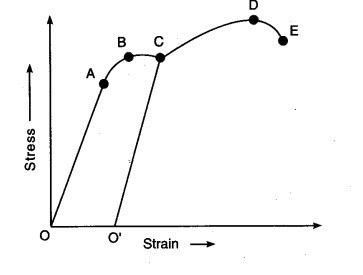
Answer
-
limit of proportionality
-
elastic limit
-
yield point
-
Ultimate tensile strength
-
Breaking point
Question 2
Question
The density of a substance is defined as its [blank_start]mass[blank_end] per [blank_start]unit[blank_end] [blank_start]volume[blank_end].
Answer
-
mass
-
unit
-
volume
Question 3
Question
What is the equation to find density?
Answer
-
P=m/V
-
P=mV
-
F=ke
Question 4
Question
Hooke’s Law can be expressed as F=ke.
Answer
- True
- False
Question 5
Question
State Hooke’s Law
Answer
-
Force is proportional to extension
-
Force is inversely proportional to extension up to the limit of proportionality
-
Force is proportional to extension up to the limit of proportionality
Question 6
Question
K in the Hooke’s Law equation represents how elastic a material is.
Answer
- True
- False
Question 7
Question
A brittle material has [blank_start]very little/no [blank_end]extension before [blank_start]breaking[blank_end].
Answer
-
very little/no
-
breaking
Question 8
Question
A ductile material [blank_start]extends[blank_end] significantly before [blank_start]breaking[blank_end] and can be drawn into [blank_start]wires[blank_end].
Answer
-
extends
-
breaking
-
wires
Question 9
Question
[blank_start]Force[blank_end] is proportional to extension and the material[blank_start] obeys Hooke’s Law[blank_end] up to the limit of proportionality
Answer
-
Force
-
obeys Hooke’s Law
Question 10
Question
The [blank_start]elastic limit[blank_end] is the maximum amount that a material can be stretched and still return to its [blank_start]original length[blank_end]
Answer
-
elastic limit
-
original length
Question 11
Question
The yield point is the point at which [blank_start]stress[blank_end] in the wire suddenly [blank_start]drops[blank_end] when the wire is subject to increasing [blank_start]strain[blank_end]
Answer
-
stress
-
drops
-
strain
Question 12
Question
The ultimate tensile strength is the greatest stress on a material before breaking
Answer
- True
- False
Question 13
Question
What is the breaking point of an object?
Answer
-
The point at which the object fails
-
The point at which the material undergoes plastic deformation
Question 14
Question
Elastic behaviour is when an object [blank_start]will[blank_end] return to its [blank_start]original shape[blank_end] when the deforming force is removed
Answer
-
will
-
original shape
Question 15
Question
Plastic behaviour is when the object [blank_start]does not[blank_end] return to its [blank_start]original shape[blank_end] when the deforming force is removed
Answer
-
does not
-
original shape
Question 16
Question
Plastic deformation is permanent deformation/ permanent extension
Answer
- True
- False
Question 17
Question
Stress is [blank_start]force per unit cross-sectional area[blank_end]
Answer
-
force per unit cross-sectional area
Question 18
Question
Strain is [blank_start]extension divided by its original length[blank_end]
Answer
-
extension divided by its original length
Question 19
Question
The Young Modulus of a material is the [blank_start]stress divided by the strain [blank_end]
Answer
-
stress divided by the strain
Question 20
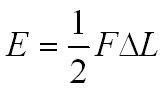
Answer
-
Elastic potential energy
-
Heat energy
-
Kinetic energy
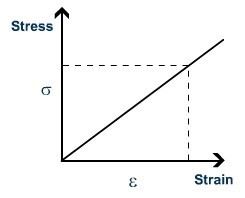
Question 21
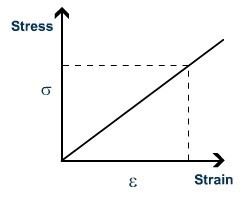
Answer
-
Young Modulus
Question 22
Question
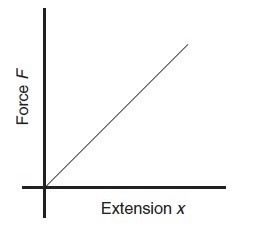
What does the gradient of this graph and the area underneath it represent?
Image:
Mobile upload (image/jpeg)
Answer
-
the spring constant
-
the elastic energy stored
Question 23
Answer
-
energy per unit volume
Want to create your own Quizzes for free with GoConqr? Learn more.