
13523830
Description

Quiz by Ryan Halcomb, updated more than 1 year ago

|
Created by Ryan Halcomb
over 7 years ago
|
|
Question 1
Question
Because monopoly firms do not have to compete with other firms, the outcome in a market with a monopoly is often
Answer
-
not in the best interest of society.
-
one that fails to maximize total economic well-being.
-
inefficient.
-
All of the above are correct.
Question 2
Question
The fundamental source of monopoly power is
Answer
-
barriers to entry.
-
profit.
-
decreasing average total cost.
-
a product without close substitutes.
Question 3
Question
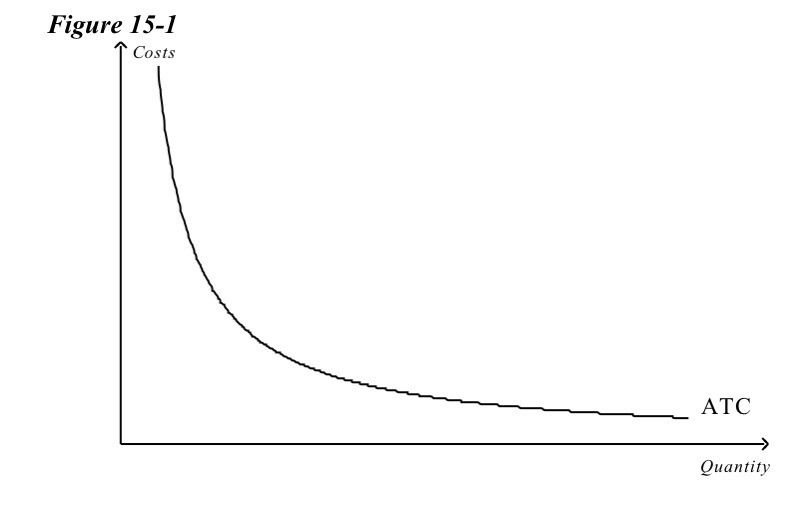
Refer to Figure 15-1. The shape of the average total cost curve reveals information about the nature of the barrier to entry that might exist in a monopoly market. Which of the following monopoly types best coincides with the figure?
Image:
Mobile upload (image/jpeg)
Answer
-
ownership of a key resource by a single firm
-
natural monopoly
-
government-created monopoly
-
a patent or copyright monopoly
Question 4
Question
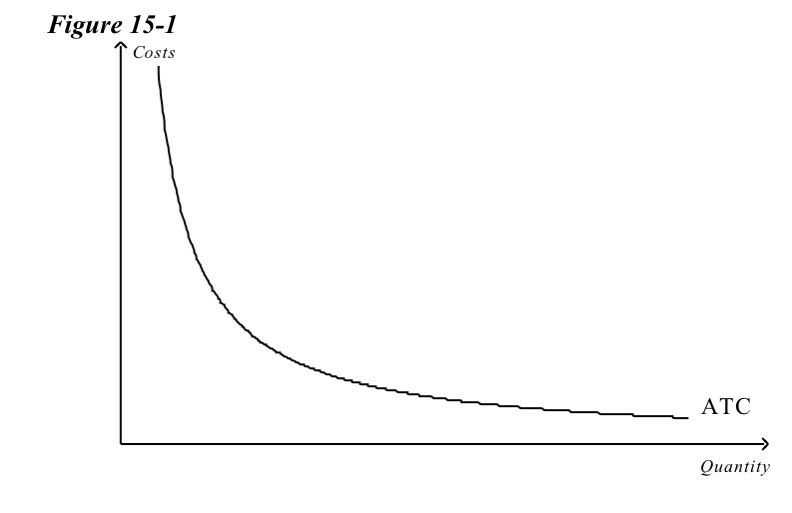
Refer to Figure 15-1. Considering the relationship between average total cost and marginal cost, the marginal cost curve for this firm
Image:
Mobile upload (image/jpeg)
Answer
-
must lie entirely above the average total cost curve.
-
must lie entirely below the average total cost curve.
-
must be upward sloping.
-
does not exist.
Question 5
Question
The profit-maximization problem for a monopolist differs from that of a competitive firm in which of the following ways?
Answer
-
A competitive firm maximizes profit at the point where marginal revenue equals marginal cost; a monopolist maximizes profit at the point where marginal revenue exceeds marginal cost.
-
A competitive firm maximizes profit at the point where average revenue equals marginal cost; a monopolist maximizes profit at the point where average revenue exceeds marginal cost.
-
For a competitive firm, marginal revenue at the profit-maximizing level of output is equal to marginal revenue at all other levels of output; for a monopolist, marginal revenue at the profit-maximizing level of output is smaller than it is for larger levels of output.
-
For a profit-maximizing competitive firm, thinking at the margin is much more important than it is for a profit-maximizing monopolist.
Question 6
Question
When a monopolist increases the number of units it sells, there are two effects on revenue. They are the
Answer
-
demand effect and the supply effect.
-
competition effect and the cost effect.
-
competitive effect and the monopoly effect.
-
output effect and the price effect.
Question 7
Question
For a monopolist, marginal revenue is
Answer
-
positive when the demand effect is greater than the supply effect.
-
positive when the monopoly effect is greater than the competitive effect.
-
negative when the price effect is greater than the output effect.
-
negative when the output effect is greater than the price effect.
Question 8
Question
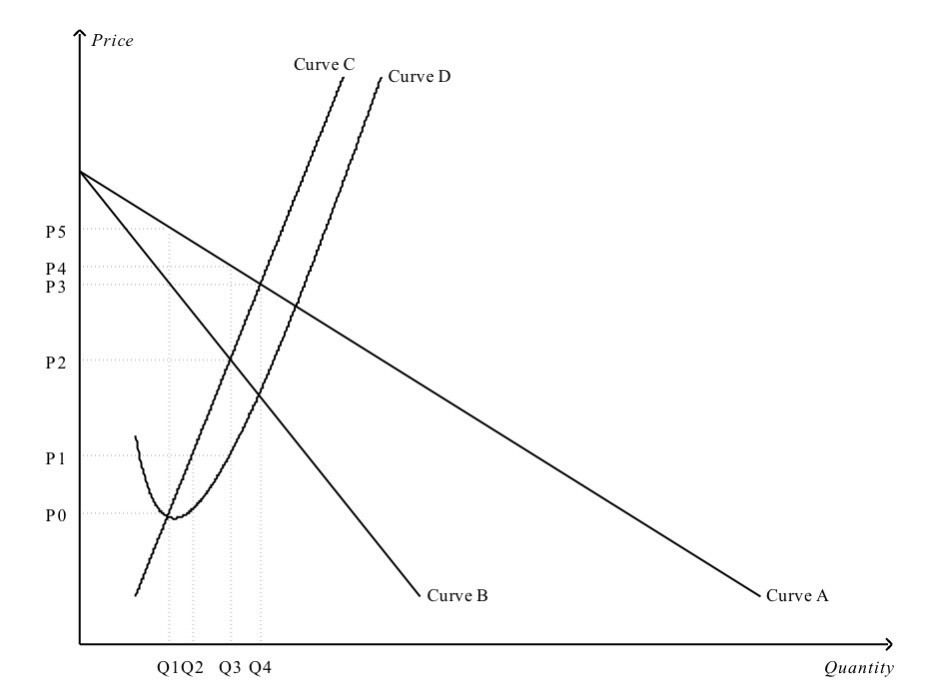
Refer to Figure 15-4. A profit-maximizing monopoly will produce an output level of
Image:
Mobile upload (image/jpeg)
Answer
-
Q1
-
Q2
-
Q3
-
Q4
Question 9
Question
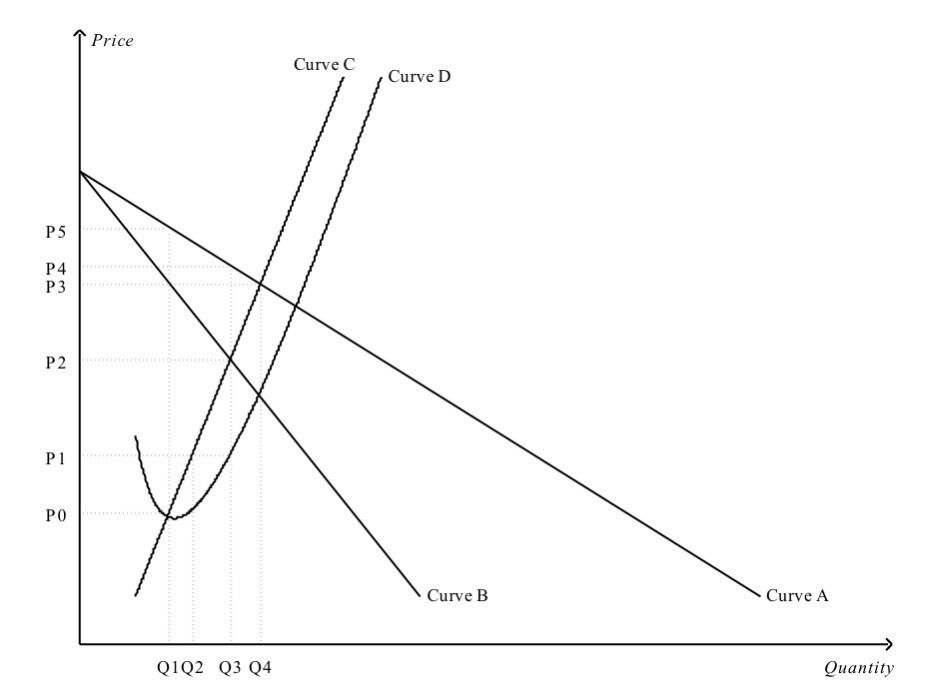
Refer to Figure 15-4. A profit-maximizing monopoly will charge a price of
Image:
Mobile upload (image/jpeg)
Answer
-
P5
-
P4
-
P3
-
P2
Question 10
Question
Refer to Figure 15-4. A profit-maximizing monopoly's total revenue is equal to
Answer
-
P4 x Q3.
-
P5 x Q1.
-
P3 x Q4.
-
(P4-P2) x Q3.
Question 11
Question
Which of the following statements is correct? Monopolies are socially inefficient because they
(i) charge a price above marginal cost.
(ii) produce too little output.
(iii) earn profits at the expense of consumers.
(iv) maximize the market’s total surplus.
Answer
-
(i) and (ii) only
-
(iii) only
-
(iii) and (iv) only
-
(i), (ii), (iii), and (iv)
Question 12
Question
Price discrimination
Answer
-
forces monopolies to charge a lower price as a result of government regulation.
-
is an attempt by a monopoly to prevent some customers from purchasing its product by charging a high price.
-
is an attempt by a monopoly to increases its profit by selling the same good to different customers at different prices.
-
increases the consumer surplus associated with a monopolistic market.
Question 13
Question
With perfect price discrimination the monopoly
Answer
-
eliminates all price discrimination by charging each customer the same price.
-
charges each customer an amount equal to the monopolist's marginal cost of production.
-
eliminates deadweight loss.
-
eliminates profits and increases consumer surplus.
Question 14
Question
Which of the following statements is not correct?
Answer
-
Monopolistic competition is similar to monopoly because in each market structure the firm can charge a price above marginal costs.
-
Monopolistic competition is similar to perfect competition because both market structures are characterized by free entry.
-
Monopolistic competition is similar to oligopoly because both market structures are characterized by barriers to entry.
-
Monopolistic competition is similar to perfect competition because both market structures are characterized by many sellers.
Question 15
Question
In a market that is characterized by imperfect competition,
Answer
-
firms are price takers.
-
there are always a large number of firms.
-
there are at least a few firms that compete with one another.
-
the actions of one firm in the market never have any impact on the other firms' profits.
Question 16
Question
Monopolistic competition is characterized by which of the following attributes (i) free entry
(ii) product differentiation
(iii) many sellers
Answer
-
(i) and (iii) only
-
(i) and (ii) only
-
(ii) and (iii) only
-
(i), (ii), and (iii)
Question 17
Question
Which of the following statements is correct?
Answer
-
Monopolistic competition is similar to monopoly because both market structures are characterized by patents.
-
Monopolistic competition is similar to perfect competition because both market structures are characterized by each seller being small compared to the market.
-
Monopolistic competition is similar to oligopoly because both market structures are characterized by free entry.
-
Monopolistic competition is similar to perfect competition because both market structures are characterized by excess capacity.
Question 18
Question
For a monopolistically competitive firm,
Answer
-
marginal revenue and price are the same.
-
average revenue and price are the same.
-
at the profit-maximizing quantity of output, price equals marginal cost.
-
at the profit-maximizing quantity of output, price equals the minimum of average total cost.
Question 19
Question
To maximize its profit, a monopolistically competitive firm chooses its level of output by looking for the level of output at which
Answer
-
price equals marginal cost.
-
marginal revenue equals marginal cost.
-
average total cost is minimized.
-
All of the above are correct.
Question 20
Question
For a profit-maximizing monopolistically competitive firm, price exceeds marginal cost in
Answer
-
the short run but not in the long run.
-
the long run but not in the short run.
-
both the short run and the long run.
-
neither the short run nor the long run.
Question 21
Question
When existing firms lose customers and profits due to entry of a new competitor, a
Answer
-
predatory-pricing externality occurs.
-
consumption externality occurs.
-
business-stealing externality occurs.
-
product-variety externality occurs.
Question 22
Question
Advertising
Answer
-
provides information about products, including prices and seller locations.
-
has been proven to increase competition and reduce prices compared to markets without advertising.
-
signals quality to consumers, because advertising is expensive.
-
All of the above are correct.
Question 23
Question
The debate over the efficiency of markets in which products with brand names are sold
Answer
-
is framed by the role of regulation in advertising.
-
is likely to be resolved by reference to anecdotal evidence.
-
hinges on whether consumers are rational in their choices.
-
hinges on the effectiveness of advertising that identifies price differences.
Question 24
Question
When monopolistically competitive firms advertise, in the long run
Answer
-
they will still earn zero economic profit.
-
they can earn positive economic profit by increasing market share.
-
the market price must fall.
-
the market price must rise.
Question 25
Question
A firm maximizes its profit by producing output up to the point where marginal revenue equals marginal cost
Answer
-
only when the market is a monopoly.
-
only when the market is a monopoly or monopolistically competitive.
-
only when the market is monopolistically competitive or perfectly competitive.
-
when the market is perfectly competitive, monopolistically competitive, or monopolistic.
Question 26
Question
A firm produces the welfare-maximizing level of output
Answer
-
only when the market is perfectly competitive.
-
only when the market is a monopoly or monopolistically competitive.
-
only when the market is monopolistically competitive or perfectly competitive.
-
when the market is perfectly competitive, monopolistically competitive, or monopolistic.
Question 27
Question
Which of the following statements about oligopolies is not correct?
Answer
-
An oligopolistic market has only a few sellers.
-
The actions of any one seller can have a large impact on the profits of all other sellers.
-
Oligopolistic firms are interdependent in a way that competitive firms are not.
-
Unlike monopolies and monopolistically competitive markets, oligopolies prices do not exceed their marginal revenues.
Question 28
Question
Which of the following statements is correct?
Answer
-
If duopolists successfully collude, then their combined output will be equal to the output that would be observed if the market were a monopoly.
-
Although the logic of self-interest decreases a duopoly’s price below the monopoly price, it does not push the duopolists to reach the competitive price.
-
Although the logic of self-interest increases a duopoly’s level of output above the monopoly level, it does not push the duopolists to reach the competitive level.
-
All of the above.
Question 29
Question
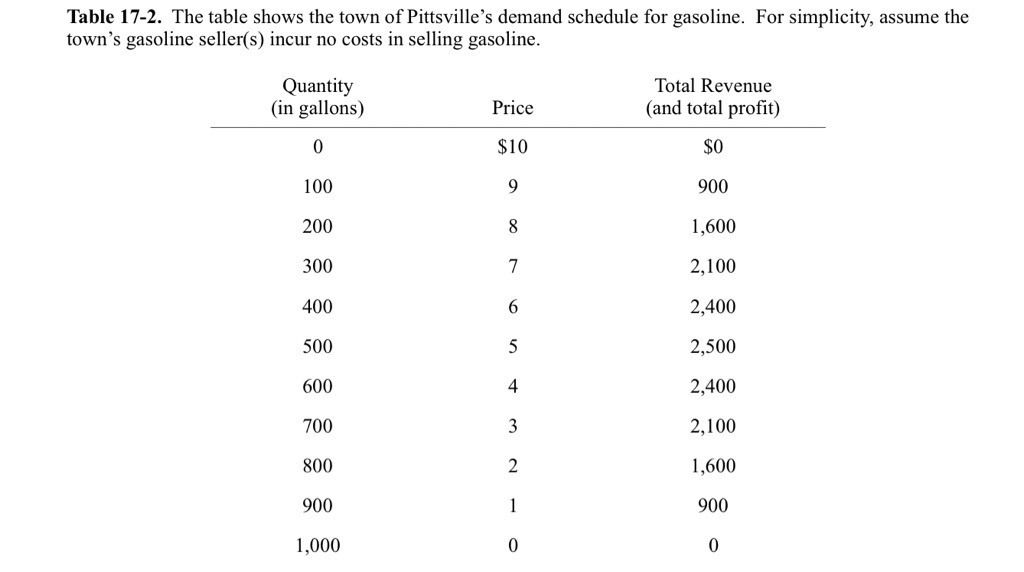
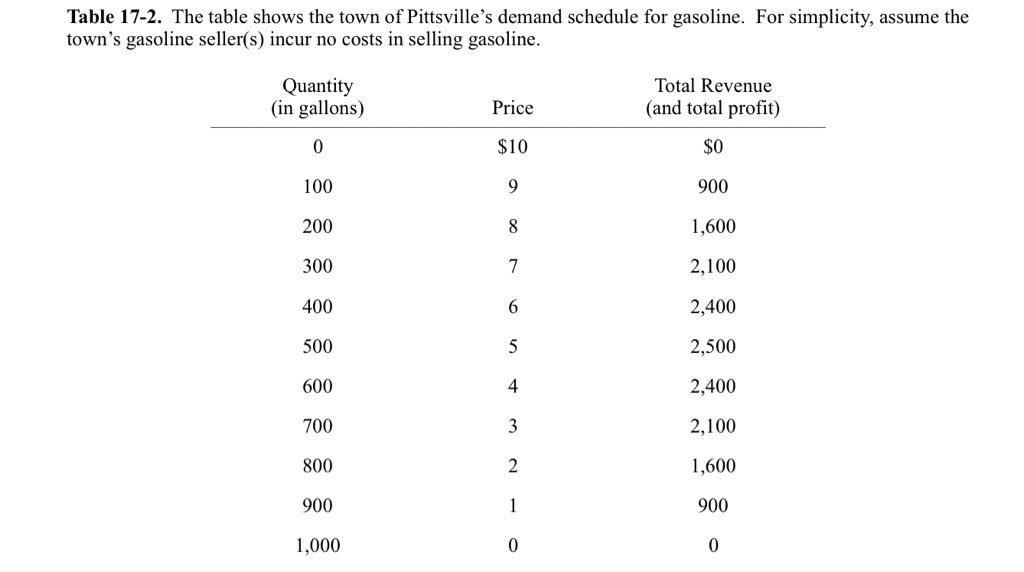
Refer to Table 17-2. If the market for gasoline in Pittsville is a monopoly, then the profit-maximizing monopolist will charge a price of
Image:
Mobile upload (image/jpeg)
Answer
-
$8 and sell 200 gallons.
-
$5 and sell 500 gallons.
-
$2 and sell 800 gallons.
-
$0 and sell 1,000 gallons.
Question 30
Question
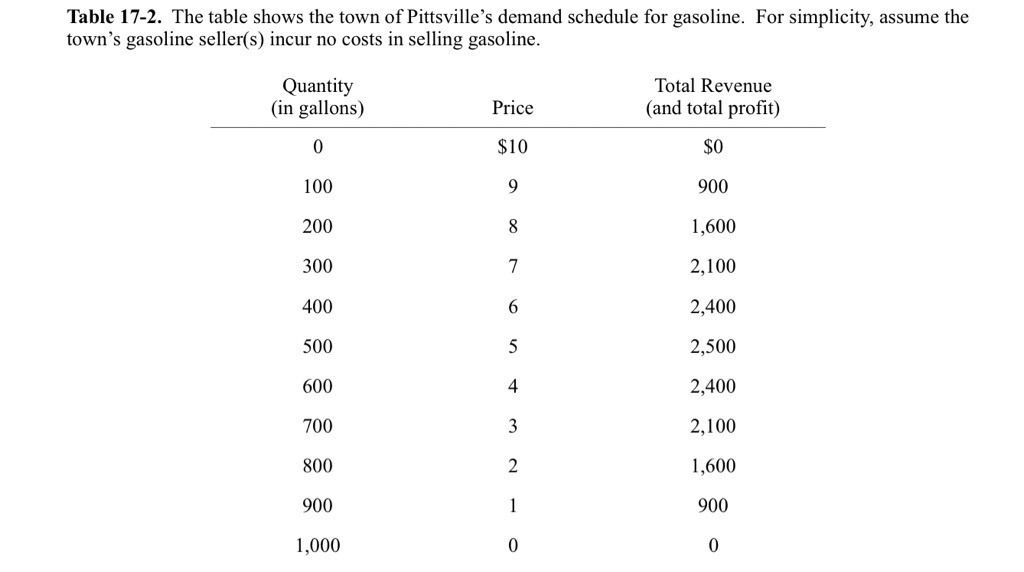
Refer to Table 17-2. If the market for gasoline in Pittsville is perfectly competitive, then the equilibrium price of gasoline is
Image:
Mobile upload (image/jpeg)
Answer
-
$8 and the equilibrium quantity is 200 gallons.
-
$5 and the equilibrium quantity is 500 gallons.
-
$2 and the equilibrium quantity is 800 gallons.
-
$0 and the equilibrium quantity is 1,000 gallons.
Question 31
Question
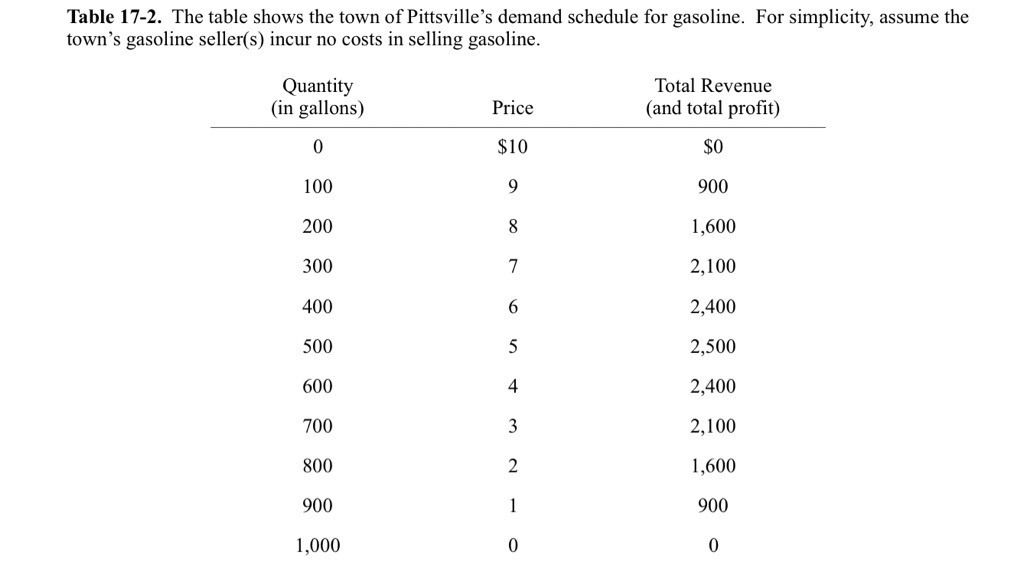
Refer to Table 17-2. If there are exactly two sellers of gasoline in Pittsville and if they collude, then which of the following outcomes is most likely?
Image:
Mobile upload (image/jpeg)
Answer
-
Each seller will sell 500 gallons and charge a price of $5.
-
Each seller will sell 250 gallons and charge a price of $2.50.
-
Each seller will sell 350 gallons and charge a price of $3.
-
Each seller will sell 250 gallons and charge a price of $5.
Question 32
Question
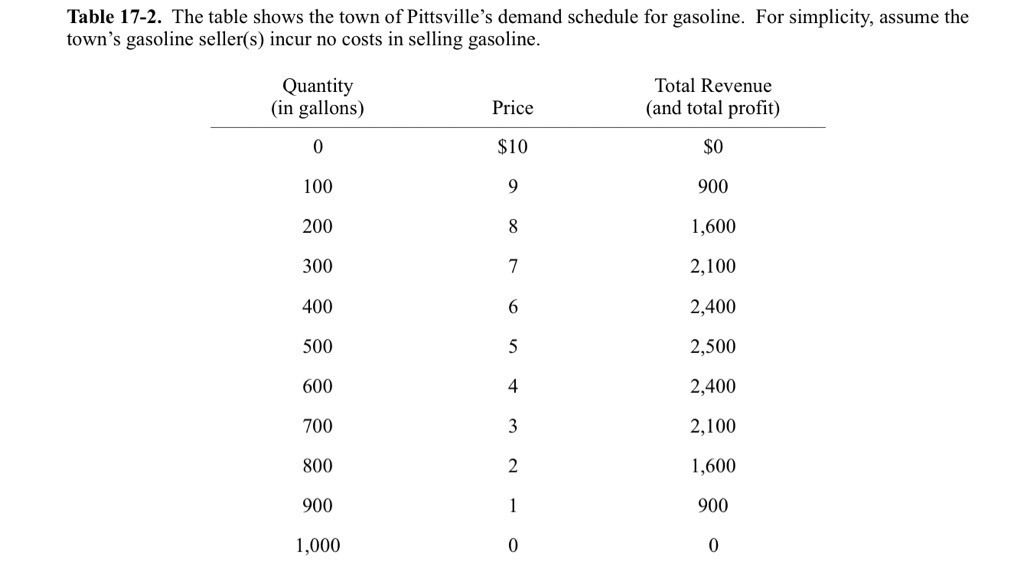
Refer to Table 17-2. Suppose there are exactly two sellers of gasoline in Pittsville: Exxoff and BQ. If Exxoff sells 300 gallons and BQ sells 400 gallons, then
Image:
Mobile upload (image/jpeg)
Answer
-
Exxoff’s profit is $900 and BQ’s profit is $1,200.
-
Exxoff’s profit is $2,100 and BQ’s profit is $2,400.
-
there is an excess demand for gasoline in Pittsville.
-
there is an excess supply of gasoline in Pittsville.
Question 33
Question
As the number of sellers in an oligopoly becomes very large,
Answer
-
the quantity of output approaches the socially efficient quantity.
-
the price approaches marginal cost.
-
the price effect is diminished.
-
All of the above are correct.
Question 34
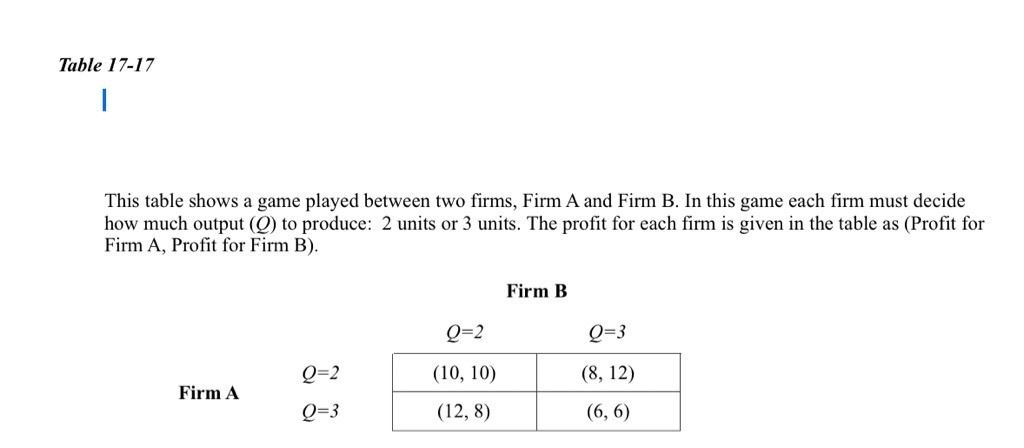
Answer
-
neither player has a dominant strategy.
-
both players have a dominant strategy.
-
Firm A has a dominant strategy, but Firm B does not have a dominant strategy.
-
Firm B has a dominant strategy, but Firm A does not have a dominant strategy.
Question 35
Question
Refer to Table 17-17. Which of the following outcomes represent the Nash equilibrium in this game?
Image:
Mobile upload (image/jpeg)
Answer
-
Q=2 for Firm A and Q=3 for Firm B.
-
Q=3 for Firm A and Q=2 for Firm B.
-
There is no Nash equilibrium in this game since neither player has a dominant strategy.
-
Both a and b are correct.
Want to create your own Quizzes for free with GoConqr? Learn more.