
20405008
Description

Quiz by Ryan Elwell, updated more than 1 year ago

|
Created by Ryan Elwell
about 6 years ago
|
|
Question 1
Question
Centripetal Force is a byproduct of which of Newton's Laws of Motion?
Answer
-
Newton's First Law
-
Newton's Second Law
-
Newton's Third Law
-
Universal Gravitation
Question 2
Question
Which of the following statements about the coefficient of friction is correct?
Answer
-
It has no units
-
It depends on mass
-
It depends on the surfaces in contact only
-
It is a higher value when objects are not in motion
Question 3
Question
What is the centripetal force acting on a 1.0 kg ball being spun in a circle with radius of 0.25 meters at a speed of 3.0 m/s?
F = [blank_start]32[blank_end] N
Answer
-
32
Question 4
Question
Which direction will the ball travel if the string breaks at this point?
Image:
Ballstring (image/gif)
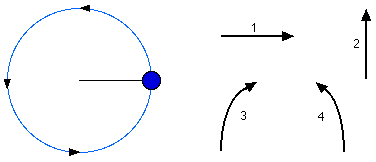
Answer
-
1
-
2
-
3
-
4
Question 5
Question
Which of the following are true of the spring force?
Answer
-
It is restorative
-
It is always opposite the direction of stretch
-
It is always pulling toward equilibrium
-
It can push or pull
-
It is measured in Newtons
Question 6
Question
Which of the following statements is true?
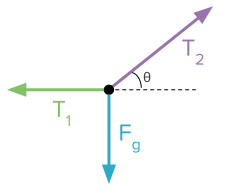
Answer
-
The value is zero for the y component of the T1 Force
-
The force of gravity is equal to the sum of the y components of T1 and T2
-
The force of gravity is equal to the y component of T2
-
T2 > T1
Question 7
Question
A wooden pallet carrying a load of 600.0 kg rests on a wooden floor and the mu value is 0.280 between the two items. A forklift driver decides to push it without lifting it. What force must be applied to just get the pallet moving?
F = [blank_start]1650[blank_end] N
Answer
-
1650
Question 8
Question
A spring with a natural height of 57 mm is compressed by a 300 g mass to a new height of 51 mm. What is the spring constant for this spring?
The first blank is for the numerical value. The second blank is the units. Put a space between EACH character for the units!
k = [blank_start]750[blank_end] [blank_start]N / m[blank_end]
Answer
-
750
-
N / m
Question 9
Question
What values should be plotted on the x and y axes of a Cartesian graph in order to provide a line whose slope will give you the spring constant?
Answer
-
x = displacement y = force
-
x = force y = gravity
-
x = distance y = displacement
-
x = distance y = time
Question 10
Question
A block is at rest on a slope. What direction does friction act?
Answer
-
There is no friction is the block is not moving
-
Friction is acting downwards into the slope
-
Friction is acting upwards, parallel to the slope
-
Friction is acting downwards, parallel to the slope
Want to create your own Quizzes for free with GoConqr? Learn more.