
4684415
Description

Quiz by Neil Revollo, updated more than 1 year ago

|
Created by Neil Revollo
almost 10 years ago
|
|
Question 1
Question
The [blank_start]high side[blank_end] is created by compressing, or squeezing, the gas. When a gas is compressed, the heat in the gas is concentrated and the temperature rises. This is done by a component called a [blank_start]compressor[blank_end].
Answer
-
high side
-
compressor
Question 2
Question
Expanding a gas or liquid causes its pressure and temperature to drop. This is done by the [blank_start]expansion valve[blank_end].
Answer
-
expansion valve
Question 3
Question
The [blank_start]increased[blank_end] pressure on the [blank_start]high side[blank_end] raises the condensing temperature, allowing the condenser to reject large amounts of heat while condensing the refrigerant.
Answer
-
high side
-
increased
Question 4
Question
The [blank_start]decreased[blank_end] pressure on the [blank_start]low side[blank_end] lowers the evaporation temperature, allowing the evaporator to absorb large amounts of heat while the refrigerant evaporates.
Answer
-
decreased
-
low side
Question 5
Question
Electric strip heat: [blank_start]110 - 125ºF[blank_end]
Gas heating: [blank_start]120 - 140ºF[blank_end]
Heat pumps: [blank_start]95 - 115ºF[blank_end]
Answer
-
110 - 125ºF
-
120 - 140ºF
-
95 - 115ºF
Question 6
Question
The [blank_start]heat source[blank_end] is where the heat comes from when the heat pump is operating in the heating cycle. The [blank_start]sink[blank_end] is where the heat pump puts the heat.
Answer
-
heat source
-
sink
Question 7
Question
Split systems usually consist of an indoor unit and an outdoor unit connected together through a large [blank_start]gas line[blank_end] and a small [blank_start]liquid line[blank_end].
Answer
-
gas line
-
liquid line
Question 8
Question
The large gas line is a [blank_start]low-pressure suction line[blank_end] when operating in cooling and a [blank_start]high-pressure discharge line[blank_end] when operating in heating.
Answer
-
low-pressure suction line
-
high-pressure discharge line
Question 9
Question
In the summer they move heat from the [blank_start]inside[blank_end] to the [blank_start]outside[blank_end], and in the winter they move heat from the [blank_start]outside[blank_end] to the [blank_start]inside[blank_end].
Answer
-
inside
-
outside
-
outside
-
inside
Question 10
Question
When a heat pump is in the [blank_start]heating[blank_end] mode, the outdoor coil becomes the evaporator and the indoor coil becomes the condenser. When a heat pump is in the [blank_start]cooling[blank_end] mode, the outdoor coil becomes the condenser and the indoor coil becomes the evaporator.
Answer
-
heating
-
cooling
Question 11
Question
The outdoor coil is the [blank_start]condenser[blank_end] in the cooling cycle and the [blank_start]evaporator[blank_end] in the heating cycle. The indoor coil is the [blank_start]evaporator[blank_end] in the cooling mode and the [blank_start]condenser[blank_end] in the heating cycle.
Answer
-
condenser
-
evaporator
-
evaporator
-
condenser
Question 12
Question
During the cooling cycle, the [blank_start]high-pressure[blank_end]/[blank_start]high-temperature[blank_end] discharge gas is directed from the compressor to the [blank_start]outdoor coil[blank_end] (condenser), where it condenses to a [blank_start]high-pressure[blank_end], [blank_start]high-temperature[blank_end] subcooled liquid.
Answer
-
high-pressure
-
high-temperature
-
high-pressure
-
high-temperature
-
outdoor coil
Question 13
Question
To avoid the restriction of the [blank_start]metering device[blank_end] connected to the outlet of the outdoor coil, a [blank_start]check valve[blank_end] is installed, allowing the liquid to bypass the outdoor [blank_start]metering device[blank_end].
Answer
-
metering device
-
check valve
-
metering device
Question 14
Question
The liquid travels inside through the [blank_start]liquid[blank_end] line, where the indoor [blank_start]check valve[blank_end] closes, forcing the refrigerant through the indoor [blank_start]metering device[blank_end].
Answer
-
check valve
-
metering device
-
liquid
Question 15
Question
The indoor metering device drops the refrigerant [blank_start]pressure[blank_end] and [blank_start]temperature[blank_end] so that heat can be absorbed in the indoor coil.
Answer
-
pressure
-
temperature
Question 16
Question
The refrigerant vapor produced in the indoor coil now travels through the [blank_start]reversing valve[blank_end] to the [blank_start]suction accumulator[blank_end] and on to the [blank_start]compressor[blank_end]
Answer
-
reversing valve
-
suction accumulator
-
compressor
Question 17
Question
In the [blank_start]heating[blank_end] cycle the reversing valve changes position, changing the direction of gas flow.
Answer
-
heating
Question 18
Question
The [blank_start]high-pressure[blank_end], [blank_start]high-temperature[blank_end] gas from the compressor flows through the reversing valve to the [blank_start]indoor[blank_end] coil.
Answer
-
high-pressure
-
high-temperature
-
indoor
Question 19
Question
The indoor coil now acts as a [blank_start]condenser[blank_end], adding [blank_start]heat[blank_end] into the return air from the conditioned area.
Answer
-
condenser
-
heat
Question 20
Question
The hot vapor is condensed, and the temperature is reduced to produce a [blank_start]high-pressure[blank_end], [blank_start]high-temperature[blank_end] [blank_start]subcooled[blank_end] liquid.
Answer
-
high-pressure
-
high-temperature
-
subcooled
Question 21
Question
The indoor [blank_start]check valve[blank_end] opens and allows the liquid refrigerant to flow around the indoor [blank_start]metering device[blank_end]. Continuing through the liquid line, the liquid refrigerant is forced through the outdoor coil [blank_start]metering device[blank_end] by the closing of the [blank_start]check valve[blank_end] connected in parallel with it.
Answer
-
check valve
-
metering device
-
check valve
-
metering device
Question 22
Question
The [blank_start]low-pressure[blank_end], [blank_start]low-temperature[blank_end] mixture of liquid and vapor refrigerant flows into the outdoor coil, which is now the [blank_start]evaporator[blank_end].
Answer
-
low-pressure
-
low-temperature
-
evaporator
Question 23
Question
The low refrigerant [blank_start]pressure[blank_end] keeps the refrigerant temperature [blank_start]lower[blank_end] than the outdoor temperature. Since the outdoor air is [blank_start]warmer[blank_end] than the refrigerant, heat is picked up from the outdoor air, [blank_start]evaporating[blank_end] the liquid refrigerant.
Answer
-
pressure
-
lower
-
evaporating
-
warmer
Question 24
Question
This refrigerant vapor then flows through the [blank_start]vapor[blank_end] line, [blank_start]reversing valve[blank_end], and [blank_start]accumulator[blank_end] to the compressor.
Answer
-
vapor
-
reversing valve
-
accumulator
Question 25
Question
The reversing valve is composed of three main parts: the [blank_start]pilot[blank_end] valve, the main [blank_start]valve[blank_end], and the [blank_start]solenoid[blank_end] coil.
Answer
-
pilot
-
valve
-
solenoid
Question 26
Question
The solenoid coil controls the [blank_start]pilot[blank_end] valve, which in turn controls the suction [blank_start]bleed[blank_end] to the main valve.
Answer
-
bleed
-
pilot
Question 27
Question
The purpose of the [blank_start]main[blank_end] valve is to [blank_start]reverse[blank_end] the refrigerant route through the indoor and outdoor coils, thereby exchanging the functions of the condenser and evaporator coils.
Answer
-
main
-
reverse
Question 28
Question
By imposing the discharge pressure on one end of the [blank_start]reversing[blank_end] valve and the suction pressure on the other end of the valve, the [blank_start]pressure[blank_end] difference will shift the internal cylinder toward the side that is connected to the [blank_start]suction[blank_end] pressure.
Answer
-
reversing
-
pressure
-
suction
Question 29
Question
The main valve body is constructed with the permanent [blank_start]suction[blank_end] in the middle of the valve on one side and the permanent [blank_start]discharge[blank_end] in the middle of the valve directly opposite the permanent [blank_start]suction[blank_end] port.
Answer
-
suction
-
discharge
-
suction
Question 30
Question
When at rest, the sliding cylinder always straddles two tube openings. One of these openings is always the permanent [blank_start]suction[blank_end] port, which is connected to the [blank_start]low[blank_end] side of the system. The other opening will be either the indoor coil port or the outdoor coil port. This makes whichever coil is connected to the permanent [blank_start]suction[blank_end] via the sliding valve the [blank_start]evaporator[blank_end].
Answer
-
suction
-
low
-
suction
-
evaporator
Question 31
Question
The port that is not covered by the sliding valve is open to the permanent [blank_start]discharge[blank_end] port located opposite the permanent [blank_start]suction[blank_end] port. This makes whichever coil is connected to the uncovered port the [blank_start]condenser[blank_end].
Answer
-
discharge
-
suction
-
condenser
Question 32
Question
What role does the outdoor coil serve as in this illustration (e.g., condenser or evaporator)?
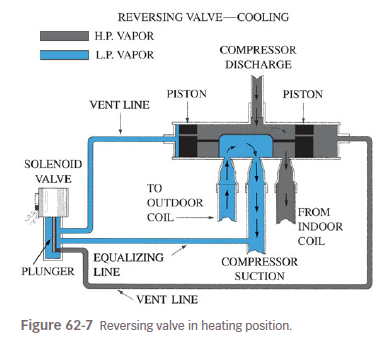
Answer
-
Evaporator
Question 33
Question
The solenoid valve is de-energized and the control plunger is [blank_start]down[blank_end], closing the bottom port vent line connected to the [blank_start]right[blank_end] end of the piston. The top port vent line connected to the [blank_start]left[blank_end] end of the piston is open to the equalizing line. This allows the pressure to [blank_start]bleed[blank_end] off from the [blank_start]left[blank_end] end of the piston to the permanent [blank_start]suction[blank_end] line.
Answer
-
down
-
right
-
left
-
bleed
-
left
-
suction
Question 34
Question
This creates a pressure difference across the left-side piston (usually 75–100 psig or greater), which causes it to travel to the extreme left. This movement repositions the slide valve to align the control port from the outdoor coil with the control port leading to the compressor [blank_start]suction[blank_end], making the outdoor coil the [blank_start]evaporator[blank_end]. This same movement also aligns the compressor [blank_start]discharge[blank_end] with the indoor coil, making the indoor coil the [blank_start]condenser[blank_end].
Answer
-
suction
-
evaporator
-
discharge
-
condenser
Question 35
Question
What role does the indoor coil serve in this illustration (e.g., evaporator or condenser)?
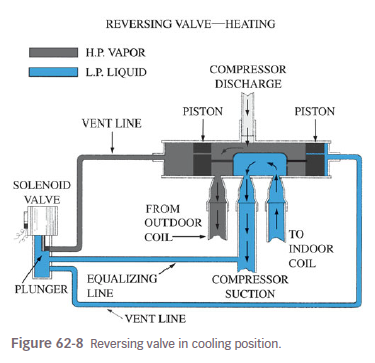
Answer
-
Evaporator
Question 36
Question
The solenoid valve is [blank_start]energized[blank_end] and the control plunger lifts, [blank_start]closing[blank_end] the top port vent line connected to the left end of the piston. The bottom port vent line connected to the right end of the piston is [blank_start]open[blank_end] to the equalizing line. This allows the pressure to [blank_start]bleed[blank_end] off from the right end of the piston, which causes it to travel to the extreme right, repositioning the slide valve to align the control port from the [blank_start]indoor[blank_end] coil with the control port leading to the compressor [blank_start]suction[blank_end], making the indoor coil the evaporator. This same movement also aligns the compressor [blank_start]discharge[blank_end] with the outdoor coil, making the outdoor coil the [blank_start]condenser[blank_end].
Answer
-
energized
-
closing
-
open
-
bleed
-
suction
-
indoor
-
discharge
-
condenser
Question 37
Question
Since both the indoor and outdoor coils must function as the [blank_start]evaporator[blank_end], both coils need [blank_start]metering[blank_end] devices.
Answer
-
evaporator
-
metering
Question 38
Question
It is possible to have a single expansion valve on packaged [blank_start]water[blank_end]-source units because the two coils are so close together. Using a [blank_start]bi-flow[blank_end] valve that meters in both directions allows manufacturers to build a unit with only one metering device, eliminating [blank_start]check[blank_end] valves completely.
Answer
-
water
-
bi-flow
-
check
Question 39
Question
The sensing bulb is not located on the [blank_start]outlet[blank_end] of either coil. Instead, the sensing bulb is located after the [blank_start]reversing[blank_end] valve and before the suction [blank_start]accumulator[blank_end]. In this way the bulb will respond to the refrigerant condition leaving either coil, regardless of mode.
Answer
-
outlet
-
reversing
-
accumulator
Question 40
Question
The [blank_start]check[blank_end] valves in the heat pump circuit are vital to ensure that proper pressures are maintained. Today, most heat pump systems use [blank_start]metering[blank_end] devices with built-in [blank_start]check[blank_end] valves, rather than separate [blank_start]check[blank_end] valves. The [blank_start]check[blank_end] valves are still there but are incorporated into the [blank_start]metering[blank_end] devices.
Answer
-
check
-
metering
-
check
-
check
-
check
-
metering
Want to create your own Quizzes for free with GoConqr? Learn more.