
4863204

Question 1
Question
Peak N13 is recorded from the:
Answer
-
cuneate nucleus
-
medial lemniscus
Question 2
Question
Peaks to identify pre and post central gyrus respectively are:
Answer
-
N20, P25
-
P22, N20
Question 3
Question
What is the analysis time for median SSEPs?
Answer
-
50 msec
-
100 msec
Question 4
Question
What is the best recording montage for P31?
Answer
-
Cv5-Fpz
-
Cv5-hand
Question 5
Question
What is asynchronous stimulation?
Answer
-
stimulation with delay
-
stimulating two different nerves
Question 6
Question
When doing asynchronous stimulation for intra-operative SSEPs, it is:
Answer
-
difficult to differentiate between left and right side responses
-
easy to differentiate between left and right side responses
Question 7
Question
According to the guidelines, P37 is a:
Answer
-
near field response
-
far field response
Question 8
Question
When performing a C5-C6 vertebral body fusion, what SSEP montages give the most information?
Answer
-
Ulnar- median
-
Posterior tibial -median
Question 9
Question
P14 is defined as a far-field response from the:
Answer
-
Caudal medial lemniscus
-
brainstem
Question 10
Question
If you are missing Erb's point and N20 responses during your median nerve SSEP recordings, what could be the cause?
Answer
-
increasing of inhalational agents
-
peripheral stimulation problem
Question 11
Question
Where do you place the active popliteal-fossa electrode?
Answer
-
lateral to the crease behind the knee
-
distal to crease behind the knee
Question 12
Question
When stimulating the posterior tibial nerve at the ankle, where do you monitor for TOF?
Answer
-
tibialis anterior
-
abductor hallucis
Question 13
Question
During an anterior cervical discectomy, a loss of N20 but preservation of N13 is consistent with:
Answer
-
spinal cord damage
-
compression of carotid
Question 14
Question
During a L4 vertebral body fusion what modalities are the most informative?
Answer
-
triggered EMG -post tibial SSEP
-
median SSEP- post tibial SSEP
Question 15
Question
Which of the following montages would be good for using a multiply time base?
Answer
-
median and Ulnar SSEPs
-
BAER and median
Question 16
Question
If you need to monitor the C7 vertebrae, what nerve would be most appropriate?
Answer
-
median
-
Ulnar
Question 17
Question
Which of the following conditions would most likely affect tibial nerve SSEPs?
Answer
-
ataxia
-
diabetes
Question 18
Question
If you have changes in the right ulnar SSEP response, and the surgery is thoracic, what could be happening?
Answer
-
positioning effect
-
thoracic spine manipulation
Question 19
Question
When doing language mapping on the cortex, what's the most common way it's done?
Answer
-
direct cortical stimulation with an awake patient
-
direct cortical stimulation with a patient under general anesthesia
Question 20
Question
What waveforms are recorded off the pre-central and post-central gyrus respectively?
Answer
-
P22 and N20
-
N20 and P25
Question 21
Question
What could be the problem with synchronous stimulation?
Answer
-
unable to detect unilateral changes
-
painful for the patient
Question 22
Question
What is the optimal stimulating rate for SSEPs?
Answer
-
3.7
-
15.1
Question 23
Question
If cortical responses are lost, what will you do next?
Answer
-
look at the second cortical
-
check stimulation electrodes
Question 24
Question
What will be a false positive data?
Answer
-
abnormal changes is your data
-
changes in data, but no deficits post-operatively
Question 25
Question
What will be a false negative data?
Answer
-
no changes in data but patient has post-operative deficits.
-
changes in data but no deficits post-operatively
Question 26
Question
Positioning changes in SSEP will be represented by:
Answer
-
loss of contralateral erb's, cervical, and cortical responses
-
loss of ipsilateral erb's, contralateral cervical and cortical responses
Question 27
Question
Somatosensory evoked potentials are most likely to be highly variable and less reliable in patients with
Answer
-
a tethered spinal cord
-
neuromuscular disease
Question 28
Question
Which of the following evoked potential test would have the highest rate of abnormalities in patients with MS?
Answer
-
BAEP
-
SEP of the lower extremity
Question 29
Question
What is the application of the 10-20 system most appropriate for?
Answer
-
landmarks for electrodes
-
placement of Queens Square electrode array
Question 30
Question
Which of the following evoked potentials has the most critical electrode placement?
Answer
-
post tibial SSEP
-
cognitive EP
Question 31
Question
Where would you record P37?
Answer
-
Cpz
-
Cpc
Question 32
Question
Using a recording montage of Fpz to a non-cephalic reference, what is the best description of N14?
Answer
-
near-field potential
-
propagated potential
Question 33
Question
If you have a pre-stimulus "negative" delay of 15 ms and a time base of 45 ms, 15 ms will be displayed:
Answer
-
before the stimulus and 30 ms after.
-
after the stimulus and 30 ms after.
Question 34
Question
Which one of the following is most likely to cause a false negative for a thoracolumbar fusion?
Answer
-
bilateral synchronous stimulation of posterior tibial nerve.
-
bilateral asynchronous stimulation of peroneal nerve at the knee.
Question 35
Question
What is an advantage of synchronous stimulation?
Answer
-
maximal response
-
easy setup
Question 36
Question
If you lose EP and N20 in median SSEP, what is the first thing you should check?
Answer
-
arm position
-
increase in anesthesia
Question 37
Question
If you lose EP in median SSEP, what is the first thing you should check?
Answer
-
integrity of stimulation and recording electrodes
-
recent surgical manipulations
Question 38
Question
If, while monitoring a thoracolumbar procedure, over the past three hours, there is a steady decrease in bilateral P37 with stable P31 , what should you do?
Answer
-
continue to monitor P31
-
increase stimulation intensity
Question 39
Question
If you are unable to acquire a motor twitch, what is the preferred method of assuring maximal stimulation?
Answer
-
increase stimulation to maximum
-
increase stimulation until Erb's point potential is at a maximum
Question 40
Question
If your cortical SSEP is small in amplitude, what is the preferred method to increase the response?
Answer
-
increase rep rate
-
increase intensity
Question 41
Question
What is the purpose of an SSEP epidural electrode placed caudal to the surgical site?
Answer
-
to verify the adequacy of stimulation
-
to record a motor action potential
Question 42
Question
What is the purpose of pre-operative SSEP data?
Answer
-
to detect abnormalities
-
to use for intra-operative comparison
Question 43
Question
During a C5-7 ACDF, what are optimal SSEP stimulation sites?
Answer
-
ulnar and posterior tibial
-
median and peroneal at the knee
Question 44
Question
Posterior tibial nerve SSEP would be used over median nerve SSEP for an aneurysm of which artery?
Answer
-
middle cerebral
-
anterior cerebral
Question 45
Question
SSEPs would be best used for which of the following?
Answer
-
scoliosis correction
-
trans sphenoidal resection of adenoma
Question 46
Question
When recording scalp SSEP, the signal is transmitted primarily through the:
Answer
-
dorsal column ipsilateral to stimulation
-
spinothalamic pathway contralateral to stimulation
Question 47
Question
Which of the following EPs is a combination of near-field and far-field potentials?
Answer
-
SSEPs
-
half-field pattern reversal
Question 48
Question
When setting up stimulation electrodes for posterior tibial nerve SSEP, it is important to:
Answer
-
never wrap tape all the way around the ankle or limb
-
avoid using stress loops
Question 49
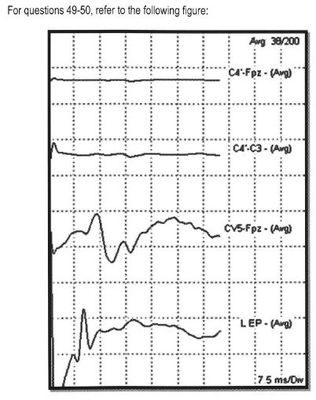
Answer
-
N20
-
N13
Question 50
Question
What is the most likely cause for the missing peak?
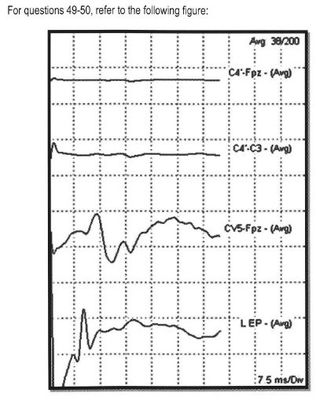
Answer
-
right parietal lesion
-
brachial plexopathy
Question 51
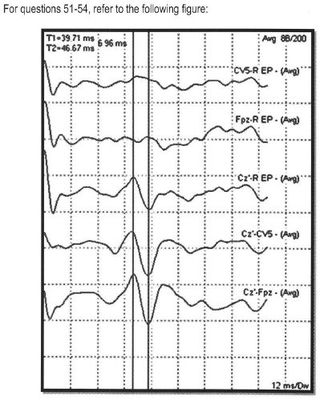
Answer
-
P37
-
N20
Question 52
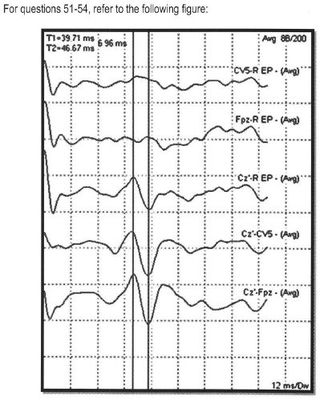
Answer
-
P31
-
N14
Question 53
Question
What channel gives you the best recording of the peak at 30.04?

Answer
-
scalp-neck
-
scalp-scalp
Question 54
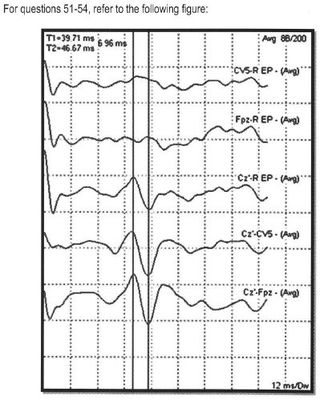
Answer
-
Cz' - Cv5
-
Fpz- REP
Question 55

Answer
-
4E and 4D
-
4D and 4C
Question 56
Question
What channel represents the primary sensory cortex?
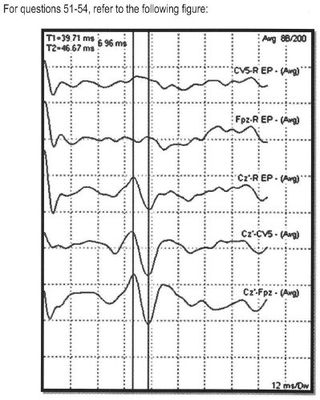
Answer
-
4C
-
4D
Question 57
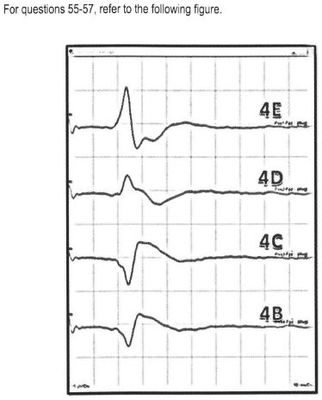
Answer
-
pre-central gyrus
-
somatosensory cortex
Question 58
Question
What is the maximal recommended stimulation duration for lower SSEPs?
Answer
-
300 us
-
600 us
Question 59
Question
Stimulation of the median nerve and direct cortical recording for phase reversal is used to locate the:
Answer
-
sensorimotor cortex
-
central Sulcus
Question 60
Question
What is the interval time between P14 and N20?
Answer
-
CCT
-
dwell
Question 61
Question
The initial negative activity appearing at the scalp (between 16-19 ms) from the stimulation of the upper extremity is thought to be generated by the:
Answer
-
thalamus
-
precentral gyrus
Question 62
Question
Synaptic transmission and/or changes in the thalamocortical projections are believed to produce:
Answer
-
cortical potentials
-
the P100 potential
Question 63
Question
Stimulation of the median nerve at the wrist in a normal adult will elicit:
Answer
-
a primary cortical response at about 20 msec
-
an Erb's point response at about 15 msec
Question 64
Question
Generator sites are typically deep within anatomic structures. Most EPs are considered to be:
Answer
-
far-field responses
-
steady state potentials
Question 65
Question
SSEP recordings are thought to be generated by which of the following sensory tracts?
Answer
-
posterior columns and medical lemniscus
-
lateral geniculate
Question 66
Question
When recording a posterior tibial nerve SSEP, the Fpz-C5s channel records:
Answer
-
sub cortical far-field potentials
-
sub cortical near-field potentials
Question 67
Question
When recording from LP-IC, the latency of the peak is:
Answer
-
12 ms
-
22 ms
Question 68
Question
An advantage of referential recordings as opposed to bipolar recording of spinal cord somatosensory evoked potentials is:
Answer
-
less invasion of the surgical field
-
avoiding cancellation of the potentials
Question 69
Question
The median nerve SSEP can also be helpful as a measure of:
Answer
-
cerebral blood flow
-
lower spinal cord function
Question 70
Question
A patient is admitted to the operating room diagnosed with a burst fracture of the L1 vertebra. The most appropriate nerve(s) to monitor would be the:
Answer
-
posterior tibial and ulnar nerves
-
posterior tibial and peroneal nerves
Question 71
Question
During micro vascular decompression (MVD) of the trigeminal nerve, the monitoring of median nerve SSEPS will demonstrate the:
Answer
-
effect of retractor placement on the cochlear and vestibular nerves
-
integrity of the somatosensory system traversing brainstem structure
Question 72
Question
The intensity of stimulation should be adjusted to:
Answer
-
sensation level
-
produce a minimal movement at the joint involved
Question 73
Question
The filter settings optimal for recording a median nerve somatosensory evoked potential is:
Answer
-
5-1000
-
20-3000
Question 74
Question
When you experience 60 Hz noise on one of your channels due to a loose electrode, whose position is blocked by the sterile field , what should you do?
Answer
-
remove that channel from further recordings
-
switch to your backup electrode
Question 75
Question
Why is braiding wires beneficial?
Answer
-
reduces ambient noise
-
decreases CMRR
Question 76
Question
Both SSEP and BAEP waveforms can be affected by structural manipulation using:
Answer
-
retractors
-
suction
Question 77
Question
During lumbar interbody fusion using cage modalities to monitor are:
Answer
-
upper and lower SSEPs
-
lower SSEPs and s-EMG
Question 78
Question
Peripheral conduction time is between:
Answer
-
N9-P14
-
N9-N20
Question 79
Question
Central conduction time for posterior tibial SSEP is:
Answer
-
LP- P37
-
P31-P37
Question 80
Question
Supra-maximal stimulation can be confirmed by the amplitude of:
Answer
-
peripheral responses
-
cortical responses
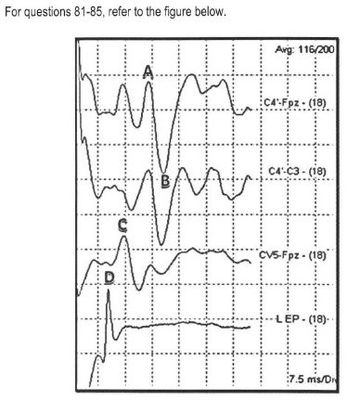
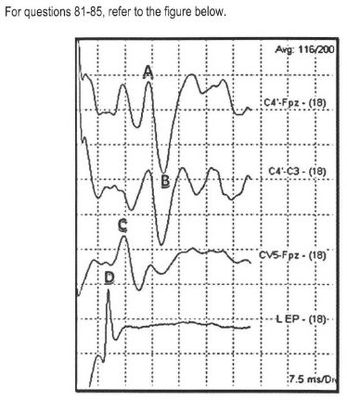
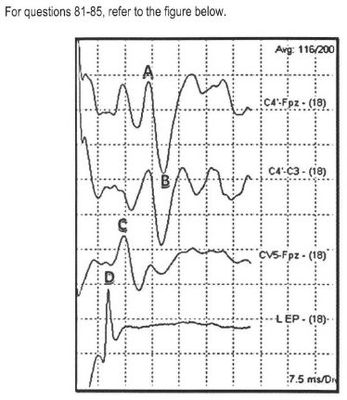
Question 81
Question
The peak labeled as 'A' is also known as:
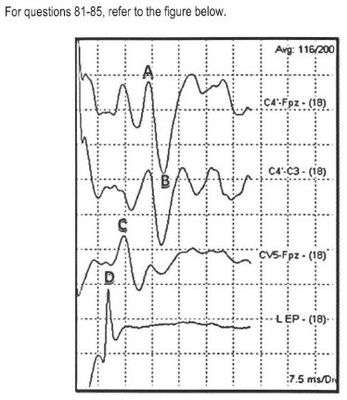
Answer
-
N20
-
N30
Question 82
Question
The peak labeled as 'B' is also known as:
Answer
-
P30
-
N20
Question 83
Question
The peak labeled as 'C' is also known as:
Answer
-
P31
-
P14
Question 84
Question
The peak labeled as 'D' is also known as:

Answer
-
N9
-
P10
Question 85
Question
The SSEP traces are recorded for the:
Answer
-
left median
-
left ulnar
Question 86
Question
The second trace in the recording is the:

Answer
-
cortical response
-
transcortical response
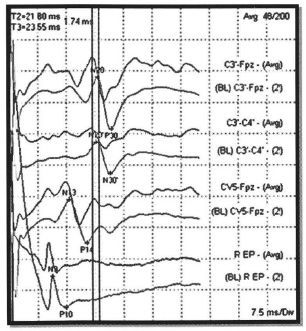
Question 87
Question
What is the probable cause of changes in the data in the picture below?
Answer
-
anesthesia
-
temperature
Question 88
Question
Peroneal nerve stimulation can be performed at the:
Answer
-
lateral malleolus
-
fibular head
Question 89
Question
Amplitude of the scalp SSEP responses is:
Answer
-
0.1-10 uV
-
10-100 uV
Question 90
Question
For peroneal nerve SSEP stimulation, the ground should be at the:
Answer
-
calf
-
thigh
Question 91
Question
During upper extremity SSEP recording the Erb's point electrode records the activity from the:
Answer
-
brachial plexus
-
lumbar plexus
Question 92
Question
During PTN stimulation, if there is a change in cz· -Fpz cortical response, which other montage should be used to confirm the change?
Answer
-
CPc- CPi
-
Cv5- Fpz
Question 93
Question
Monitoring only SSEP may fail to recognize the changes in:
Answer
-
ascending spinal cord tracts
-
anterior spinal cord function
Question 94
Question
A dermatome is a:
Answer
-
patch of skin that sends pain information via single nerve roots through the spinal cord
-
specific stimulus site for SSEP recordings
Question 95
Question
If the body temperature of a patient drops to 29 degree C it will cause:
Answer
-
decrease in latencies with a decrease in amplitude
-
increase in latencies with a decrease in amplitude
Question 96
Question
If there is a rapid loss of cortical responses with consistent subcortical responses, the cause will be:
Answer
-
anesthesia
-
blood loss
Question 97
Question
The rationale for monitoring popliteal fossa recording during a thoracic spine surgery is to:
Answer
-
limit chassis leakage
-
verification of adequacy of stimulation
Question 98
Question
Hypothermia of the lower extremities will result in:
Answer
-
increased P31 -P37 1atency
-
prolonged peripheral conduction time
Question 99
Question
Nerves to be used for SSEP monitoring intra-operatively depends upon the:
Answer
-
surgical procedure
-
surgeon
Question 100
Question
What should be reported to the surgeon during a surgical procedure?
Answer
-
Loss of responses
-
Change is electrode impedance
Want to create your own Quizzes for free with GoConqr? Learn more.