
5024917

Question 1
Question
Label these lymph nodes and associated structures. There are 11 sets/specific lymph nodes altogether.

Answer
-
Occipital nodes
-
Posterior/retro-auricular nodes
-
Digastric muscle
-
jugulodigastric node
-
internal jugular vein
-
deep cervical nodes
-
jugulo-omohyoid node
-
omohyoid muscle
-
supraclavicular nodes
-
superficial cervical nodes
-
submental nodes
-
submandibular nodes
-
parotid/pre-auricular nodes
Question 2
Question
Complete the table outlining lymphatic drainage of the head and neck.
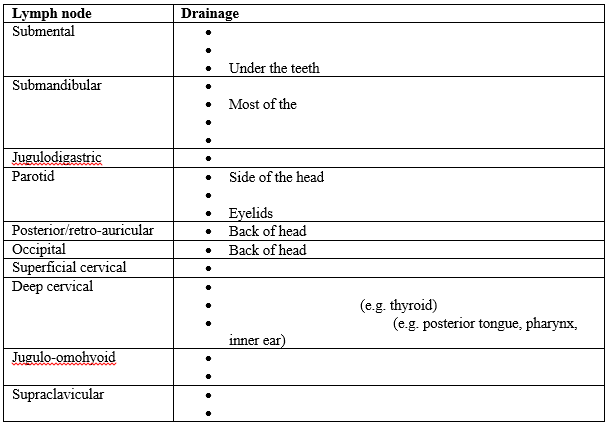
Answer
-
Tip of the tongue
-
Lips
-
lower part of face
-
mouth
-
Nasal cavity
-
Maxillary sinus
-
Tonsils
-
upper part of face
-
neck structures
-
superficial nodes
-
neck structures
-
deep head structures
-
Lingual tonsil
-
Posterior tongue
-
Chest
-
Abdomen
Question 3
Question
Label this diagram of the larynx from a lateral view.
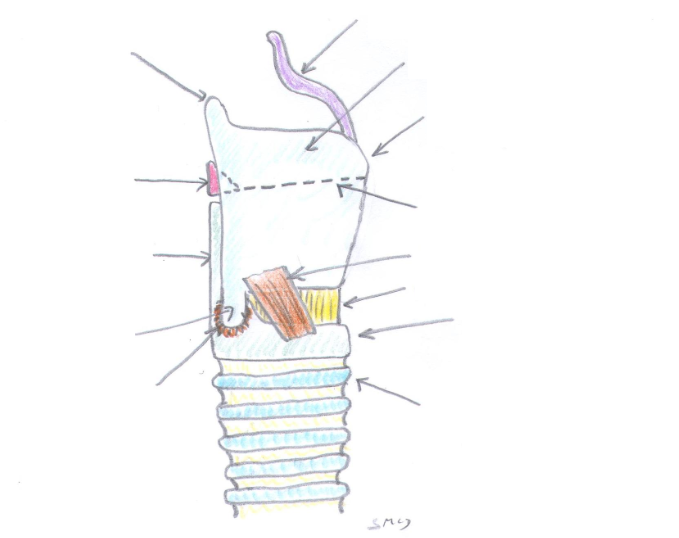
Answer
-
epiglottis
-
thyroid cartilage
-
laryngeal eminence
-
position of vocal fold
-
cricothyroid muscle
-
cricothyroid ligament
-
arch of cricoid cartilage
-
first tracheal ring
-
cricothyroid joint
-
inferior horn of thyroid cartilage
-
lamina of cricoid cartilage
-
arytenoid cartilage
-
superior horn of thyroid cartilage
Question 4
Question
Label these diagrams of the larynx from an anterior and posterior view.
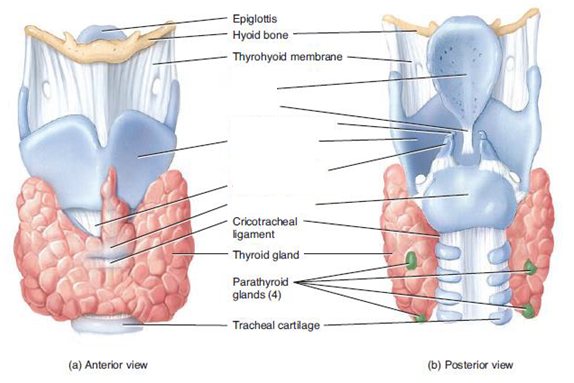
Answer
-
epiglottis
-
thyroid cartilage
-
cricothyroid ligament
-
arytenoid cartilage
-
corniculate cartilage
-
cricoid cartilage
Question 5
Question
What is the function of the cricothyroid muscle?
Answer
-
Contraction causes higher frequency vibration of the vocal fold - therefore increases pitch
-
Contraction causes higher frequency vibration of the vocal fold - therefore decreases pitch
-
Contraction causes lower frequency vibration of the vocal fold - therefore increases pitch
-
Contraction causes lower frequency vibration of the vocal fold - therefore decreases pitch
Question 6
Question
Where is an emergency tracheotomy carried out?
Answer
-
Cricothyroid ligament
-
1st tracheal rings
-
Region of 2/3/4 tracheal rings
-
Above the sternum
Question 7
Question
What are the 3 paired cartilages in the larynx?
1. [blank_start]Arytenoid[blank_end] cartilages
2. [blank_start]Corniculate[blank_end] cartilages
3. [blank_start]Cuneiform[blank_end] cartilages
Answer
-
Arytenoid
-
Corniculate
-
Cuneiform
Question 8
Question
At what (spinal) level is the larynx located?
Answer
-
C4-6
-
C2-4
-
C4-8
-
C2-6
-
C6-8
Question 9
Question
What is the space between the ventricular folds of the larynx called?
Answer
-
Rima vestibuli
-
Rima glottidis
-
Laryngeal isthmus
-
Ventricular isthmus
-
Rima ventriculi
Question 10
Question
What is the space between the vocal folds in the larynx called?
Answer
-
Rima glottidis
-
Rima vestibuli
-
Rima ventriculi
-
Laryngeal isthmus
-
Vocal isthmus
Question 11
Question
What sort of epithelium does the larynx have above the vocal folds?
Answer
-
Non-keratinised stratified squamous
-
Keratinised stratified squamous
-
Pseudostratified ciliated columnar
-
Pseudostratified ciliated cuboidal
-
Simple squamous
Question 12
Question
What sort of epithelium does the larynx have below the vocal folds?
Answer
-
Simple ciliated columnar
-
Stratified ciliated columnar
-
Simple ciliated cuboidal
-
Simple squamous
-
Non-keratinised stratified squamous
Question 13
Question
What is the motor innervation of the majority of the intrinsic laryngeal muscles?
Answer
-
Recurrent laryngeal nerve
-
External laryngeal nerve
-
Internal laryngeal nerve
-
Superior laryngeal nerve
-
Inferior laryngeal nerve
Question 14
Question
What is the only instrinsic laryngeal muscle that is NOT innervated by the recurrent laryngeal nerve?
Answer
-
Cricothyroid m.
-
Cricoarytenoid mm.
-
Transverse arytenoid mm.
-
Oblique arytenoid mm.
-
Thyroarytenoid mm.
Question 15
Question
What is the sensory innervation of the laryngeal cavity above the vocal folds?
Answer
-
Internal laryngeal nerve
-
External laryngeal nerve
-
Superior laryngeal nerve
-
Inferior laryngeal nerve
-
Recurrent laryngeal nerve
Question 16
Question
What is the sensory innervation of the laryngeal cavity BELOW the vocal folds?
Answer
-
External laryngeal nerve
-
Internal laryngeal nerve
-
Superior laryngeal nerve
-
Inferior laryngeal nerve
-
Recurrent laryngeal nerve
Question 17
Question
Describe the blood supply of the larynx.
1. [blank_start]Superior laryngeal artery[blank_end] (branch of superior thyroid artery)
2. [blank_start]Inferior laryngeal artery[blank_end] (branch of inferior thyroid artery)
Answer
-
Superior laryngeal artery
-
Inferior laryngeal artery
Question 18
Question
Describe the venous drainage of the larynx.
1. [blank_start]Superior laryngeal veins[blank_end] (drain into the internal jugular vein)
2. [blank_start]Inferior laryngeal veins[blank_end] (drain into the left brachiocephalic vein)
Answer
-
Superior laryngeal veins
-
Inferior laryngeal veins
Question 19
Question
Which lymph nodes are responsible for draining the larynx?
Answer
-
Deep cervical lymph nodes
-
Superficial cervical lymph nodes
-
Jugulo-omohyoid node
-
Submandibular lymph nodes
-
Supraclavicular lymph nodes
Question 20
Question
What are the 4 extrinsic tongue muscles?
1. [blank_start]Palatoglossus[blank_end] muscle
2. [blank_start]Styloglossus[blank_end] muscle
3. [blank_start]Genioglossus[blank_end] muscle
4. [blank_start]Hyoglossus[blank_end] muscle
Answer
-
Palatoglossus
-
Styloglossus
-
Genioglossus
-
Hyoglossus
Question 21
Question
Which of the following is the only one not innervated by the hypoglossal nerve?
Answer
-
Palatoglossus muscle
-
Styloglossus muscle
-
Hyoglossus muscle
-
Genioglossus muscle
-
Intrinsic tongue muscles
Question 22
Question
Which nerve innervates the palatoglossus muscle?
Answer
-
Vagus nerve
-
Hypoglossal nerve
-
Glossopharyngeal nerve
-
Facial nerve
Question 23
Question
What are the 4 intrinsic muscles of the tongue?
1. [blank_start]Superior longitudinal muscles[blank_end]
2. [blank_start]Vertical muscles[blank_end]
3. [blank_start]Transverse muscles[blank_end]
4. [blank_start]Inferior longitudinal muscles[blank_end]
Answer
-
Superior longitudinal muscles
-
Vertical muscles
-
Transverse muscles
-
Inferior longitudinal muscles
Question 24
Question
What are the 4 types of papillae on the tongue?
1. [blank_start]Filiform[blank_end] papillae
2. [blank_start]Fungiform[blank_end] papillae
3. [blank_start]Vallate[blank_end] papillae
4. [blank_start]Foliate[blank_end] papillae
Answer
-
Filiform
-
Fungiform
-
Vallate
-
Foliate
Question 25
Question
Which of the veins draining the tongue runs deep to the hyoglossus muscle?
Answer
-
Dorsal lingual vein
-
Deep lingual vein
Question 26
Question
What is the sensory function of the glossopharyngeal nerve in the tongue?
Answer
-
Taste in the posterior 1/3
-
Taste in the anterior 2/3
-
General sensation in anterior 2/3; rest of mouth
Question 27
Question
What is the sensory function of the lingual nerve?
Answer
-
Taste from posterior 1/3
-
General sensation in anterior 2/3; rest of mouth
-
Taste from anterior 2/3
Question 28
Question
What is the sensory function of the facial nerve in the tongue?
Answer
-
Taste from anterior 2/3
-
Taste from posterior 1/3
-
General sensation from anterior 2/3; rest of mouth
Question 29
Question
Which nerve gives off the lingual nerve, which supplies the tongue?
Answer
-
Maxillary branch of trigeminal n. (V2)
-
Mandibular branch of trigeminal n. (V3)
-
Ophthalmic branch of trigeminal n. (V1)
-
Glossopharyngeal n.
-
Hypoglossal n.
Question 30
Question
Describe the 2 stages of oral cancer.
1. Benign
a) [blank_start]Leukoplakia[blank_end]
b) [blank_start]Erythroplakia[blank_end]
2. [blank_start]Squamous cell carcinoma[blank_end]
Answer
-
Leukoplakia
-
Erythroplakia
-
Squamous cell carcinoma
Question 31
Question
What are the 5 stages of oral cancer development?
1. Normal
2. Hyperplasia/[blank_start]hyperkeratosis[blank_end]
3. [blank_start]Mild/moderate dysplasia[blank_end]
4. [blank_start]Severe dysplasia/carcinoma in situ[blank_end]
5. Squamous cell carcinoma
Answer
-
hyperkeratosis
-
Mild/moderate dysplasia
-
Severe dysplasia/carcinoma in situ
Want to create your own Quizzes for free with GoConqr? Learn more.