
Quiz
PhysX #1 bugaga
Create a free account to finish this quiz
Save your progress and see your final score.
Already have an account? Sign in
Questions in this quiz (40)
1Consider a graphical representation (Fig.) of simple harmonic motion as described mathematically by equation. When the particle is at point A on the graph, what can you say about its position and
velocity?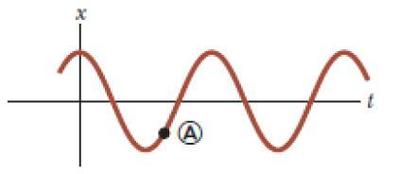
- AThe position and velocity are both positive
- BThe position and velocity are both negative
- CThe position is positive, and the velocity is zero
- DThe position is positive and the velocity is negative
- EThe position is negative, and the velocity is positive
2Which of the following statements is not true regarding a mass- spring system that moves with simple harmonic motion in absence of friction?
- AThe total energy of the system remains constant
- BThe energy of the system is continually transformed between kinetic and potential energy
- CThe total energy of the system is proportional to the square of the amplitude
- DThe potential energy stored in the system is greatest when the mass passes through the equilibrium position.
3When a thin uniform stick of mass M and length L is pivoted about its midpoint, its rotational inertia is ML^2/12. When pivoted about a parallel axis through one end, its rotational inertia is:
- AML^2/12
- BML^2/6
- CML^2/3
- D7ML^2/12
- E13ML^2/12
4A baseball of mass m is thrown upward with some initial speed. A gravitational force is exerted on the ball
- AAt all points in its motion
- BAt all points in its motion except at the highest point
- CAt no points in its motion
- DOnly at downward part of its direction
5The kinetic friction will always be
- AGreater than static friction
- BEqual to the static friction
- CLess than static friction
- DNegative
6Centripetal acceleration and tangential acceleration are always __________.
- AParallel to Each other, but in opposite direction
- BPerpendicular to each other
- CNone of these
- DParallel to Each other, but in the same direction
7The dimensions of angular momentum are __________.
- AMLT^-1
- BMLT^-2
- CML^2T^-2
- DML^2T^-1
8Two waves have the same frequency. Which wave characteristic must also be identical for both waves?
- APhase
- BAmplitude
- CIntensity
- DPeriod
9A mechanical wave generally does NOT
- AMove the medium from one place to another
- BMove through a medium
- CMove through solids
- DDisturb the medium
10Which statements are correct?
- ACharges of opposite sign attract one another and charges of the same sign repel one another. Total charge in an isolated system is conserved. Charge is quantized.
- BCharges of opposite sign repel one another and charges of the same sign attract one another.Total charge in an isolated system is conserved. Charge is quantized.
- CCharges of opposite sign attract one another and charges of the same sign repel one another. Total charge in an isolated system is not conserved. Charge is quantized
- DCharges of opposite sign repel one another and charges of the same sign attract one another. Total charge in an isolated system is ot conserved. Charge is not quantized.
- ENo correct answer
11Which statements are correct?
- AConductors are materials in which electrons move freely. Insulators are materials in which electrons do not move freely.
- BInsulators are materials in which electrons move freely. Conductors are materials in which electrons do not move freely.
- CConductors are materials in which electrons don’t move freely. Insulators are materials in which electrons move freely.
- DAll answers are correct
- ENo correct answer
12If the electric field is uniform and makes an angle θ with the normal to a surface of area A, the electric flux through the surface is:
- AΦ = EAcosθ
- BΦ = EAsinθ
- CΦ = Acosθsinθ
- DΦ = Ecosθ
- ENo correct answer
13A conductor in electrostatic equilibrium has the following properties:
- A1) The electric field is zero everywhere inside the conductor.
2) Any net charge on the conductor resides entirely on its surface.
3) The electric field just outside the conductor is perpendicular to its surface and has a magnitude σ/ε0, where σ is the surface charge density at that point.
4) On an irregularly shaped conductor, the surface charge density is greatest where the radius of curvature of the surface is the smallest. - B1) The electric field is zero everywhere inside the conductor.
2) Any net charge on the conductor resides partially on its surface, partially inside the conductor.
3) The electric field just outside the conductor is parallel to its surface and has a magnitude σ/ε0, where σ is the surface charge density at that point.
4) On an irregularly shaped conductor, the surface charge
density is greatest where the radius of curvature of the surface is the smallest. - C1) The electric field is non zero everywhere inside the conductor.
2) Any net charge on the conductor resides entirely on its surface.
3) The electric field just outside the conductor is perpendicular to its surface and has a magnitude σ/ε0, where σ is the surface charge density at that point.
4) On an irregularly shaped conductor, the surface charge density is greatest where the radius of curvature of the surface is the biggest. - D1) The electric field is zero everywhere inside the conductor.
2) Any net charge on the conductor resides entirely inside the conductor.
3) The electric field just outside the conductor is perpendicular to its surface and has a magnitude σ/ε0, where σ is the surface charge density at that point.
4) On an irregularly shaped conductor, the surface charge density is smallest where the radius of curvature of the surface is the smallest. - ENo correct answer
- A1) The electric field is zero everywhere inside the conductor.
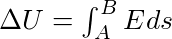
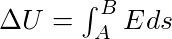
14When a positive test charge q0 is moved between points A and B in an electric field E, the change in the potential energy of the charge–field system is:
- A1

- B2
- C3
- D4

- ENo correct answer
- A1
15The potential difference ΔV between points A and B in an electric field E is defined as:
- A1

- B2

- C3

- D4

- ENo correct answer
- A1
16The potential difference between two points A and B in a uniform electric field E, where s (d=|s|) is a vector that points from A to B and is parallel to E is:
- AΔV = -Ed
- BΔV = 0
- CΔV = Ed
- DΔV = -Edsinθ
- ENo correct answer
17Which statements are correct?
- AAn equipotential surface is one on which all points are at the same electric potential. Equipotential surfaces are perpendicular to electric field lines.
- BAn equipotential surface is one on which all points are at the same electric potential. Equipotential surfaces are parallel to electric field lines.
- CAn equipotential surface is one on which all points are not at the same electric potential. Equipotential surfaces are perpendicular to electric field lines.
- DAn equipotential surface is one on which all points are at the same electric potential. Equipotential surfaces are perpendicular to gravitation field lines.
- ENo correct answer
18If we define V = 0 at rA = ∞ the electric potential due to a point charge at any distance r from the charge is:
- AV = kq/r
- BV = kq^2/r
- CV = kq/r^2
- DV = q/r
- ENo correct answer
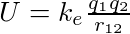
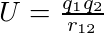
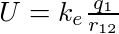
19The potential energy associated with a pair of point charges separated by a distance r12 is:
- A1
- B2
- C3

- D4
- ENo correct answer
- A1
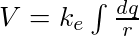
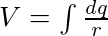
20The electric potential due to a continuous charge distribution is:
- A1
- B2
- C3
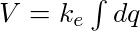
- D4
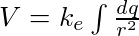
- ENo correct answer
- A1
21The electric dipole moment p of an electric dipole has a magnitude:
- Ap = 2aQ
- Bp = Q
- Cp = Q^2
- Dp = -2aQ
- ENo correct answer
22The torque acting on an electric dipole in a uniform electric field E is:
- Aτ = pxE
- Bτ = p·E
- Cτ = p/E
- Dτ = qpxE
- ENo correct answer
23The potential energy of the system of an electric dipole in a uniform external electric field E is:
- AU = - p·E
- BU = pxE
- CU = p·E
- DNo correct answer
- EU = p/E
24The average current in a conductor is related to the motion of the charge carriers through the relationship:
- AI = nqvA
- BI = nqv
- CI = qvA
- DI = nq/vA
- ENo correct answer
25Ohm’s law in the differential form is:
- AJ = σE
- BI = U/R
- CI = R/U
- DJ = σ/E
- ENo correct answer
26Ohm’s law in the integral form is:
- AJ = σE
- BI = U/R
- CI = R/U
- DJ = σ/E
- ENo correct answer
27The power supplied to the element, is:
- AP = IΔV
- BP = I/ΔV
- CP = I^2ΔV
- DP = IΔV^2
- ENo correct answer
28The power delivered to a resistor can be defined as:
- AP = I^2R
- BP = IR
- CP = IR^2
- DP = I^2/R
- ENo correct answer
29Circuits involving more than one loop are conveniently analyzed with the use of Kirchhoff’s rules:
- A1) The sum of the currents entering any junction in an electric circuit must equal the sum of the
currents leaving that junction.
2) The sum of the potential differences across all elements around any circuit loop must be zero - B1) The product of the currents entering any junction in an electric circuit must equal the
sum of the currents leaving that junction.
2) The sum of the potential differences across all elements around any circuit loop must be constant. - C1) The sum of the currents at any circuit loop must be zero.
2) The sum of the potential differences across all elements around any circuit loop must be zero. - D1) The sum of the currents entering any junction in an electric circuit must equal the sum of the currents leaving that junction.
2) The product of the potential differences across all elements around any circuit loop must be zero. - ENo correct answer
- A1) The sum of the currents entering any junction in an electric circuit must equal the sum of the
30Two objects, with different sizes, masses, and temperatures, are placed in thermal contact. Energy travels
- AFrom the larger object to the smaller object
- BFrom the object with more mass to the one with less
- CFrom the object at higher temperature to the object at lower temperature
- DEnergy doesn’t travel
- EFrom the object at lower temperature to the object at higher temperature
31The second law of thermodynamics can be given as __________
- AFor any spontaneous process, the entropy of the universe increases
- BThe entropy of a pure crystalline substance at absolute zero is zero
- CΔS = Q/T at constant temperature
- DΔE = Q + W
32How does the internal energy of an ideal gas change as it follows path i->f in figure?
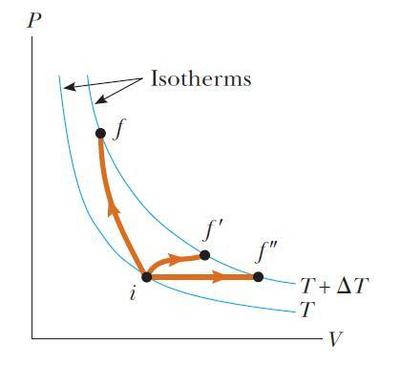
- AE(int) increases
- BE(int) decreases
- CE(int) stays the same
- DThere is not enough information to determine how E(int) changes
33How does the internal energy of an ideal gas as it follows path f->f' along the isotherm labeled T + ΔT in figure ?
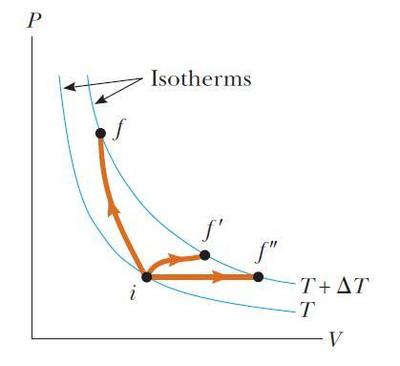
- AE(int) increases
- BE(int) decreases
- CE(int) stays the same
- DThere is not enough information to determine how E(int) changes
34Two containers hold an ideal gas at the same temperature and pressure. Both containers hold the same type of gas but container B has twice the volume of container A. The average translational kinetic energy per molecule in container B is
- ATwice that for container A
- BThe same as that for container A
- CHalf that for container A
- DImpossible to determine.
35Two containers hold an ideal gas at the same temperature and pressure. Both containers hold the same type of gas but container B has twice the volume of container A. The internal energy of the gas in container B is
- ATwice that for container A
- BThe same as that for container A
- CHalf that for container A
- DImpossible to determine
36Two containers hold an ideal gas at the same temperature and pressure. Both containers hold the same type of gas but container B has twice the volume of container A. The rms speed of the gas molecules in container B is
- ATwice that for container A
- BThe same as that for container A
- CHalf that for container A
- DImpossible to determine
37The molar specific heat of a gas is measured at constant volume and found to be 11R/2. The gas is most likely to be
- AMonatomic
- BDiatomic
- CMonatomic or diatomic, depends on the conditions
- DPolyatomic
- EAll answers are incorrect
38Parallel wires carrying currents I1 and I2 respectively
- ARepel if they are directed opposite
- BWill attract if they are directed opposite
- CWill not interact
39A material that can be permanently magnetized is generally said to be
- AMagnetic
- BElectromagnetic
- CPermanently magnetic
- DFerromagnetic
40The magnetic flux around a straight currentcarrying wire
- AGets stronger with increasing distance from the wire
- BIs strongest near the wire
- CDoes not vary in strength with distance from the wire
- DConsists of straight lines parallel to the wire
Information
- Description
- Quiz
- Author
- Hanzo Conard
- Language
- English
- Views
- 47
- Tags
- Rating
- No ratings yet Rate this quiz