
9363960
Description

Quiz by Eilidh Young, updated more than 1 year ago

|
Created by Eilidh Young
over 8 years ago
|
|
Question 1
Question
Upon studying whether the classification of species is arbitrary or real, the general finding confirms that species are real and represent discrete groups that can reflect morphological, genetic and behavioural differences.
However at present there is no one general agreed species definition.
Answer
- True
- False
Question 2
Question
The biological species concept is at present the most commonly used concept.
A species is a group of [blank_start]populations[blank_end] whose members can [blank_start]interbreed[blank_end] and produce viable offspring but [blank_start]do not[blank_end] interbreed with members of other species.
Answer
-
populations
-
interbreed
-
do not
-
do
Question 3
Question
One limit of the biological species concept is that it doesn’t apply to asexual organisms e.g. prokaryotes.
Answer
- True
- False
Question 4
Question
Other species concepts
The biological species concept focuses on reproductive barriers keeping species apart, other concepts emphasise unity within species.
1. [blank_start]Morphological[blank_end] species concept, distinguishes a species based on body shape and size.
2. [blank_start]Ecological[blank_end] species concept, defines a species in terms of its ecological niche.
3. [blank_start]Phylogenetic[blank_end] species concept, defines a species as the smallest group of individuals that share a common ancestor.
4. [blank_start]Specific mate recognition[blank_end] species concept, defines a species as a group of organisms that share a common mate recognition system.
Answer
-
Morphological
-
Ecological
-
Phylogenetic
-
Specific mate recognition
Question 5
Question
ALLOPATRIC SPECIATION
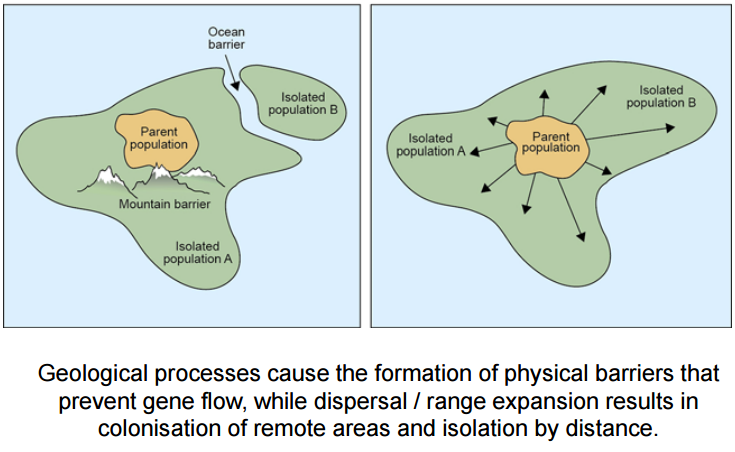
Allopatric speciation occurs when [blank_start]gene flow[blank_end] is interrupted as a result of a population being divided into geographically isolated subpopulations.
Answer
-
gene flow
Question 6
Question
Label the images as either vicariance or dispersal allopatric speciation.
Answer
-
Vicariance
-
Dispersal
Question 7
Question
SYMPATRIC SPECIATION
Sympatric speciation can occur via [blank_start]polyploidy[blank_end], [blank_start]sexual selection[blank_end] and [blank_start]habitat differentiation[blank_end].
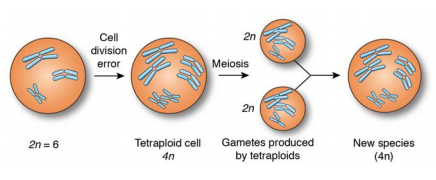
Two forms of polyploidy have been observed in plants – autopolyploidy ([blank_start]self[blank_end]) and allopolyploidy ([blank_start]other[blank_end]).
Answer
-
polyploidy
-
diploidy
-
monoploidy
-
sexual selection
-
natural selection
-
habitat differentiation
-
habitat integration
-
self
-
other
-
other
-
self
Question 8
Question
What type of sympatric speciation is this diagram representing?
Image:
Autopolyploidy (image/png)
Answer
-
autopolyploidy
Question 9
Question
Select all that are CORRECT with regards to Allopolyploidy.
Answer
-
An allopolyploid is a plant that is a hybrid between only one species.
-
The resulting polyploid plants contain chromosome sets derived from two or more species.
-
Most hybrids are sterile because their chromosomes are not homologous and cannot pair during meiosis. (Such hybrids may be able to reproduce asexually).
-
In subsequent generations, mitotic or meiotic non-disjunction can double the chromosome number and change a sterile hybrid into a fertile polyploid.
-
Allopolyploids are fertile when mating with each other but can not mate with either parental species.
Question 10
Question
PATTERNS OF SPECIATION
[blank_start]Anagenesis[blank_end] is gradual change within a single lineage over time.
[blank_start]Cladogenesis[blank_end] is evolutionary change produced by the branching of populations to form new species.
[blank_start]Adaptive radiation[blank_end] is the rapid formation of many new species from a single ancestral group, characteristically to fill a new ecological area / zone.
[blank_start]Extinction[blank_end] is the disappearance of a species from the earth, the fossil record reveals a low steady rate of extinction interrupted periodically by mass extinction.
Answer
-
Anagenesis
-
Cladogenesis
-
Adaptive radiation
-
Extinction
Question 11
Question
Both anagenesis and cladogenesis occur but cladogenesis is generally considered to be responsible for the diversity of species over evolutionary time.
Answer
- True
- False
Want to create your own Quizzes for free with GoConqr? Learn more.