
Description


|
Created by Brenda Fernández carmona
almost 7 years ago
|
|
Page 1
SIMPLE PRESENT TENSE
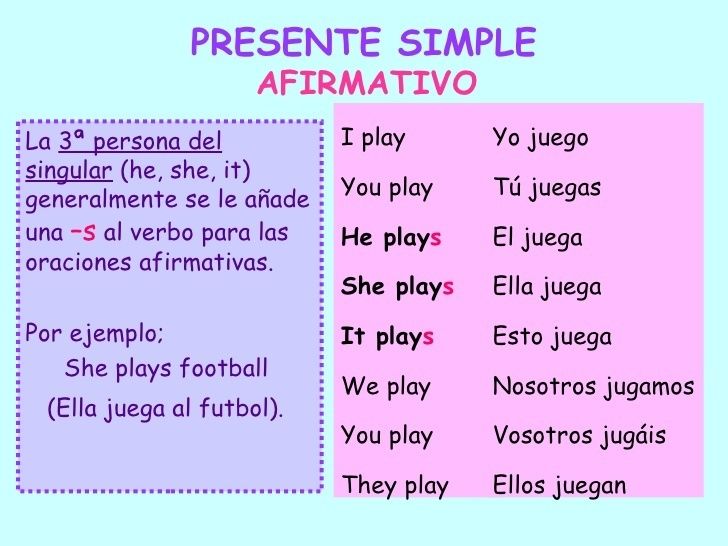
The present simple is used to talk about things that usually happen Also, it is important to take some grammatical rules, such as: To conjugate the present simple we use the infinitive for the subjects "I", "you", "we" and "they" and for the third persons "he", "she" and "it", we add a "-s" to the end of the verb.
AFFIRMATIVE SENTENCES Subject + verb The pronoun is placed, to then place the verb (identify if it is 3 person) EXAMPLES: I talk.(Yo hablo.) He eats.(Él come.) They learn.(Ellos aprenden.)
Page 2
SIMPLE PRESENT TENSE
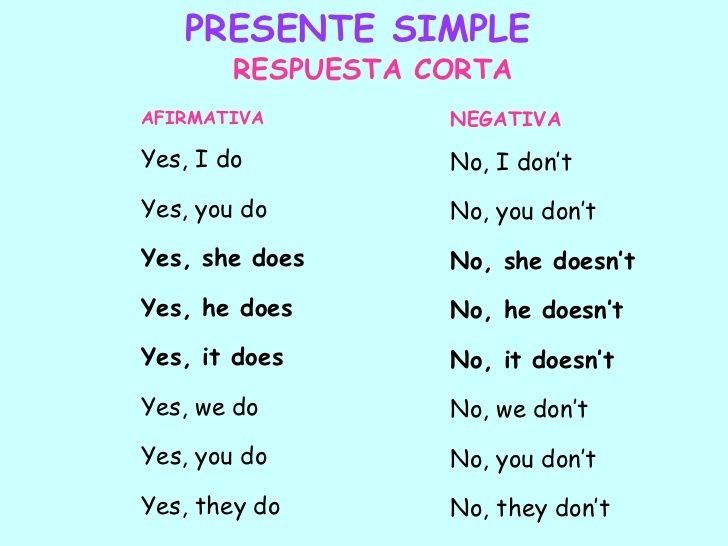
2.- NEGATIVE SENTENCES Subject + auxiliary verb (to do) + negative auxiliary ("not") + verb. To use the simple present in negative with any verb that is different from the one to be, we use the auxiliary do not or does not, normally contracted: Do not is the contraction of do and not. Does not is the contraction of does and not, which is used with he, she and it. The auxiliary verbs do not and does not place between the subject and the main verb. Note: In negative phrases, the auxiliary verb ("to do") changes and the main verb goes in the infinitive.
Page 3
SIMPLE PRESENT TENSE
TAKE INTO ACCOUNT: 1. The present simple is used to talk about things that happen habitually. Unlike with Spanish, the simple present is not used to talk about something that is happening at the moment we speak. 2.- The adverbs of time go before the verb, except the verb "to be". When using "to be" the verb goes before the adverb. 3.- It is used to talk about generalities or scientific facts.
Want to create your own Notes for free with GoConqr? Learn more.