
Modul 4 von 7 · Medien
4.
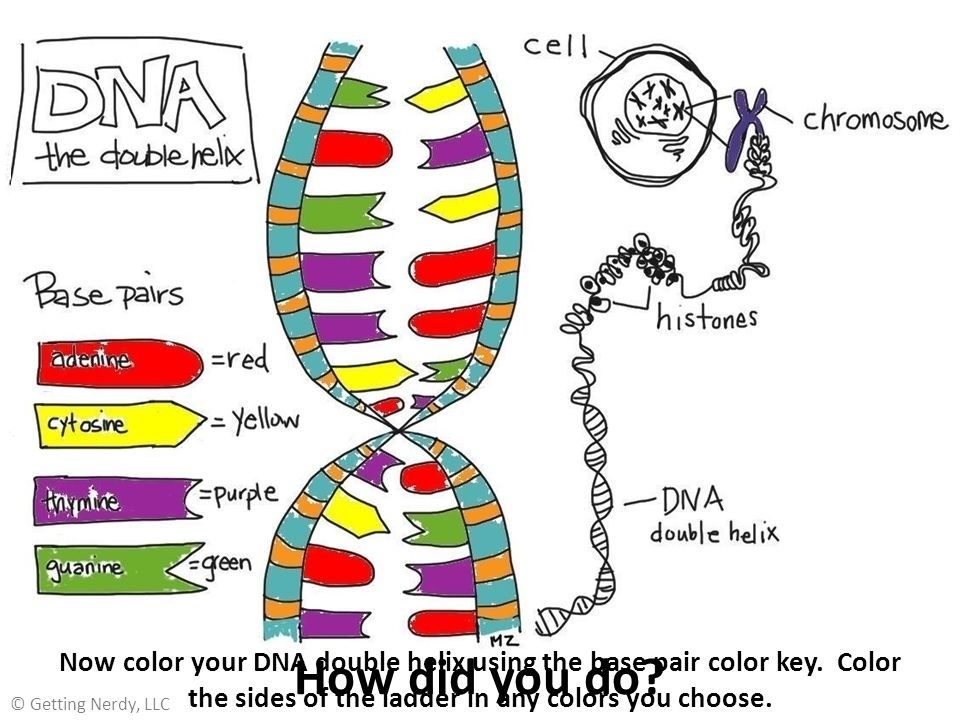
DNA resides inside the nucleus of every living cell. The shape is described as a twisted later or double helix. the sides of the latter are made of deoxyribose sugar and phosphates. The steps of the ladder are made up of matching pairs of molecules called nitrogen bases.
There are 4 types of nitrogen bases: Adenine, Thymine, Cytosine & Guanine.
Adenine ONLY pairs with Thymine. Cytosine ONLY pairs with Guanine
A nitrogen base + sugar + phosphate makes up a nucleic acid hence the name Deoxyribonucleic acid.
In 1950 Erwin Chargraff analyzed the base pair composition of DNA he discovered That %adinine == % thymine same with the other two. meaning there is some amount of adenine and thymine and the same amount of cytosine and guanine proving evediance that they pair with one anther.
Rosalind Franklin
Who is Rosalind Franklin
She studied DNA's structure.
who took over work
james Watson, Francis Crick, and Maurice Wilkins
Mighty Mincule DNA
what order do these go in
cell-> chromosome-> Histone-> DNA double Helix -> DNA with nitrogen bases
Meanings
Cell- The smallest structural and functional unit of an organism
Chromosome -a threadlike structure of nucleic acids and protein found in the nucleus of most living cells, carrying genetic info in the form of genes
Histone- any group of basic proteins found in double helix
DNA double helix-a pair of parallel helices intertwined about a common axis
DNA with nitrogen bases-a nitrogen-containing molecule that has the same chemical properties base
Types of Mutation
What is a mutation?
a permanent alteration in a sequence of DNA that makes up a gene. The sequence is unique to what is found in most individuals platation can be so small that: they affect a single base pair or so larger that it involves multiple genes mutation can affect individuals differently depending on where they can occur and the types of proteins that are created as a result.
Deletion
change the number of DNA bases by removing a piece of DNA.
Inversion
An entire section of DNA reversed
Translocation
A whole chromosome or segment attaches to another creating a hybrid
Insertion
Increases the number of DNA bases in a gene by adding a piece of DNA
Duplication
A piece of DNA that is copied one or more times