
Quiz
9702 Double & Single Slit Diffraction
Erstelle ein kostenloses Konto, um dieses Quiz zu beenden
Speichere deinen Fortschritt und sieh dir dein Endergebnis an.
oder mit deiner E-Mail registrieren
Schon ein Konto? Anmelden
Fragen in diesem Quiz (10)
1A teacher sets up the apparatus shown to demonstrate a double-slit interference pattern on the screen.
Which change to the apparatus will increase the fringe spacing?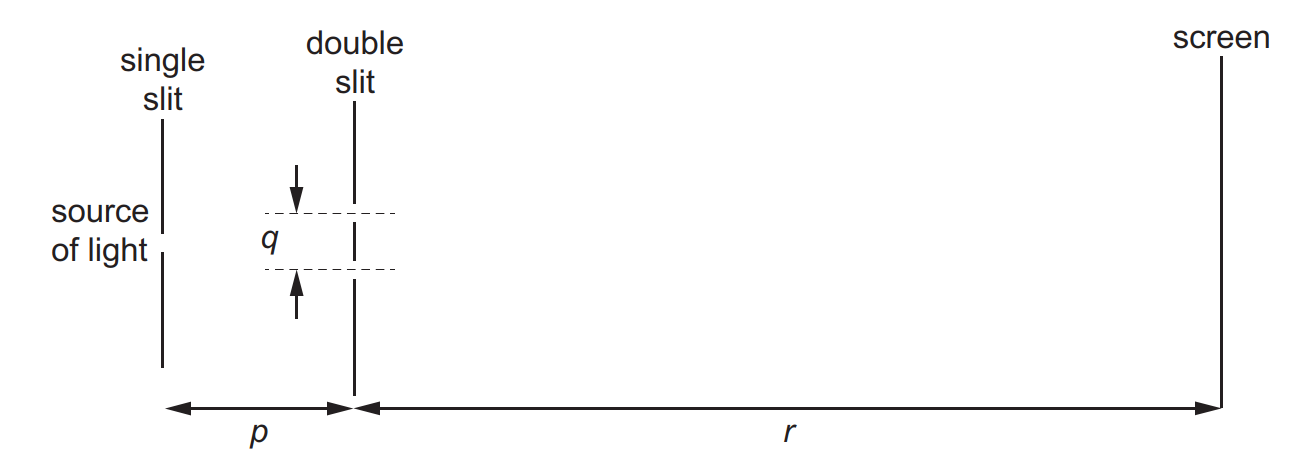
- AA decreasing the distance p.
- BB decreasing the distance q.
- CC decreasing the distance r.
- DD decreasing the wavelength of the light.
2The diagram shows two sources of waves S1 and S2. The sources oscillate with a phase difference of 180°.
The sources each generate a wave of wavelength 2.0 cm. Each source produces a wave that has amplitude x0 when it reaches point P.
What is the amplitude of the oscillation at P?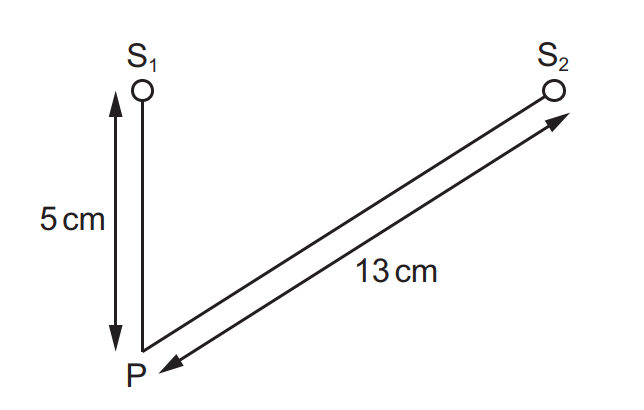
- AA 0
- BB x0/2
- CC x0
- DD 2x0
3A two-source interference experiment uses the apparatus shown.
What is the main purpose of the single slit?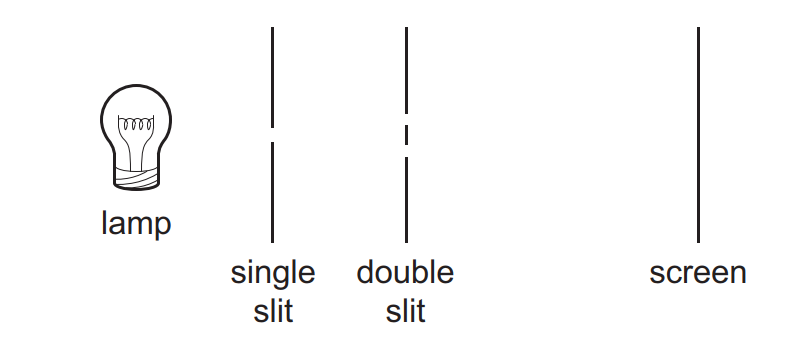
- AA to make a narrow beam of light
- BB to make the same amplitude of light incident on each slit
- CC to provide coherent light
- DD to provide monochromatic light
4Which statement gives a condition that enables diffraction to occur?
- AA A source of waves moves towards a stationary observer.
- BB A wave is partially blocked by an obstacle.
- CC Two coherent waves are superposed.
- DD Two waves of equal speed and frequency are travelling through the same part of a medium
in opposite directions.
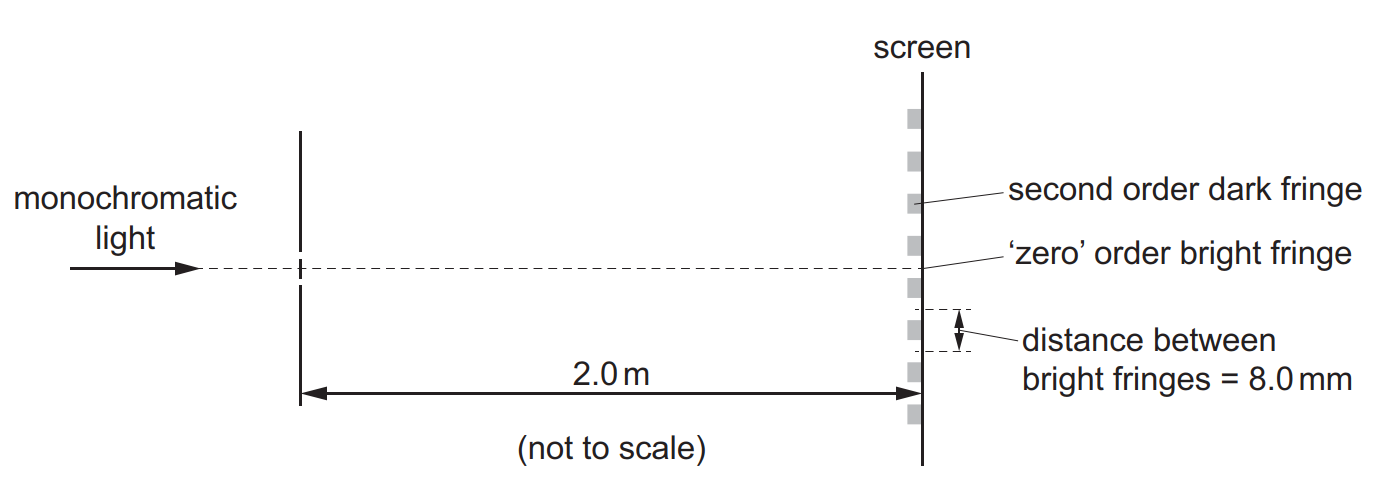
5Monochromatic light is incident on a pair of narrow slits a distance of 0.1 mm apart. A series of bright and dark fringes are observed on a screen a distance of 2.0 m away.
The distance between adjacent bright fringes is 8.0 mm.
What is the path difference between the light waves from the two slits that meet at the second order dark fringe?
- AA 2.0 × 10^–7 m
- BB 4.0 × 10^–7 m
- CC 6.0 × 10^–7 m
- DD 8.0 x 10^-7 m
6A monochromatic plane wave of speed c and wavelength λ is diffracted at a small aperture.
The diagram illustrates successive wavefronts.
After what time will some portion of the wavefront GH reach point P?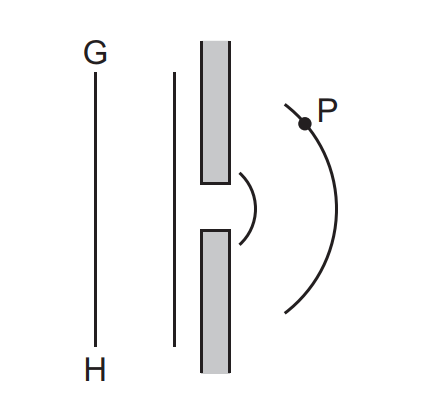
- AA 3λ/2c
- BB 2λ/c
- CC 3λ/c
- DD 4λ/c
7In an experiment to demonstrate two-source interference of light, a beam of light is split into two beams using two slits 0.50 mm apart. These two beams are incident on a laboratory wall at a distance of 4.0 m.
The wavelength of light is 550 nm.
How far apart are two adjacent interference fringes that are formed on the laboratory wall?- AA 0.22 mm
- BB 0.44 mm
- CC 2.2 mm
- DD 4.4 mm
8In a double-slit experiment the distance between the fringes, on a screen, was too small to measure.
What would increase the distance between the fringes?- AA increasing the distance between the light source and the slits
- BB increasing the distance between the slits and the screen .
- CC increasing the distance between the slits
- DD increasing the frequency of the light source
9A pattern of waves was observed without being able to view the source of the waves. The pattern is represented in the diagram.
What can cause this pattern?- AA coherence only
- BB diffraction and interference
- CC diffraction only
- DD interference only
10Which electromagnetic wave would cause the most significant diffraction effect for an atomic lattice of spacing around 10^–10 m?
- AA infra-red
- BB microwave
- CC ultraviolet
- DD X-ray
Informationen
- Beschreibung
- Quiz for AS Physics on slits and wave interference patterns.
- Autor
- Jeffrey Piggott
- Sprache
- English
- Aufrufe
- 1.326
- Schlagwörter
- Bewertung
- Noch keine Bewertungen Bewerte dieses Quiz