
Quiz
Windows Server 2016 70-740 - Simulado I
Dieses Quiz hat ein Zeitlimit und öffnet sich deshalb im gewohnten Player.
Fragen in diesem Quiz (50)
1Question #1
Note: This question is part of a series of questions that present the same scenario. Each question in the series contains a unique solution that might meet the stated goals. Some question sets might have more than one correct solution, while others might not have a correct solution.
After you answer a question in this section, you will NOT be able to return to it. As a result, these questions will not appear in the review screen.
You have two servers that run Windows Server 2016.
You plan to create a Network Load Balancing (NLB) cluster that will contain both servers.
You need to configure the network cards on the servers for the planned NLB configuration.
Solution: You configure the network cards to be on the same subnet and to have static IP addresses. You configure the cluster to use multicast.
Does this meet the goal?- AYes
- BNo
2Question #2
Note: This question is part of a series of questions that present the same scenario. Each question in the series contains a unique solution that might meet the stated goals. Some question sets might have more than one correct solution, while others might not have a correct solution. After you answer a question in this section, you will NOT be able to return to it. As a result, these questions will not appear in the review screen. You have two servers that run Windows Server 2016. You plan to create a Network Load Balancing (NLB) cluster that will contain both servers.
You need to congure the network cards on the servers for the planned NLB conguration. Solution: You congure the network cards to be on the same subnet and to have dynamic IP addresses. You congure the cluster to use multicast. Does this meet the goal?- AYes
- BNo
3Question #3
Note: This question is part of a series of questions that present the same scenario. Each question in the series contains a unique solution that might meet the stated goals. Some question sets might have more than one correct solution, while others might not have a correct solution.
After you answer a question in this section, you will NOT be able to return to it. As a result, these questions will not appear in the review screen.
You have two servers that run Windows Server 2016.
You plan to create a Network Load Balancing (NLB) cluster that will contain both servers.
You need to configure the network cards on the servers for the planned NLB configuration.
Solution: You configure the network cards to be on the same subnet and to have static IP addresses. You configure the cluster to use unicast.
Does this meet the goal?- AYes
- BNo
4Question #4
Note: This question is part of a series of questions that present the same scenario. Each question in the series contains a unique solution that might meet the stated goals. Some question sets might have more than one correct solution, while others might not have a correct solution.
After you answer a question in this section, you will NOT be able to return to it. As a result, these questions will not appear in the review screen.
You are a server administrator at a company named Contoso, Ltd.
Contoso has a Windows Server 2016 Hyper-V environment configured as shown in the following table.
All of the virtual switches are of the external type.
You need to ensure that you can move virtual machines between the hosts without causing the virtual machines to disconnect from the network.
Solution: You implement live migration by using Host3 and Host4.
Does this meet the goal?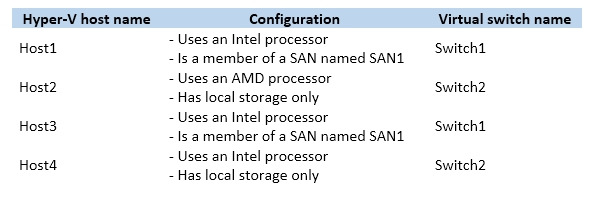
- AYes
- BNo
5Question #5
Note: This question is part of a series of questions that present the same scenario. Each question in the series contains a unique solution that might meet the stated goals. Some question sets might have more than one correct solution, while others might not have a correct solution.
After you answer a question in this section, you will NOT be able to return to it. As a result, these questions will not appear in the review screen.
You are a server administrator at a company named Contoso, Ltd.
Contoso has a Windows Server 2016 Hyper-V environment configured as shown in the following table.
All of the virtual switches are of the external type.
You need to ensure that you can move virtual machines between the hosts without causing the virtual machines to disconnect from the network.
Solution: You implement live migration by using Host1 and Host2.
Does this meet the goal?- AYes
- BNo
6Question #6
Note: This question is part of a series of questions that present the same scenario. Each question in the series contains a unique solution that might meet the stated goals. Some question sets might have more than one correct solution, while others might not have a correct solution.
After you answer a question in this section, you will NOT be able to return to it. As a result, these questions will not appear in the review screen.
You are a server administrator at a company named Contoso, Ltd.
Contoso has a Windows Server 2016 Hyper-V environment configured as shown in the following table.
All of the virtual switches are of the external type.
You need to ensure that you can move virtual machines between the hosts without causing the virtual machines to disconnect from the network.
Solution: You implement a Hyper-V Replica between Host2 and Host4.
Does this meet the goal?- AYes
- BNo
7Question #7
Note: This question is part of a series of questions that present the same scenario. Each question in the series contains a unique solution that might meet the stated goals. Some question sets might have more than one correct solution, while others might not have a correct solution.
After you answer a question in this section, you will NOT be able to return to it. As a result, these questions will not appear in the review screen.
Your network contains an Active Directory forest.
You install Windows Server 2016 on 10 virtual machines.
You need to deploy the Web Server (IIS) server role identically to the virtual machines.
Solution: You use Windows PowerShell Desired State Configuration (DSC) to create a default configuration, and then you apply the configuration to the virtual machines.
Does this meet the goal?- AYes
- BNo
8Question #8
Note: This question is part of a series of questions that present the same scenario. Each question in the series contains a unique solution that might meet the stated goals. Some question sets might have more than one correct solution, while others might not have a correct solution.
After you answer a question in this section, you will NOT be able to return to it. As a result, these questions will not appear in the review screen.
Your network contains an Active Directory forest.
You install Windows Server 2016 on 10 virtual machines.
You need to deploy the Web Server (IIS) server role identically to the virtual machines.
Solution: From a Group Policy object (GPO), you create an application control policy, and then you apply the policy to the virtual machines.
Does this meet the goal?- AYes
- BNo
9Question #9
Note: This question is part of a series of questions that present the same scenario. Each question in the series contains a unique solution that might meet the stated goals. Some question sets might have more than one correct solution, while others might not have a correct solution.
After you answer a question in this section, you will NOT be able to return to it. As a result, these questions will not appear in the review screen.
Your network contains an Active Directory forest.
You install Windows Server 2016 on 10 virtual machines.
You need to deploy the Web Server (IIS) server role identically to the virtual machines.
Solution: You create a software installation package, and then you publish the package to the virtual machines by using a Group Policy object (GPO).
Does this meet the goal?- AYes
- BNo
10Question #10
Note: This question is part of a series of questions that present the same scenario. Each question in the series contains a unique solution that might meet the stated goals. Some question sets might have more than one correct solution, while others might not have a correct solution.
After you answer a question in this section, you will NOT be able to return to it. As a result, these questions will not appear in the review screen.
You have a server named Server1 that runs Windows Server 2016.
Server1 hosts a line-of-business application named App1. App1 has a memory leak that occasionally causes the application to consume an excessive amount of memory.
You need to log an event in the Application event log whenever App1 consumes more than 4 GB of memory.
Solution: You create a performance counter data collector.
Does this meet the goal?- AYes
- BNo
11Question #11
Note: This question is part of a series of questions that present the same scenario. Each question in the series contains a unique solution that might meet the stated goals. Some question sets might have more than one correct solution, while others might not have a correct solution.
After you answer a question in this section, you will NOT be able to return to it. As a result, these questions will not appear in the review screen.
You have a server named Server1 that runs Windows Server 2016.
Server1 hosts a line-of-business application named App1. App1 has a memory leak that occasionally causes the application to consume an excessive amount of memory.
You need to log an event in the Application event log whenever App1 consumes more than 4 GB of memory.
Solution: You create a performance counter alert data collector.
Does this meet the goal?- AYes
- BNo
12Question #12
Note: This question is part of a series of questions that present the same scenario. Each question in the series contains a unique solution that might meet the stated goals. Some question sets might have more than one correct solution, while others might not have a correct solution.
After you answer a question in this section, you will NOT be able to return to it. As a result, these questions will not appear in the review screen.
You have a server named Server1 that runs Windows Server 2016.
Server1 hosts a line-of-business application named App1. App1 has a memory leak that occasionally causes the application to consume an excessive amount of memory.
You need to log an event in the Application event log whenever App1 consumes more than 4 GB of memory.
Solution: You create a system configuration information data collector.
Does this meet the goal?- AYes
- BNo
13Question #13
You have a Hyper-V host named Server1 that runs Windows Server 2016.
Server1 has a virtual machine named VM1. VM1 is configured to run the Docker daemon.
On VM1, you have a container network that uses transparent mode.
You need to ensure that containers that run on VM1 can obtain IP addresses from DHCP.
What should you do?- AOn VM1, run Get-VMNetworkAdapter-VMName VM1 | Set-VMNetworkAdapter ""MacAddressSpoofing On.
- BOn VM1, run docker network connect.
- COn Server1, run docker network connect.
- DOn Server1, run Get-VMNetworkAdapter ""VMName VM1 | Set-VMNetworkAdapter ""MacAddressSpoofing On.
14Question #14
DRAG DROP -
You have a server named Server1 that runs Windows Server 2016.
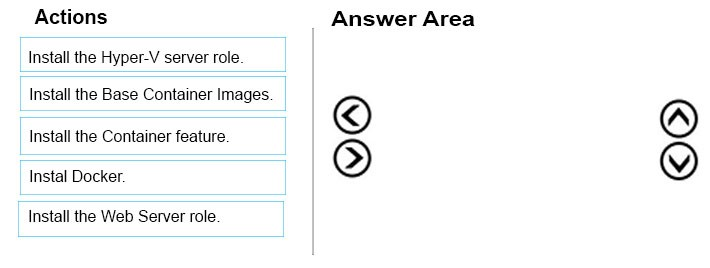
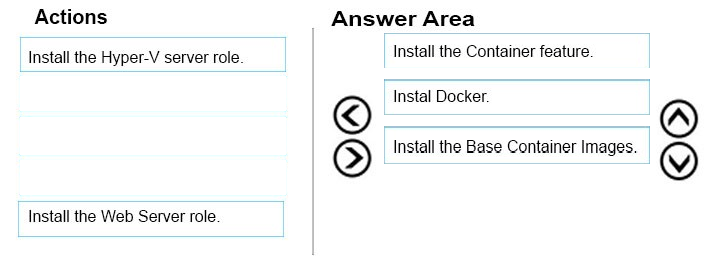
You plan to deploy Internet Information Services (IIS) in a Windows container.
You need to prepare Server1 for the planned deployment.
Which three actions should you perform in sequence? To answer, move the appropriate actions from the list of actions to the answer area and arrange them in the correct order.
Select and Place:- A
- B
- A
15Question #15
HOTSPOT -
You have a server named Server1 that runs Windows Server 2016 server.
Server1 has the Docker daemon configured and has a container named Container1.
You need to mount the folder C:\Folder1 on Server1 to C:\ContainerFolder in Container1.
Which command should you run? To answer, select the appropriate options in the answer area.
Hot Area:- A

- B

- A
16Question #16
You have a server that runs Windows Server 2016.
The server contains a storage pool named Pool1. Pool1 contains five physical disks named Disk1, Disk2, Disk3, Disk4, and Disk5.
A virtual disk named VirtualDisk1 is stored in Pool1. VirtualDisk1 uses the parity storage layout.
Disk3 fails.
You need to remove Disk3 from Pool1.
Which two commands should you run? Each correct answer presents part of the solution.- AUpdate-StoragePool ""FriendlyName Pool1
- BSet-ResiliencySetting ""StoragePool Pool1 ""PhysicalDiskRedundancyDefault 4
- CReset-PhysicalDisk ""FriendlyName Disk3
- DSet-PhysicalDisk ""FriendlyName Disk3 ""Usage Retired
- ERemove-PhysicalDisk ""FriendlyName Disk3
17Question #17
You have an Active Directory domain named Contoso.com. The domain contains servers named Server1, Server2 and Server3 that run Windows Server 2016.
Server1 and Server 2 are nodes in a Hyper-V cluster named Cluster1. You add a Hyper-V Replica Broker role named Broker1 to Cluster1.
Server3 is Hyper-V server. A virtual machine VM1 runs on Server3.
Live Migration is enabled on all three servers and it is configured to use Kerberos authentication only.
You need to ensure that you can perform the migration of VM1 to Server2.
What should you do?- AModify the Storage Migration settings on Server3.
- BModify the Cluster permissions for Cluster1.
- CAdd the Server3 computer account to the Replicator group on Server1 and Server2.
- DModify the Delegation settings of the Server3 computer account.
18Question #18
HOTSPOT -
You implement a Windows Server 2016 failover cluster named Cluster1 as a highly available file server.
You run the Get-Cluster cmdlet and receive the following output.
Use the drop-down menus to select the answer choice that completes each statement based on the information presented in the graphic.
Hot Area: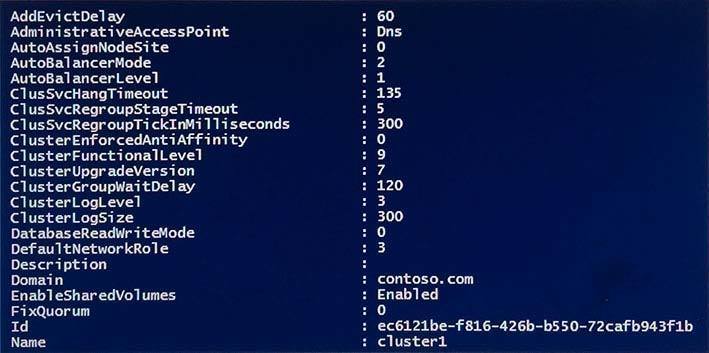
- A
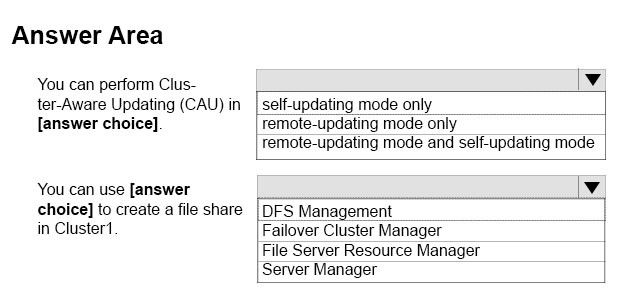
- BRemote-updating mode only
Failover Cluster Manager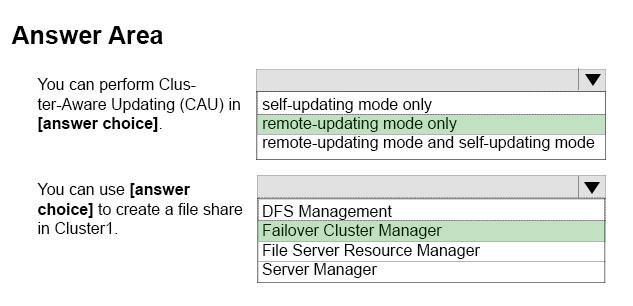
- A
19Question #19
You have a Windows Server 2016 Hyper-V failover cluster that contains two nodes named Node1 and Node2.
On Node1, you create a virtual machine named VM01 by using Hyper-V Manager.
You need to configure VM01 to move to Node2 automatically if Node1 becomes unavailable.
What should you do?- AFrom Failover Cluster Manager, run Configure Role actions.
- BFrom Hyper-V Manager, click VM01, and click Enable Replication.
- CFrom Hyper-V Manager, click Node1, and then modify the Hyper-V settings.
- DFrom Windows PowerShell, run the Enable-VMReplicationcmdlet.
20Question #20
Your network contains three Hyper-V hosts. You add all of the hosts to a cluster.
You need to create highly available storage spaces that connect to directly attached storage on the hosts.
Which cmdlet should you use?- AAdd-ClusterDisk
- BEnable-ClusterStorageSpacesDirect
- CUpdate-ClusterVirtualMachineConfiguration
- DSet-StoragePool
21Question #21
You have four servers named Server1, Server2, Server3, and Server4 that run Windows Server 2016. Each server has a single 4-TB SATA hard disk.
To each server you attach a new 4-TB SATA hard disk.
You need to create a new storage cluster that uses Storage Spaces Direct. The storage pool must contain all of the new disks.
Which command should you run before you enable Storage Space Direct?- AAdd-ClusterSharedVolume ""Name "Disk 1" ""Cluster Cluster1
- BNew-Cluster ""Name Cluster1 ""Node "˜Server1', "˜Server2', "˜Server3', "˜Server4' -NoStorage
- CGet-ClusterAvailableDisk ""Cluster Cluster1 | Add-ClusterDisk
- DNew-ClusterStorageEnclosure ""id 1 ""name Cluster1 ""type jbod ""ConnectionString "Server1,Server2,Server3,Server4"
22Question #22
HOTSPOT -
Your network contains an Active Directory domain named contoso.com. The domain contains four servers named Server1, Server2, Server3, and Server4 that run
Windows Server 2016.
Server1 and Server2 are nodes in a Hyper-V cluster named Cluster1. You have a highly available virtual machine named VM1. Server1 is the owner node of VM1.
Server3 and Server4 are nodes of a scale-out file server named Cluster2.
The storage on Server1 is configured as shown in the following table.
VM1 is stored in C:\ClusterStorage\Volume1.
You need to move the virtual disk of VM1 to a different location.
What should you do? To answer, select the appropriate options in the answer area.
Hot Area: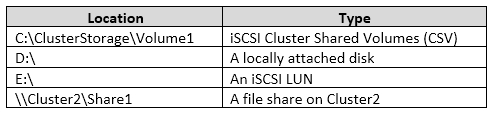
- A
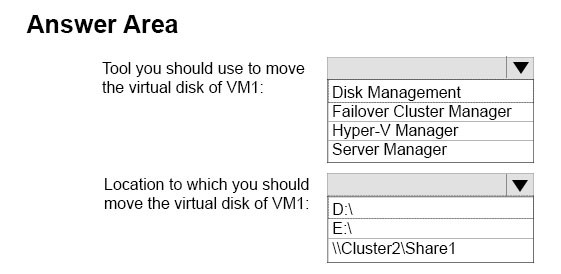
- BThe first option is Failover Cluster Manager.
The second optiom is right: \\Cluster2\Share1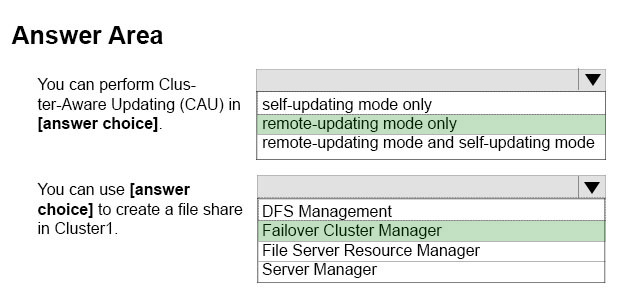
- A
23Question #23
DRAG DROP -
Note: This question is part of a series of questions that use the same scenario. For your convenience, the scenario is repeated in each question. Each question presents a different goal and answer choices, but the text of the scenario is exactly the same in each question in this series.
Your network contains an Active Directory domain named contoso.com. The functional level of the forest and the domain is Windows Server 2008 R2. All servers in the domain run Windows Server 2016 Standard. The domain contains 300 client computers that run either Windows 8.1 or Windows 10.
The domain contains nine servers that are configured as shown in the following table.
The virtual machines are configured as follows:
- Each virtual machine has one virtual network adapter.
- VM1 and VM2 are part of a Network Load Balancing (NLB) cluster.
- All of the servers on the network can communicate with all of the virtual machines.
On Server4, you plan to provision a new volume that will be used to create large, fixed-size VHDX files.
Which type of file system should you use for the new volume to minimize the amount of time required to create the VHDX files?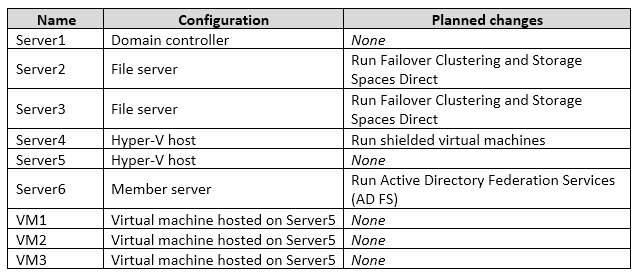
- A
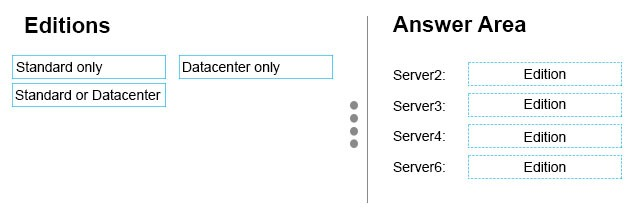
- B3x Datacenter Only, Standard ou Datacenter
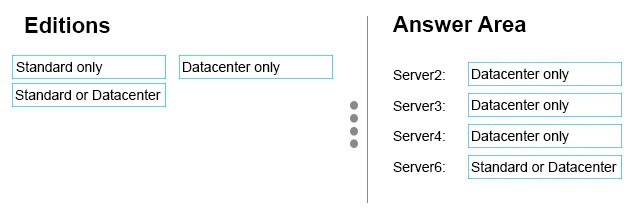
- A
24Question #24
Note: This question is part of a series of questions that use the same scenario. For your convenience, the scenario is repeated in each question. Each question presents a different goal and answer choices, but the text of the scenario is exactly the same in each question in this series.
Your network contains an Active Directory domain named contoso.com. The functional level of the forest and the domain is Windows Server 2008 R2. All servers in the domain run Windows Server 2016 Standard. The domain contains 300 client computers that run either Windows 8.1 or Windows 10.
The domain contains nine servers that are configured as shown in the following table.
The virtual machines are configured as follows:
- Each virtual machine has one virtual network adapter.
- VM1 and VM2 are part of a Network Load Balancing (NLB) cluster.
- All of the servers on the network can communicate with all of the virtual machines.
On Server4, you plan to provision a new volume that will be used to create large, fixed-size VHDX files.
Which type of file system should you use for the new volume to minimize the amount of time required to create the VHDX files?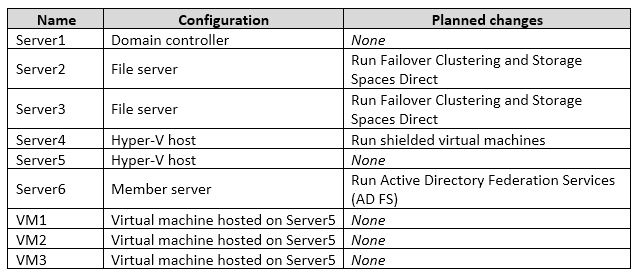
- AReFS
- BNTFS
- CCSVFS
- DexFAT
25Question #25
Your network contains an Active Directory domain named contoso.com. The functional level of the forest and the domain is Windows Server 2008 R2. All servers in the domain run Windows Server 2016 Standard. The domain contains 300 client computers that run either Windows 8.1 or Windows 10.
The domain contains nine servers that are configured as shown in the following table.
The virtual machines are configured as follows:
- Each virtual machine has one virtual network adapter.
- VM1 and VM2 are part of a Network Load Balancing (NLB) cluster.
- All of the servers on the network can communicate with all of the virtual machines.
You need to minimize the likelihood that a virtual machine running malicious code will consume excessive resources on Server5.
What should you do?- AA. Configure the virtual machines as shielded virtual machines.
- BRun the Set-VMProcessor cmdlet and specify the EnableHostResourceProtection parameter.
- CRun the Set-VMProcessor cmdlet and specify the MaximumCountPerNumaNode parameter.
- DConfigure VM Network Adapter Isolation.
26Question #26
Note: This question is part of a series of questions that use the same or similar answer choices. An answer choice may be correct for more than one question in the series. Each question is independent of the other questions in this series. Information and details provided in a question apply only to that question.
You have a Hyper-V host named Server1 that runs Windows Server 2016. Server1 has a dynamically expanding virtual hard disk (VHD) file that is 900 GB. The
VHD contains 400 GB of free space.
You need to reduce the amount of disk space used by the VHD.
What should you run?- Athe Mount-VHD cmdlet
- Bthe Diskpart command
- Cthe Set-VHD cmdlet
- Dthe Set-VM cmdlet
- Ethe Set-VMHost cmdlet
- Fthe Set-VMProcessor cmdlet
- Gthe Install-WindowsFeature cmdlet
- Hthe Optimize-VHD cmdlet
27Question #27
Note: This question is part of a series of questions that use the same or similar answer choices. An answer choice may be correct for more than one question in the series. Each question is independent of the other questions in this series. Information and details provided in a question apply only to that question.
You have a Hyper-V host named Server1 that runs Windows Server 2016. Server1 contains a virtual machine named VM1.
You need to ensure that you can use nested virtualization on VM1.
What should you run on Server1?- Athe Mount-VHD cmdlet
- Bthe Diskpart command
- Cthe Set-VHD cmdlet
- Dthe Set-VM cmdlet
- Ethe Set-VMHost cmdlet
- Fthe Set-VMProcessor cmdlet
- Gthe Install-WindowsFeature cmdlet
- Hthe Optimize-VHD cmdlet
28Question #28
Note: This question is part of a series of questions that use the same or similar answer choices. An answer choice may be correct for more than one question in the series. Each question is independent of the other questions in this series. Information and details provided in a question apply only to that question.
You have a Hyper-V host named Server1 that runs Windows Server 2016. Server1 has a virtual machine named VM1 that uses a single VHDX file. VM1 is configured as shown in the following table.
You plan to use VM1 as a virtual Machine Template to deploy shielded virtual machines.
You need to ensure that VM1 can be used to deploy shielded virtual machines.
What should you run?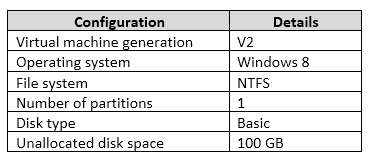
- Athe Mount-VHD cmdlet
- Bthe Diskpart command
- Cthe Set-VHD cmdlet
- Dthe Set-VM cmdlet
- Ethe Set-VMHost cmdlet
- Fthe Set-VMProcessor cmdlet
- Gthe Install-WindowsFeature cmdlet
- Hthe Optimize-VHD cmdlet
29Question #29
Note: This question is part of a series of questions that use the same scenario. For your convenience, the scenario is repeated in each question. Each question presents a different goal and answer choices, but the text of the scenario is exactly the same in each question in this series.
A company named Contoso, Ltd. has several servers that run Windows Server 2016. Contoso has a Hyper-V environment that uses failover clustering and
Windows Server Update Services (WSUS). The environment contains several Windows containers and several virtual machines.
The WSUS deployment contains one upstream server that is located on the company's perimeter network and several downstream servers located on the internal network. A firewall separates the upstream server from the downstream servers.
You plan to deploy a human resources application to a new server named HRServer5. HRServer5 contains a FAT32-formatted data volume.
The CIO of Contoso identifies the following requirements for the company's IT department:
- Deploy a failover cluster to two new virtual machines.
- Store all application databases by using Encrypted File System (EFS).
- Ensure that each Windows container has a dedicated IP address assigned by a DHCP server.
- Produce a report that lists the processor time used by all of the processes on a server named Server1 for five hours.
- Encrypt all communication between the internal network and the perimeter network, including all WSUS communications.
- Automatically load balance the virtual machines hosted in the Hyper-V cluster when processor utilization exceeds 70 percent.
You need to modify the Hyper-V cluster to meet the load balancing requirement for the virtual machine.
Which command should you run?- A(Get-ClusterParameter).AutoBalancerMode=2
- B(Get-Cluster).AutoBalancerMode=2
- C(Get-ClusterParameter).AutoBalancerLevel=2
- D(Get-Cluster).AutoBalancerLevel=2
30Question #30
Note: This question is part of a series of questions that use the same scenario. For your convenience, the scenario is repeated in each question. Each question presents a different goal and answer choices, but the text of the scenario is exactly the same in each question in this series.
A company named Contoso, Ltd. has several servers that run Windows Server 2016. Contoso has a Hyper-V environment that uses failover clustering and
Windows Server Update Services (WSUS). The environment contains several Windows containers and several virtual machines.
The WSUS deployment contains one upstream server that is located on the company's perimeter network and several downstream servers located on the internal network. A firewall separates the upstream server from the downstream servers.
You plan to deploy a human resources application to a new server named HRServer5. HRServer5 contains a FAT32-formatted data volume.
The CIO of Contoso identifies the following requirements for the company's IT department:
- Deploy a failover cluster to two new virtual machines.
- Store all application databases by using Encrypted File System (EFS).
- Ensure that each Windows container has a dedicated IP address assigned by a DHCP server.
- Produce a report that lists the processor time used by all of the processes on a server named Server1 for five hours.
- Encrypt all communication between the internal network and the perimeter network, including all WSUS communications.
- Automatically load balance the virtual machines hosted in the Hyper-V cluster when processor utilization exceeds 70 percent.
What should you do to prepare the data volume on HRServer5 to store the databases required for the human resources application?- AFormat the data volume by using ReFS.
- BEnable Trusted Platform Module (TPM) on HRServer5.
- CFormat the data volume by using NTFS.
- DEnable BitLocker Drive Encryption (BitLocker) on the data volume.
31Question #31
HOTSPOT -
Note: This question is part of a series of questions that use the same scenario. For your convenience, the scenario is repeated in each question. Each question presents a different goal and answer choices, but the text of the scenario is exactly the same in each question in this series.
A company named Contoso, Ltd. has several servers that run Windows Server 2016. Contoso has a Hyper-V environment that uses failover clustering and
Windows Server Update Services (WSUS). The environment contains several Windows containers and several virtual machines.
The WSUS deployment contains one upstream server that is located on the company's perimeter network and several downstream servers located on the internal network. A firewall separates the upstream server from the downstream servers.
You plan to deploy a human resources application to a new server named HRServer5. HRServer5 contains a FAT32-formatted data volume.
The CIO of Contoso identifies the following requirements for the company's IT department:
- Deploy a failover cluster to two new virtual machines.
- Store all application databases by using Encrypted File System (EFS).
- Ensure that each Windows container has a dedicated IP address assigned by a DHCP server.
- Produce a report that lists the processor time used by all of the processes on a server named Server1 for five hours.
- Encrypt all communication between the internal network and the perimeter network, including all WSUS communications.
- Automatically load balance the virtual machines hosted in the Hyper-V cluster when processor utilization exceeds 70 percent.
You need to create a Data Collector Set to meet the requirement for the processor time report.
What command should you run to create the Data Collector Set? To answer, select the appropriate options in the answer area.
Hot Area:- A

- B

- A
32Question #32
Your network contains a new Active Directory domain named contoso.com.
You have a security policy that states that new servers should run Nano Server whenever possible.
Which server role can be deployed on a Nano Server?- AActive Directory Domain Services
- BDHCP Server
- CNetwork Policy and Access Services
- DWeb Server (IIS)
- ERemote Desktop Services
- FWindows Server Update Services
33Question #33
You have a server named Server1 that runs Windows Server 2016.
The Windows Server 2016 installation media is mounted as drive D.
You copy the NanoServerImageGenerator folder from the D:\NanoServer folder to the C:\NanoServer folder.
You need to create a custom Nano Server image that includes the Hyper-V server role. The image will be used to deploy Nano Servers to physical servers.
Which two commands should you run? Each correct answer presents part of the solution.- ANew-NanoServerImage ""Edition Standard ""DeploymentType Guest ""MediaPath D:\ -TargetPath .\NanoServerImage\NanoServer.wim ""Compute
- BInstall-PackageProvider NanoServerPackage
- CImport-PackageProvider NanoServerPackage
- DNew-NanoServerImage ""Edition Standard ""DeploymentType Host ""MediaPath D:\ -TargetPath .\NanoServerImage\NanoServer.wim ""Compute
- EImport-Module C:\NanoServer\NanoServerImageGenerator
34Question #34
DRAG DROP -
You have a network that contains several servers that run Windows Server 2016.
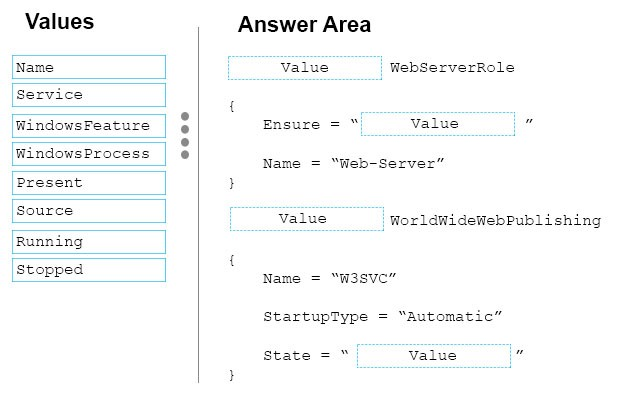
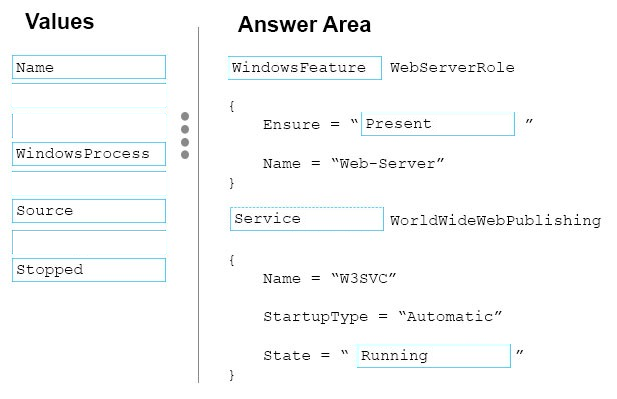
You need to use Desired State Configuration (DSC) to configure the servers to meet the following requirements:
- Install the Web Server server role
- Start the World Wide Web Publishing service.
How should you configure the DSC resources? To answer, drag the appropriate values to the correct locations. Each value may be used once, more than once, or not at all. You may need to drag the split bar between panes or scroll to view content.
Select and Place:- A
- B
- A
35Question #35
You have a server named Server1 that runs Windows Server 2016.
You need to install the DNS Server role on Server1.
What should you run?- Athe Install-Package cmdlet
- Bthe Add-WindowsPackage cmdlet
- Cthe Install-WindowsFeature cmdlet
- Dthe setup.exe command
36Question #36
You have a server named Server1 that runs Windows Server 2016.
Server1 has Internet connectivity.
You have a Nano Server image.
You need to download and save a Nano Server package in the Nano Server image. The package is NOT included in the Windows Server 2016 installation media.
Which two cmdlets should you run on Server1? Each correct answer presents part of the solution.- ASet-PackageSource
- BInstall-PackageProvider
- CAdd-AppxProvisionedPackage
- DSave-NanoServerPackage
- EAdd-WindowsPackage
37Question #37
You have a server named Server1 that runs Windows Server 2016 and has the Hyper-V server role installed.
On server1, you plan to create a virtual machine named VM1.
You need to ensure that you can start VM1 from the network.
What are two possible ways to achieve the goal? Each correct answer presents a complete solution.- ACreate a generation 2 virtual machine.
- BCreate a generation 1 virtual machine and run the Enable-NetAdapterPackageDirectcmdlet.
- CCreate a generation 1 virtual machine that has a legacy network adapter.
- DCreate a generation 1 virtual machine and configure a single root I/O virtualization (SRV-IO) interface for the network adapter.
38Question #38
HOTSPOT -
You have a server named Server1 that runs Windows Server 2016 and has the Hyper-V server role installed.
You open Disk Management on Server1 as shown in the following graphic.
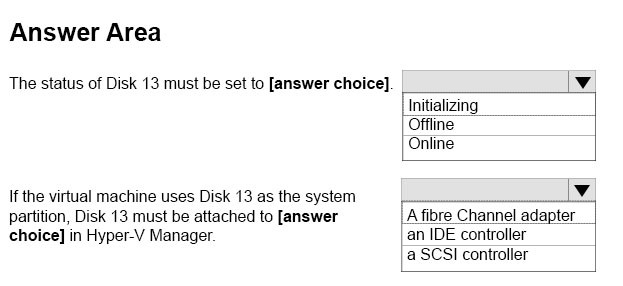
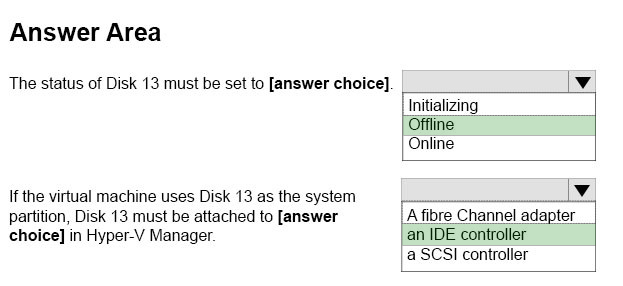
You plan to configure Disk 13 as a pass-through disk for a generation 1 virtual machine.
Use the drop-down menus to select the answer choice that completes each statement based on the information presented in the graphic.
Hot Area: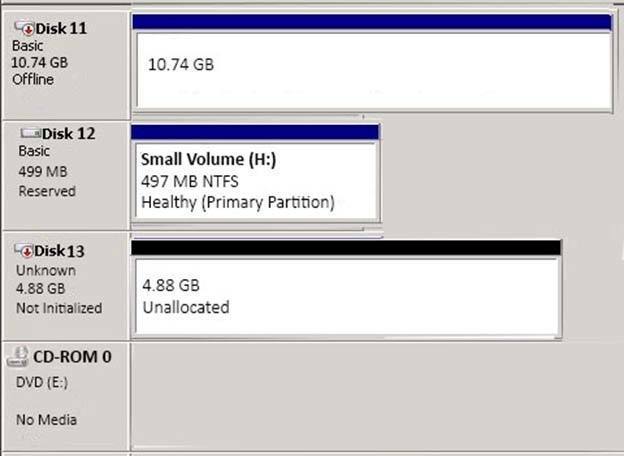
- A
- B
- A
39Question #39
HOTSPOT -
You have a Hyper-V host that runs Windows Server 2016. The Hyper-V host has a virtual machine named VM1.
You have a VHD named VHD1.vhdx that has a generalized image of Windows Server 2016.
You plan to create multiple virtual machines that will use the generalized image.
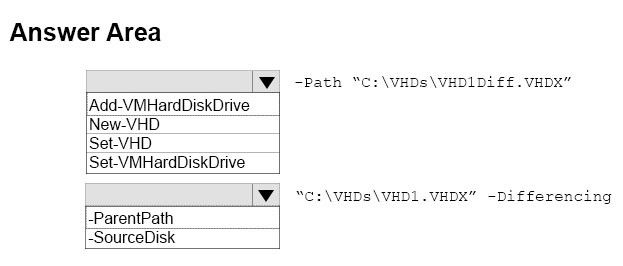
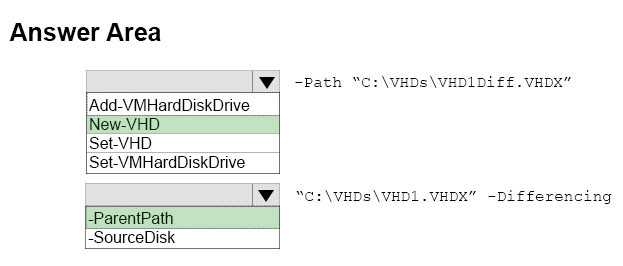
You need to create differencing disks based on VHD1.vhdx.
What command should you run? To answer, select the appropriate options in the answer area.
Hot Area:- A
- B
- A
40Question #40
You have a Hyper-V host that runs Windows Server 2016. The host contains a virtual machine named VM1. VM1 has resource metering enabled.
You need to use resource metering to track the amount of network traffic that VM1 sends to the 10.0.0.0/8 network.
Which cmdlet should you run?- AAdd-VMNetworkAdapterAcl
- BSet-VMNetworkAdapter
- CNew-VMResourcePool
- DSet-VMNetworkAdapterRoutingDomainMapping
41Question #41
DRAG DROP -
Your network contains two Hyper-V servers named Server1 and Server2. Server1 has Windows Server 2012 R2 installed. Server2 has Windows Server 2016 installed.
You perform a live migration of a virtual machine named VM1 from Server1 to Server2.
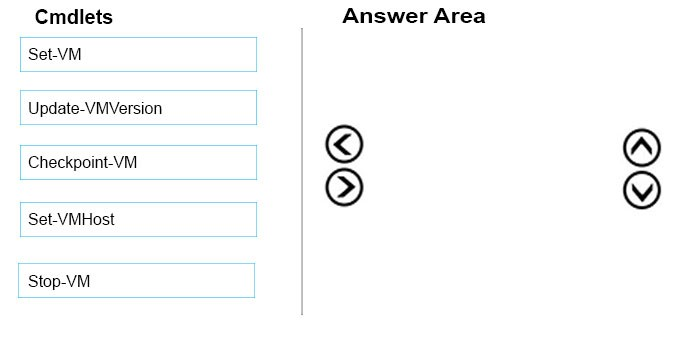
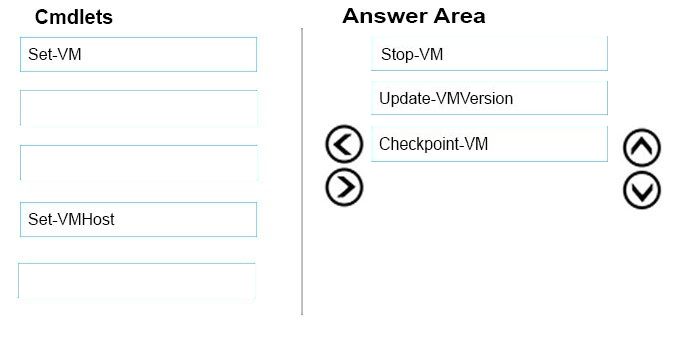
You need to create a production checkpoint for VM1 on Server2.
Which three Windows PowerShell cmdlets should you run in sequence? To answer, move the appropriate Windows PowerShell cmdlets from the list of actions to the answer area and arrange them in the correct order.
Select and Place:- A
- B
- A
42Question #42
You have a Hyper-V host named Server1 that runs Windows Server 2016. Server1 has two virtual machines named VM1 and VM2.
You discover that VM1 and VM2 can communicate with Server1 over the network.
You need to ensure that VM1 and VM2 can communicate with each other only. The solution must prevent VM1 and VM2 from communicating with Server1.
Which cmdlet should you use?- ASet-VMSwitch
- BEnable-VMSwitchExtension
- CSet-NetNeighbor
- DRemove-VMSwitchTeamMember
43Question #43
DRAG DROP -
You are planning the configuration of a virtual network switch for a Hyper-V environment. The environment will contain the following Hyper-V hosts:
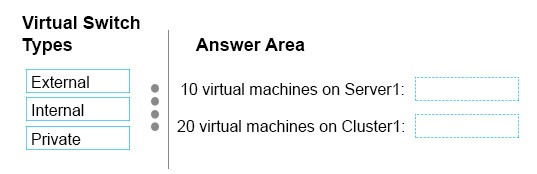
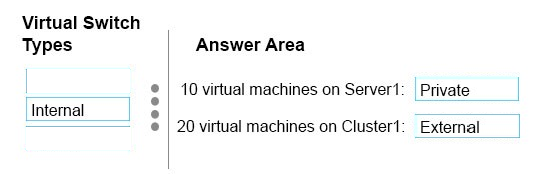
- A server named Server1 will have 10 virtual machines that must be able to communicate with each other. The virtual machines must be prevented from communicating with Server1 and all other servers on the corporate network.
- A two-node failover cluster named Cluster1 will have 20 virtual machines. The virtual machines will run on both nodes. Hyper-V hosts on the corporate network must be able to connect to the virtual machines.
Which type of virtual switch should you select for each Hyper-V host? To answer, drag the appropriate virtual switch types to the correct hosts. Each virtual switch type must be used once, more than once, or not at all. You may need to drag the split bar between panes or scroll to view content.
Select and Place:- A
- B
- A
44Question #44
You have a Hyper-V host named Server1 that runs Windows Server 2016. Server1 contains four virtual machines that are configured as shown in the following table.
To which virtual machine or machines can you connect by using Virtual Machine Connection from Hyper-V Manager?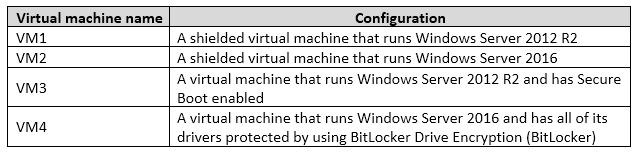
- AVM1, VM2, VM3, and VM4
- BVM4 only
- CVM1 and VM2 only
- DVM3 and VM4 only
- EVM2 only
45Question #45
Note: This question is part of a series of questions that use the same or similar answer choices. An answer choice may be correct for more than one question in the series. Each question is independent of the other questions in this series. Information and details provided in a question apply only to that question.
You have a two-node Hyper-V cluster named Cluster1 at a primary location and a stand-alone Hyper-V host named Server1 at a secondary location.
A virtual machine named VM1 runs on Cluster1.
You configure a Hyper-V Replica of VM1 to Server1.
You need to perform a Test Failover of VM1.
Which tool should you use?- Athe clussvc.exe command
- Bthe cluster.exe command
- Cthe Computer Management snap-in
- Dthe configurehyperv.exe command
- Ethe Disk Management snap-in
- Fthe Failover Cluster Manager snap-in
- Gthe Hyper-V Manager snap-in
- Hthe Server Manager app
46Question #46
Note: This question is part of a series of questions that use the same or similar answer choices. An answer choice may be correct for more than one question in the series. Each question is independent of the other questions in this series. Information and details provided in a question apply only to that question.
You have three servers named Server1, Server2, and Server3 that run Windows Server 2016.
The servers are configured only with the components listed in the table below:
You need to create a Hyper-V cluster.
Which tool should you use first?- Athe clussvc.exe command
- Bthe cluster.exe command
- Cthe Computer Management snap-in
- Dthe configurehyperv.exe command
- Ethe Disk Management snap-in
- Fthe Failover Cluster Manager snap-in
- Gthe Hyper-V Manager snap-in
- Hthe Server Manager app
47Question #47
Note: This question is part of a series of questions that use the same or similar answer choices. An answer choice may be correct for more than one question in the series. Each question is independent of the other questions in this series. Information and details provided in a question apply only to that question.
You have a Hyper-V host named Server1 that runs Windows Server 2016 and a two-node scale-out file server cluster named Cluster1.
A virtual machine named VM1 runs on Server1.
You need to migrate the storage on VM1 to Cluster1.
Which tool should you use?- Athe clussvc.exe command
- Bthe cluster.exe command
- Cthe Computer Management snap-in
- Dthe configurehyperv.exe command
- Ethe Disk Management snap-in
- Fthe Failover Cluster Manager snap-in
- Gthe Hyper-V Manager snap-in
- Hthe Server Manager app
48Question #48
You have a Nano Server named Nano1. Which cmdlet should you use to identify whether the DNS Server role is installed on Nano1?- AFind-NanoServerPackage
- BGet-Package
- CFind-Package
- DGet-WindowsOptionalFeature
49Question #49
Note: In this section, you'll see one or more sets of questions with the same scenario and problem. Each question presents a unique solution to the problem, and you must determine whether the solution meets the stated goals. Any of the solutions might solve the problem. It is also possible that none of the solutions solve the problem.
Once you answer a question in this section, you will NOT be able to return to it. As a result these questions will not appear in the review screen.
Note: This question is part of a series of questions that present the same scenario. Each question in the series contains a unique solution. Determine whether the solution meets the stated goals.
Your network contains an Active Directory forest named contoso.com. The forest contains a member server named Server1 that runs Windows Server 2016. All domain controllers run Windows Server 2012 R2. Contoso com has the following configuration:
You plan to deploy an Active Directory Federation Services (AD FS) farm on Server1 and to configure device registration. You need to configure Active Directory to support the planned deployment.
Solution: You raise the domain functional level to Windows Server 2012 R2.
Does this meet the goal?
- AYes
- BNo
50Question #50
You are configuring a Windows Server 2016 failover cluster in a workgroup. Before installing one of the nodes, you run the ipconfig /all command and receive the following output:
You need to ensure that Server1 can be added as a node in the cluster. What should you do?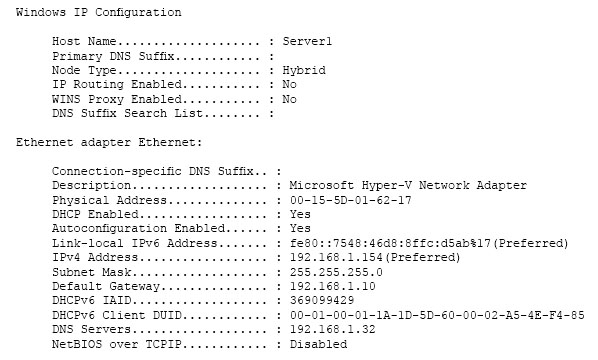
- AAssign a static IP address
- BChange the Node Type to Broadcast
- CConfigure a DNS suffix
- DEnable NetBIOS over TCP/IP
Informationen
- Beschreibung
- Simulado do exame em ingles para realização da certificação do windows server 2016 MCSA e MCSE.
- Autor
- gabriel ribeiro
- Sprache
- Português
- Aufrufe
- 161
- Schlagwörter
- Bewertung
- Noch keine Bewertungen Bewerte dieses Quiz