
Quiz
ACC 301: Chapter 6 (theory)
Dieses Quiz enthält Fragetypen, die sich im gewohnten Player öffnen.
Fragen in diesem Quiz (45)
1Which of the following items may be confused with cash but is normally categorized under a different balance sheet caption (not categorized as cash)?
- AForeign currency on deposit in a foreign bank.
- BUn-deposited credit card sales receipts.
- CPostdated checks.
- DNegotiable checks.
2The definition of cash equivalents includes:
I. available to pay current obligations
II. short-term, highly liquid investments
III. so near maturity that there is little risk of changes in value because of changes in interest rates- AI and II.
- BII and III.
- CI, II, and III.
- DI and III.
3Which of the following is an important element of internal control over cash?
- AThey are required for all companies.
- BThey include a petty cash system.
- CThey guarantee that a company's financial reports are reliable.
- DAll of the choices are correct regarding internal controls.
4Non-trade receivables include [blank_start]deposits with utilities[blank_end] while trade receivables include [blank_start]accounts receivable[blank_end].
- Adeposits with utilities
- Bnotes receivable
- Caccounts receivable
- Daccounts receivable
- Eadvances to employees
- Floans made by nonfinancial companies
5Revenue recognition criteria include [blank_start]realization must have occurred[blank_end] and [blank_start]must be earned[blank_end] which result in revenue generally being recognized when [blank_start]the product or service is delivered[blank_end].
- Arealization must have occurred
- Breadily available for general use
- Cmust be earned
- Dnot bound by any restrictions
- Ethe product or service is delivered
- Fall defective items have been returned
6Cash (sales) discounts [blank_start]induce prompt payment[blank_end] and are recorded using either the gross price method or the net price method.
- Ainduce prompt payment
- Bare price reductions for large purchases
- Chide real prices from competitors
7When a company records accounts receivable using the gross price method and the customer pays and takes advantage of the discount, which of the following is true?
- AThe company records accounts receivable and sales at the net invoice price and no further adjustment is required.
- BNo adjustment is needed because the amount of cash received is equal to the recorded amount of the receivable.
- CThe company credits an account entitled Sales Discounts Not Taken.
- DThe difference between the cash received and the original amount of accounts receivable is recorded as a debit to Sales Discounts Taken.
8A [blank_start]sales allowance[blank_end] occurs when a customer retains defective goods; conceptually, the company should estimate and record in the period of sale so as to properly report sales revenue and ending accounts receivable.
- Asales allowance
- Bcash discount
- Csales return
9Which of the following statements is correct with regard to the direct write-off method?
I. Allows the manipulation of income.
II. Is simple to apply.- AI only.
- BII only.
- CI and II
- DNeither I nor II
10Using the [blank_start]% of outstanding accounts receivable[blank_end] approach, a company considers the existing balance in the allowance account and records bad debt expense as the amount necessary to adjust the allowance to its desired balance.
- A% of outstanding accounts receivable
- Bdirect write-off
- C% of credit sales
11The net realizable value of a company's accounts receivable is the balance of the accounts receivable account
I. Plus the allowance for sales returns
II. Minus the allowance for doubtful accounts
III. Plus deferred gross profit
IV. Minus allowance for sales discounts- AI, II, and III
- BII and IV
- CII, III, and IV
- DI, II, III, and IV
12What method of bad debt estimation categorizes individual accounts receivable based on the length of time outstanding? Why is this length of time an important factor?
- AAging is based on the fact that credit risk tends to decrease with the age of the account receivable.
- BA company that "ages" its accounts receivable first classifies the individual accounts receivable based on the length of time they have been outstanding and then estimates the allowance for bad debts by applying appropriate bad debts percentages to each age category.
- CAging is a relatively simple balance sheet approach which bases the estimated expense on the historical relationship between the actual bad debts and the outstanding accounts receivable balance at the end of the year.
- DAll of the choices are correct regarding aging of accounts receivable.
13When accounts receivable are sold or factored
- Athe transaction is accounted for as a lending agreement.
- Bthe transferor records a gain or loss.
- Cthe creditor can require the amounts collected from the accounts receivable be used to repay the amount owed.
- Dthe proceeds from the transfer of financial assets are recorded as a liability.
14Accounts receivable are considered sold when
I. the transferred assets are put beyond the reach of the transferor.
II. the transferee has the right to sell the transferred assets.
III. the transferee has recourse against the transferor.
IV. the transferor does not maintain effective control over the transferred assets.- AI, II, III, and IV.
- BI, III, and IV.
- CI, II, and III.
- DI, II, and IV
15Unlike accounts receivable, notes receivable [blank_start]are negotiable[blank_end] and usually [blank_start]involve interest[blank_end].
- Aare negotiable
- Barise from the company's operations
- Cinvolve interest
- Dare grouped as trade or nontrade in the
16Sally Company accepted a 3-month, non-interest-bearing note receivable on December 1. If Sally's year end is December 31, what entry would be recorded
- Adebit Cash and credit Interest Revenue.
- Bdebit Interest Expense and credit Cash.
- Cdebit Discount on Note Receivable and credit Interest Revenue.
- Ddebit Interest Expense and credit Discount on Note Receivable.
17If a note is [blank_start]transferred with recourse[blank_end], the company reports a(n) [blank_start]liability[blank_end] at the estimated amount it would have to pay the buyer.
- Atransferred with recourse
- Bassigned
- Cliability
- Dexpense
18When a note receivable is transferred, the cash proceeds equal the [blank_start]maturity value[blank_end] of the note [blank_start]less[blank_end] a discount. The discount is determined by multiplying the discount rate times the [blank_start]maturity value of the note[blank_end] for the discount period.
- Amaturity value
- Bpresent value
- Cless
- Dplus
- Ematurity value of the note
- Fpresent value of the note
- Gface value of the note less total intere
19When financial assets are transferred, U.S. GAAP focuses on whether [blank_start]control has been surrendered[blank_end] in determining whether the transfer is accounted for as a secured borrowing or a sale. Under IFRS, the derecognition of a financial asset is based on whether the seller has transferred substantially all the risks and rewards of ownership.
- Acontrol has been surrendered
- Ban accounting mismatch arises
- Cthe seller has transferred risk/rewards
20Which of the following transactions would not be appropriate for the use of a petty cash system?
- APaying for postage.
- BPaying cab fare home for late-working employees.
- CPaying for NSF checks.
- DPaying for small amounts of office supplies.
21Why are actual expenses, rather than the petty cash account, debited when the fund is replenished?
- ABecause the entry records the expenses incurred for the period.
- BBecause this process provides an external, independent control to verify a company's cash balance.
- CBecause the petty cash fund is always carried in the company's accounting records at its current remaining balance.
- DAll of the choices are correct regarding the petty cash account.
22Differences between the cash balance listed on a company's bank statement and the balance shown in the company's cash account include all of the following except:
- AOutstanding checks.
- BBank service charge expense.
- CRecourse liability expense.
- DDeposits in transit.
23Which of the following items appearing on a bank reconciliation would require the company to make an adjusting entry?
- ABank service charge.
- BDeposit in transit
- COutstanding checks.
- DAll of the choices would require an adjusting entry.
24Which of the following items should be classified under the heading of cash on the balance sheet?
- A
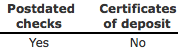
- B
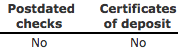
- C
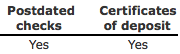
- D
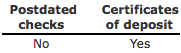
- A
25Greenfield Company had the following cash balances at December 31, 2016:
- Cash in banks: $1,300,000
- Petty cash funds (all funds were reimbursed on December 31, 2016): 20,000
- Cash legally restricted for additions to plant (expected to be disbursed in 2018): 2,000,000
Cash in banks includes $300,000 of compensating balances against short-term borrowing arrangements at December 31, 2016. The compensating balances are not legally restricted as to withdrawal by Greenfield.
In the current assets section of Greenfield's December 31, 2016, balance sheet, what total amount should be reported as cash?- A$3,020,000
- B$1,320,000
- C$3,320,000
- D$1,020,000
26Cash on hand is [blank_start]included in[blank_end] cash on the company's balance sheet.
Checking account is [blank_start]included in[blank_end] cash on the company's balance sheet.
Sinking fund is [blank_start]excluded from[blank_end] cash on the company's balance sheet.
Savings account is [blank_start]included in[blank_end] cash on the company's balance sheet.
Certificates of deposit is [blank_start]excluded from[blank_end] cash on the company's balance sheet.
Negotiable checks is [blank_start]included in[blank_end] cash on the company's balance sheet.
Compensating balance is [blank_start]excluded from[blank_end] cash on the company's balance sheet.
Travel advance is [blank_start]excluded from[blank_end] cash on the company's balance sheet.
Deposits in a foreign bank is [blank_start]included in[blank_end] cash on the company's balance sheet.- Aincluded in
- Bexcluded from
- Cincluded in
- Dexcluded from
- Eexcluded from
- Fincluded in
- Gincluded in
- Hexcluded from
- Iexcluded from
- Jincluded in
- Kincluded in
- Lexcluded from
- Mexcluded from
- Nincluded in
- Oexcluded from
- Pincluded in
- Qincluded in
- Rexcluded from
27Which of the following would not be included with cash and cash equivalents on the balance sheet?
- Aunrestricted funds on deposit.
- Bchecks.
- Csinking funds.
- Dundeposited credit card sales receipts.
28A short-term investment is considered a cash equivalent if it is
- Ahighly liquid.
- Breadily convertible into an unknown amount of cash.
- Cwithin 120 days of maturity.
- Dall of these choices.
29Internal cash control procedures are
- Arequired by law for publicly traded companies.
- Benhanced by routine reviews of the accuracy of recorded cash transactions.
- Cenhanced by the separation of employee duties.
- Dall of these choices.
30All of the following are a cash control over receipts except
- Adaily recording of all cash receipts in the accounting records.
- Bdaily deposit of all receipts in the company’s bank account.
- Cimmediate counting of receipts by the person opening the mail or the salesperson using the cash register, and subsequent verification by an independent person.
- Dmaking all payments by check (or electronic funds transfer) so there is a record for every company expenditure.
31Which of the following would not be classified as a trade receivable?
- Acustomer accounts receivable for the sale of merchandise on account.
- Bshort-term customer note receivable in exchange for merchandise.
- Caccrued interest on investments.
- Dobligations arising from customers for services rendered.
32Which of the following is treated as a cash sale?
- Acredit card sale involving a bank credit card.
- Bcredit card sale involving the store's credit card.
- Csale involving the receipt of a note receivable.
- Dall of these choices.
33When a customer retains defective goods at a reduced price, the reduction is called a
- Asales discount.
- Bsales return.
- Csales allowance.
- Dtrade discount.
34 Using the net price method, which account does not apply when recording the receipt of payment on account after the discount period?
- AAccounts Receivable.
- BCash.
- CSales Discounts Not Taken.
- DSales Revenue.
35Using the gross price method, the journal entry for a sale on account for $10,000 under the terms 2/10, n/30 would include a
- Adebit to Cash for $9,800.
- Bdebit to Accounts Receivable for $10,000.
- Cdebit to Accounts Receivable for $9,800.
- Ddebit to Sales Revenue for $9,800.
36Which of the following is not true of the account Allowance for Doubtful Accounts?
- AIt is an expense account.
- BIt is reported on the balance sheet.
- CIt is debited when writing off an uncollectible account receivable.
- DIts balance is deducted from the balance in Accounts Receivable to determine the net realizable value of the company’s receivables.
37Using the allowance method, which is the proper journal entry for writing off an uncollectible account?
- ADebit Bad Debt Expense; credit Accounts Receivable.
- BDebit Bad Debt Expense; credit Allowance for Doubtful Accounts.
- CDebit Allowance for Doubtful Accounts; credit Accounts Receivable.
- DDebit Accounts Receivable; credit Allowance for Doubtful Accounts.
38Which of the following is not true of the direct write-off method?
- AIt is the preferred method under GAAP.
- BBad debt expense is recorded only when a specific customer account is determined uncollectible.
- CIt matches bad debts of previous sales against current sales.
- DAn uncollectible account is written off by debiting Bad Debt Expense and crediting Accounts Receivable.
39If the transfer of receivables does not meet the conditions of a sale, it should be accounted for as
- Asecured borrowing.
- Bfactoring.
- Ca securitization.
- Da sale with recourse.
40If Gable Company sells $50,000 of its accounts receivable to a factor without recourse, receiving 90% value and paying a 10% commission, the journal entry will include
- Aa debit to Cash for $40,000.
- Ba debit to Receivable from Factor for $5,000.
- Ca debit to Factoring Expense for $5,000.
- Dall of these
41A retailer made $2,000 of bank credit card sales and is charged a 4% fee when depositing the receipts. Assuming it uses the gross price method of recording sales, the entry will include
- Aa debit to Cash for $2,000.
a credit to Sales Revenue for $1,920. - Ba debit to Credit Card Expense for $80.
- Cnone of these
- Aa debit to Cash for $2,000.
42Which of the following are true of a note receivable?
- AA note receivable gives the holder the right to collect money on demand.
- BA note receivable is not a negotiable instrument.
- CA note receivable usually does not involve interest.
- DNone of these choices are true of a note receivable
43The journal entry for the collection of a $10,000, 90-day, 10% note receivable would include
- Aa debit to Cash for $10,000.
- Ba credit to Notes Receivable for $9,750.
- Ca credit to Interest Revenue for $250.
- Da debit to Interest Expense for $250.
44A petty cash fund is established for $300. At the end of the accounting period, there is $50 cash and $245 in petty cash vouchers. The journal entry to replenish the fund will include
- Aa debit to Petty Cash for $250.
- Ba credit to Cash for $250.
- Ca debit to various expenses for $245.
- Da credit to Cash Short and Over for $5.
45On a bank reconciliation, which of the following would be deducted from the bank statement balance?
- Adeposits in transit.
- Boutstanding checks.
- Cbank service charges.
- Da note collected by the bank.
Informationen
- Beschreibung
- yo
- Autor
- jmkerstell
- Sprache
- English
- Aufrufe
- 238
- Schlagwörter
- Bewertung
- Noch keine Bewertungen Bewerte dieses Quiz