
Quiz
Internetworking Basics
Fragen in diesem Quiz (44)
1Network Segmentation is the breaking up of a large network into smaller networks.
- ARichtig
- BFalsch
2What causes LAN traffic on the network (Choose three)
- AToo many hosts in a broadcast or collision domains.
- BBroadcast storms.
- CHigh network bandwidth.
- DAdding hubs for connectivity to the network.
3What functions does routers provide?
- AThey break up broadcast domains.
- BRouters do not break up collision domains.
- CRouters provide packet switching and packet filtering.
- DRouters provide internetwork communication.
4The diagram shows a group of networks connected to a router. How many collision domains and broadcast domains totaled?
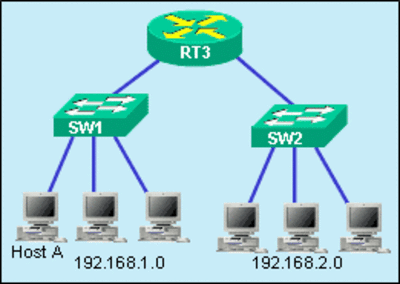
- AThere are 2 broadcast domains and 7 collision domains.
- BThere are 2 broadcast domains and 8 collision domains.
- CThere are 3 broadcast domains and 8 collision domains.
5Bridges are software based and Switches are hardware based (ASICs)
- ARichtig
- BFalsch
6What statements best defined the OSI Model?
- AIt is a hierarchical design and it divides the network communication process into smaller and simpler components thus aiding component development, design and troubleshooting.
- BIt allows multiple-vendor development through standardization of network components and allows various types of network hardware and software to communicate.
- CAny changes in one layer can affect the other layer process.
- DIt prevents changes in one layer from affecting other layers, so it does not hamper development.
7The OSI is not a physical model but rather a blueprint set of guidelines that application developers can use to create and implement applications that run on a network. It also provides a framework for creating and implementing networking standards, devices and internetworking schemes.
- ARichtig
- BFalsch
8The OSI model is divided into two groups, one is the top three upper layers (Application, Presentation, Session) which define how the applications within the end stations will communicate with each other. The bottom four layers (Transport, Network, Data Link, Physical) define how data is transmitted end to end.
- ARichtig
- BFalsch
9What does the application layer's function in the OSI model?
- AProvides Dialog control and keeps different applications' data separate.
- BPresents data and handles processing such as encryption, compression, and translation services.
- CProvides logical addressing which routers use for path determination.
- DProvides a user interface. Also is associated with File, print, message, database, and application services. Applications do not reside in the application layer but rather interfaces with application layer protocols.
10Application layer protocols involve HTTP, FTP, DNS, IMAP, Telnet, SSH, POP, SMTP, SMNP, and LDAP.
- ARichtig
- BFalsch
11What is the function of the Presentation layer?
- AIs responsible for setting up, managing, and then tearing down sessions between Presentation layer entities.
- BIt segments and reassembles data into a data stream It also responsible for providing mechanisms for multiplexing upper layer applications, establishing sessions, and tearing down virtual circuits. Its finally hides details of any network-dependent information from the higher layers by providing transparent data transfer.
- CThe layer presents data to the Application layer and is responsible for data translation and code formatting. Data encryption and compression are additional functions of this layer.
12Since the Presentation layer is essentially a translator and provides coding and conversion functions, an example of this data transfer technique is converting EBCDIC to ASCII format.
- ARichtig
- BFalsch
13In the OSI model what are the functions of the Session layer?
- AThis layer of the OSI Model is where users actually communicate to the computer. Its also responsible for identifying and establishing the availability of the intended communication partner and determining whether sufficient resources for the intended communication exist.
- BThis layer of the OSI Model segments and reassembles data into a data stream. Its also responsible for providing mechanisms for multiplexing upper layer applications, establishing sessions, and tearing down virtual circuits.
- CThis layer of the OSI model is responsible for setting up, managing, and then tearing down sessions between Presentation layer entities. This layer also provides a dialog control between devices or nodes. It coordinates communication between systems by offering three different modes: Simplex, Half Duplex, and Full Duplex. This layer basically keeps different applications' data separate from other applications' data.
14What functions and services does the Transport Layer of the OSI model offer?
- AThis layer manages device addressing, tracks the location of devices on the network, and determines the best way to move data, which means that this layer must transport traffic between devices that are not locally attached.
- BThis layer segments and reassembles data into a data stream. It provides end to end data transport services and can establish a logical connection between the sending host and destination host on an internetwork. Examples are TCP and UDP.
- CThis layer provides the physical transmission of the data and handles error notification, network topology and flow control. It formats the message into pieces each called a data frame.
15Flow control is data integrity maintained at the Transport layer. It prevents a sending host on one side of the connection from overflowing the buffers in the receiving host.
- ARichtig
- BFalsch
16What is connection-oriented communication?
- AIts a connection that guarantees a way to establish communication through certain entities that provide retransmission of data.
- BIts an established session (Virtual Circuit) that is setup from the transmitting sender and receiving host using what is called a three-way-handshake or call setup. Data is then transferred until finished then a call termination takes place to tear down the virtual circuit.
17What is windowing?
- AWindowing controls how information is passed through the network using a transmitting technique that controls data flow.
- BWindows are used to control the amount of outstanding, unacknowledged data segments. The size of the window controls how much data is transferred from one end of the device to the other.
18A feature of Windowing that ensures reliable data segment delivery from the transmitting machine to the receiving machine is called "Positive Acknowledgement with Retransmission". This technique is used by the receiving machine to send acknowledgement message to the sender when it receives data.
- ARichtig
- BFalsch
19During windowing once the sender transmits data segments it sets a timer and waits for the acknowledgment before sending the next round of segments. If the timer expires without an acknowledgement then it retransmits if the timer expires without an acknowledgement from the receiving host.
- ARichtig
- BFalsch
20What best describes the Network layer?
- AThis layer transmits bits into bytes and bytes into frames. It provides the physical transmission of the data and handles error notification, network topology and flow control.
- BThis layer communicates directly with the various types of actual communication media. It specifies the electrical , mechanical , procedural and functioning requirements for activating, maintaining, deactivating a physical link between end systems. This is where you find the DTE and DCE specifications.
- CThis layer manages device addressing, tracks the location of the devices on the network., and determines the best way to move data, which means that the Network layer must transport traffic between devices that aren't locally attached. Two types of packets in this layer are routed protocols and routing protocols.
21What is a routing protocol?
- ARouting protocols are used to transport user data through the internetwork. They are assigned to an interface and determine the method of packet delivery.
Examples are IP and IPv6. - BRouting Protocols are used to update neighboring router about the networks connected to all routers within the internetwork. Examples of routing protocols are OSPF, RIP, EIGRP, and RIPv2
- ARouting protocols are used to transport user data through the internetwork. They are assigned to an interface and determine the method of packet delivery.
22What is a routed protocol?
- ARouted Protocols are used to update neighboring router about the networks connected to all routers within the internetwork. Examples of routing protocols are OSPF, RIP, EIGRP, and RIPv2
- BRouted protocols are used to transport user data through the internetwork. They are assigned to an interface and determine the method of packet delivery.
Examples are IP and IPv6.
23What are the functions of the Data Link Layer?
- AIts the layer where users actually communicates with the computer. Applications do not reside in this layer but it interfaces with application protocols. Examples are HTTP, DNS, SMTP, SMNP, Telnet, SSH, Print, database and application services.
- BIts the layer that is responsible for setting up, managing and then tearing down sessions between Presentation layer entities. It coordinates communication between systems and services by offering three modes: Simplex, Half Duplex, and Full Duplex.
- CThis layer provides the physical transmission of the data and handles error notification, network topology, and flow control. This layer also ensures messages being delivered to the assigned device via hardware addresses with the devices examples of Switches and Bridges.
24 Bridges reside in layer 2 which are hardware-based devices using ASIC integration (Application Specific Integrated Circuits)
- ARichtig
- BFalsch
25What are the two sublayers at the Data Link layer? (Choose two)
- AMedia Access Control (802.3) defines how packets are placed on the media. Physical addressing is defined here as well as logical topologies which is the signal path through a physical topology. Provides error notification, and optional flow control.
- B802.1Q is an IEEE standard that supports layer 2 virtual local area networks. The standard defines a system of VLAN tagging for Ethernet frames.
- CLogical Link Control (LLC) 802.2 is responsible for identifying Network layer protocols and then encapsulating them. An LLC header tells the Data Link layer what to do with a packet once a frame is received.
26Transparent Bridging on Layer 2 is when a filter table on a switch or bridge is built, the device will forward frames only to the segment where the destination hardware address is located. If the destination device is on the same segment as the frame the layer 2 device will block the frame from going to any other segments. If the destination is on a different segment then the frame can be transmitted only to that segment.
- ARichtig
- BFalsch
27When a switch interface receives a frame with a destination hardware address that isn't found on the filter table, it will forward the frame to all connected segments.
- ARichtig
- BFalsch
28What functions are performed from the Physical Layer of the OSI Model?
- APhysical Layer sends and receives bits.
- BThis layer specifies the electrical, mechanical, procedural, and functional requirements for activating, maintaining, and deactivating a physical link between end systems.
- CThis layer identifies the interface between the data terminal equipment (DTE) and the data communication equipment (DCE). The DCE is usually located at the service provider and DTE is the attached device.
- DThis layer provides end to end connection using voltage standards.
29Hubs are called multi-port repeaters.
- ARichtig
- BFalsch
30What are the functions and advantages of Routers? (Choose three)
- ARouters perform packet switching, filtering and path selection.
- BRouters break up broadcast domains and reduce broadcast traffic.
- CRouters do not break up collision domains
- DRouters facilitate internetwork communications.
31What is Ethernet?
- AEthernet is a trademark for a family of Ethernet technologies for Local Area Networks (LANs) was introduced in 1980 and standardized in 1985 as IEEE 802.3
- BEthernet is a contention based media access method that allows all hosts on a network to share the same bandwidth of a link.
- CEthernet is a protocol that provides end to end delivery method.
32What is a cut-through method in Ethernet?
- ACut-Through is a Ethernet architecture switching device technology. A cut-through device begins forwarding a frame after examining only the first part of its header
- BCut-Through is a Ethernet architecture switching device technology. A cut-through device will buffer the entire frame before forwarding it .
33What is Store and Forward technology?
- AStore and Forward is an Ethernet switch architecture technology that begins to forward a data packet once it reads the header part of the frame.
- BStore and Forward is an Ethernet switch architecture technology that will first buffer the entire frame before making a forwarding decision.
34Congestion Avoidance are flow control techniques that monitor network traffic loads in an effort to anticipate and avoid congestion at common network bottlenecks.
- ARichtig
- BFalsch
35What is RFC 1918 Private Addressing for Class A ?
- A10.0.0.0 - 10.255.255.255 range using 10.0.0.0/8
- B172.16.0.0 - 172.31.255.255 range using 172.16.0.0/20
- C192.168.0.0 - 192.168.255.255 range using 192.168.0.0/16
36
What is RFC 1918 Private Addressing for Class B ?- A10.0.0.0 - 10.255.255.255 range using 10.0.0.0/8
- B172.16.0.0 - 172.31.255.255 range using 172.16.0.0/20
- C192.168.0.0 - 192.168.255.255 range using 192.168.0.0/16
37What is RFC 1918 Private Addressing for Class C ?
- A10.0.0.0 - 10.255.255.255 range using 10.0.0.0/8
- B172.16.0.0 - 172.31.255.255 range using 172.16.0.0/20
- C192.168.0.0 - 192.168.255.255 range using 192.168.0.0/16
38What is IPv6?
- AIts a 32 bit decimal-dotted network address
- BIts a 64 bit colon-delimited hexadecimal address
- CIts a 128 bit colon-delimited hexadecimal address
39How many fields in an IPv6 address?
- AThere are sixteen 8 bit fields separated by colon in hexadecimal format
- BThere are thirty two 8 bit fields separated by colon in hexadecimal format
- CThere are eight 16 bit fields separated by a delimited colon in hexadecimal format
40What are the rules of leading zeros and shortening representation of IPv6
- AYou can suppress all leading zeroes in IPv6 with double colons
- BYou can only suppress on set of leading zeroes in IPv6 with double colons
41Is there a Time to live (TTL) in IPv6?
- AThere is a Time to Live (TTL) in IPv6 which the maximum is 255
- BThe Time to Live (TTL) has been renamed to hop-count which is the default is 64 and can go up to 255.
42What are some features of IPv6 ? (Choose three)
- AIPv6 provides three address types which are unicast (address for a single interface), multicast (one to many), anycast (one to nearest)
- BIPv6 address types are global, reserved, link-local, and site-local.
- CIPv6 has a 32 bit colon-delimited hexadecimal.
- DEvery IPv6 enabled interface contains at least one loopback and one link-local address.
43What is Link-Local address for IPv6?
- ADynamically created on all IPv6 interfaces by using a specific link-local prefix (FE80::/10) and a 64-bit interface identifier.
- Bone to nearest IPv6 address type.
- CAll anycast nodes should provide uniform service.
44What are three reasons to migrate from IPv4 to IPv6.
- AHosts can be assigned an IP address with the use of DHCP
- BIPv6 can provide enough IP addresses to assign more than 4 million IP addresses to every person on earth.
- CIPv6 eliminates the requirement for NAT.
- DHosts can be assigned without the use of DHCP.
Informationen
- Beschreibung
- Chapter 2 of the Cisco Data Center objectives
- Autor
- sirhulk1
- Sprache
- English
- Aufrufe
- 185
- Schlagwörter
- Bewertung
- Noch keine Bewertungen Bewerte dieses Quiz