
Flussdiagramm
Demand forecasting in logistics: models and systems
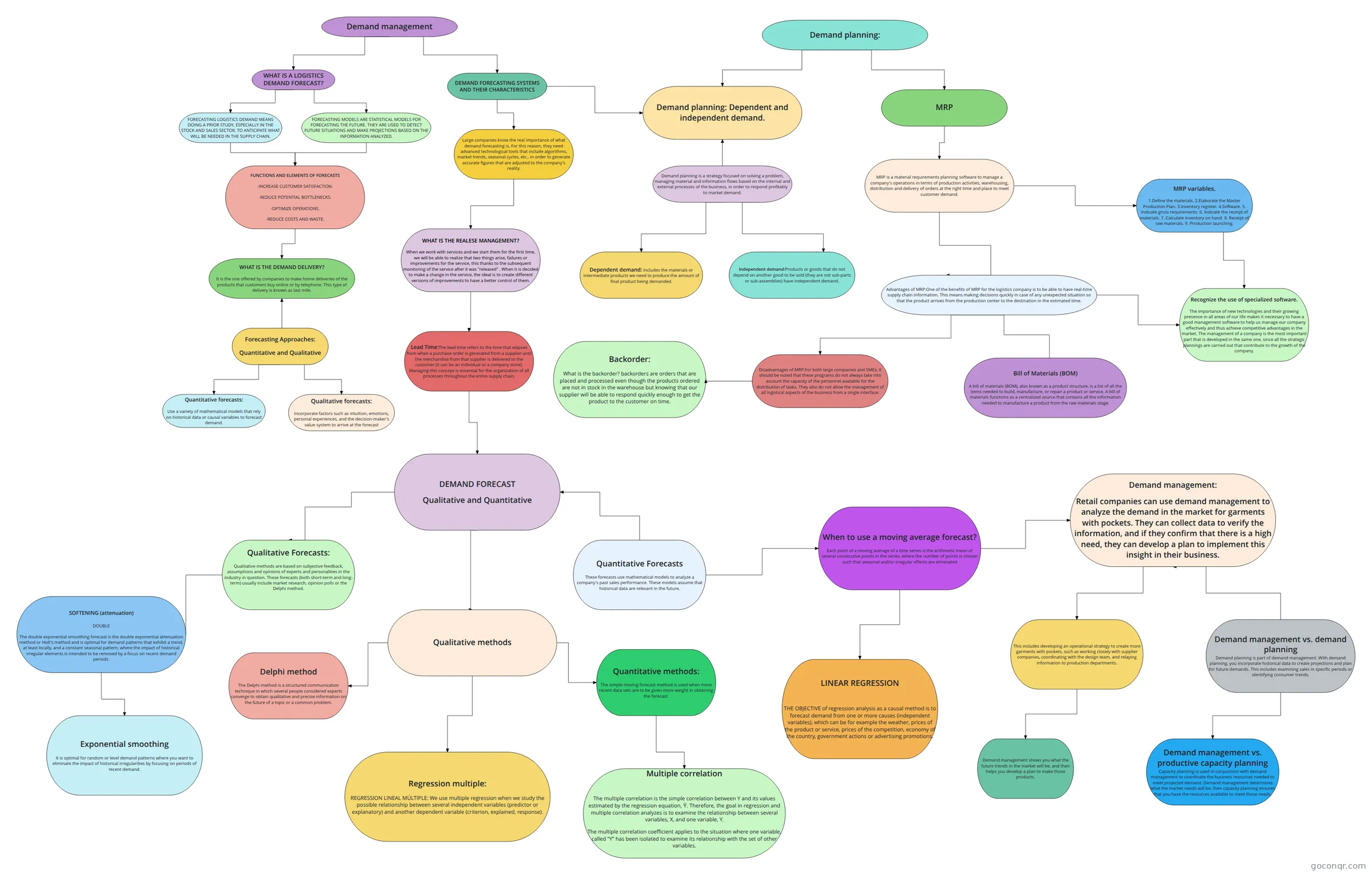
Flowchart: Demand management, forecasting, and release management
Inhalt des Flussdiagramms
Demand management
WHAT IS A LOGISTICS DEMAND FORECAST?
FORECASTING LOGISTICS DEMAND MEANS DOING A PRIOR STUDY, ESPECIALLY IN THE STOCK AND SALES SECTOR, TO ANTICIPATE WHAT WILL BE NEEDED IN THE SUPPLY CHAIN.
FORECASTING MODELS ARE STATISTICAL MODELS FOR FORECASTING THE FUTURE. THEY ARE USED TO DETECT FUTURE SITUATIONS AND MAKE PROJECTIONS BASED ON THE INFORMATION ANALYZED.
FUNCTIONS AND ELEMENTS OF FORECASTS
-INCREASE CUSTOMER SATISFACTION.
-REDUCE POTENTIAL BOTTLENECKS.
-OPTIMIZE OPERATIONS.
-REDUCE COSTS AND WASTE.
DEMAND FORECASTING SYSTEMS AND THEIR CHARACTERISTICS
Large companies know the real importance of what demand forecasting is. For this reason, they need advanced technological tools that include algorithms, market trends, seasonal cycles, etc., in order to generate accurate figures that are adjusted to the company's reality.
WHAT IS THE REALESE MANAGEMENT?
When we work with services and we start them for the first time, we will be able to realize that two things arise, failures or improvements for the service, this thanks to the subsequent monitoring of the service after it was "released" . When it is decided to make a change in the service, the ideal is to create different versions of improvements to have a better control of them.
WHAT IS THE DEMAND DELIVERY?
It is the one offered by companies to make home deliveries of the products that customers buy online or by telephone. This type of delivery is known as last mile.
Forecasting Approaches:
Quantitative and Qualitative
Quantitative forecasts:
Use a variety of mathematical models that rely on historical data or causal variables to forecast demand.
Qualitative forecasts:
Incorporate factors such as intuition, emotions, personal experiences, and the decision-maker's value system to arrive at the forecast
Demand planning:
Demand planning: Dependent and independent demand.
Demand planning is a strategy focused on solving a problem, managing material and information flows based on the internal and external processes of the business, in order to respond profitably to market demand.
Dependent demand: Includes the materials or intermediate products we need to produce the amount of final product being demanded.
Independent demand:Products or goods that do not depend on another good to be sold (they are not sub-parts or sub-assemblies) have independent demand.
MRP
MRP is a material requirements planning software to manage a company's operations in terms of production activities, warehousing, distribution and delivery of orders at the right time and place to meet customer demand.
Advantages of MRP:One of the benefits of MRP for the logistics company is to be able to have real-time supply chain information. This means making decisions quickly in case of any unexpected situation so that the product arrives from the production center to the destination in the estimated time.
Disadvantages of MRP:For both large companies and SMEs, it should be noted that these programs do not always take into account the capacity of the personnel available for the distribution of tasks. They also do not allow the management of all logistical aspects of the business from a single interface.
Backorder:
What is the backorder? backorders are orders that are placed and processed even though the products ordered are not in stock in the warehouse but knowing that our supplier will be able to respond quickly enough to get the product to the customer on time.
Lead Time:The lead time refers to the time that elapses from when a purchase order is generated from a supplier until the merchandise from that supplier is delivered to the customer (it can be an individual or a company store). Managing this concept is essential for the organization of all processes throughout the entire supply chain.
Bill of Materials (BOM)
A bill of materials (BOM), also known as a product structure, is a list of all the items needed to build, manufacture, or repair a product or service. A bill of materials functions as a centralized source that contains all the information needed to manufacture a product from the raw materials stage.
MRP variables.
1.Define the materials. 2.Elaborate the Master Production Plan. 3.Inventory register. 4.Software. 5. Indicate gross requirements. 6. Indicate the receipt of materials. 7. Calculate inventory on hand. 8. Receipt of raw materials. 9. Production launching.
Recognize the use of specialized software.
The importance of new technologies and their growing presence in all areas of our life makes it necessary to have a good management software to help us manage our company effectively and thus achieve competitive advantages in the market. The management of a company is the most important part that is developed in the same one, since all the strategic plannings are carried out that contribute to the growth of the company.
DEMAND FORECAST
Qualitative and Quantitative
Qualitative Forecasts:
Qualitative methods are based on subjective feedback, assumptions and opinions of experts and personalities in the industry in question. These forecasts (both short-term and long-term) usually include market research, opinion polls or the Delphi method.
Quantitative Forecasts
These forecasts use mathematical models to analyze a company's past sales performance. These models assume that historical data are relevant in the future.
Qualitative methods
Delphi method
The Delphi method is a structured communication technique in which several people considered experts converge to obtain qualitative and precise information on the future of a topic or a common problem.
Quantitative methods:
The simple moving forecast method is used when more recent data sets are to be given more weight in obtaining the forecast.
When to use a moving average forecast?
Each point of a moving average of a time series is the arithmetic mean of several consecutive points in the series, where the number of points is chosen such that seasonal and/or irregular effects are eliminated
LINEAR REGRESSION
THE OBJECTIVE of regression analysis as a causal method is to forecast demand from one or more causes (independent variables), which can be for example the weather, prices of the product or service, prices of the competition, economy of the country, government actions or advertising promotions.
SOFTENING (attenuation)
DOUBLE
The double exponential smoothing forecast is the double exponential attenuation method or Holt's method and is optimal for demand patterns that exhibit a trend, at least locally, and a constant seasonal pattern, where the impact of historical irregular elements is intended to be removed by a focus on recent demand periods.
Regression multiple:
REGRESSION LINEAL MÚLTIPLE: We use multiple regression when we study the possible relationship between several independent variables (predictor or explanatory) and another dependent variable (criterion, explained, response).
Exponential smoothing
It is optimal for random or level demand patterns where you want to eliminate the impact of historical irregularities by focusing on periods of recent demand.
Multiple correlation
The multiple correlation is the simple correlation between Y and its values estimated by the regression equation, Ŷ. Therefore, the goal in regression and multiple correlation analyzes is to examine the relationship between several variables, X, and one variable, Y.
The multiple correlation coefficient applies to the situation where one variable, called “Y” has been isolated to examine its relationship with the set of other variables.
.
Demand management:
Retail companies can use demand management to analyze the demand in the market for garments with pockets. They can collect data to verify the information, and if they confirm that there is a high need, they can develop a plan to implement this insight in their business.
This includes developing an operational strategy to create more garments with pockets, such as working closely with supplier companies, coordinating with the design team, and relaying information to production departments.
Demand management shows you what the future trends in the market will be, and then helps you develop a plan to make those products.
Demand management vs. demand planning
Demand planning is part of demand management. With demand planning, you incorporate historical data to create projections and plan for future demands. This includes examining sales in specific periods or identifying consumer trends.
Demand management vs. productive capacity planning
Capacity planning is used in conjunction with demand management to coordinate the business resources needed to meet projected demand. Demand management determines what the market needs will be, then capacity planning ensures that you have the resources available to meet those needs.
Informationen
- Beschreibung
- Flussdiagramm am Ohne Titel, erstellt von Jennifer Nolasco Rodriguez am 20/10/2022.
- Erstellt von
- Jennifer Nolasco Rodriguez
- Aufrufe
- 0
- Bewertung