
Karteikarten
UNIT 3.5 - FEATURES OF WAVES

Karten in diesem Stapel (19)
- 1Waves can transfer __________ and information without a net __________ of the medium through which they travel. They involve ____________ (oscillations) of some sort.Waves can transfer ENERGY and information without a net MOTION of the medium through which they travel.
They involve VIBRATIONS (oscillations) of some sort. - 2In transverse waves, the ___________________ (oscillations) are __________________ (at right angles) to the ________________ of energy transfer.In transverse waves, the VIBRATIONS (oscillations) are PERPENDICULAR (at right angles) to the DIRECTION of energy transfer.

- 3—

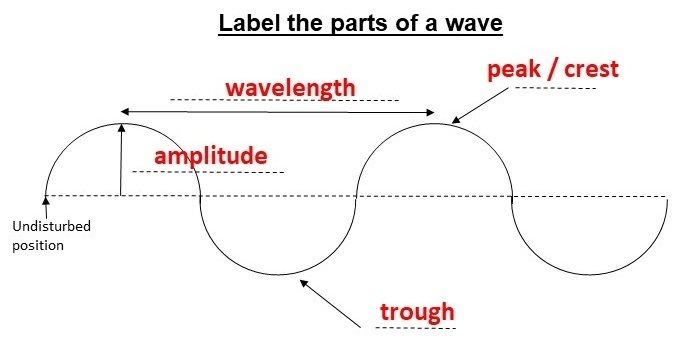
- 4What is wavelength?The wavelength of a wave is the distance between a point on one wave and the SAME point on the next wave.
It is often easiest to measure this from the crest of one wave to the crest of the next wave, but it doesn't matter where as long as it is the same point in each wave.
- 5What is amplitude?The amplitude of a wave is its maximum displacement (height) from the undisturbed position.
NOTE: the amplitude is NOT the distance between the top and bottom of a wave. - 6What is frequency?The frequency of a wave is the number of waves that pass a certain point each second.
The unit of frequency is Hertz (Hz). - 7wave speed (meters per second) = frequency (Hertz) × wavelength (meters) Calculate the speed of a wave.sound wave with a wavelength of 0.65 m and a frequency of 512 Hz.wave speed (meters per second) = frequency (Hertz) × wavelength (meters)
wave speed = 512 x 0.65
wave speed = 332.8 m/s - 8In longitudinal waves, the _________________ (oscillations) are in the ________ direction as the direction of travel.In longitudinal waves, the VIBRATIONS (oscillations) are along the SAME direction as the direction of travel.

- 9When waves ____________ off a plane (_____) barrier, the __________ of reflection and the angle of ________________ will be equal.When waves REFLECT off a plane (FLAT) barrier, the ANGLE of reflection and the angle of INCIDENCE will be equal.

- 10Describe the changes in wavelength, frequency and speed of a wave when it is reflected.When a wave is reflected there is NO change in it's wavelength, frequency or speed.
- 11Refraction occurs when water waves pass between deep and __________ water. The waves slow ______ in shallow water. The _______________ of the waves remain constant and so the ______________ decreases.Refraction occurs when water waves pass between deep and SHALLOW water.
The waves slow DOWN in shallow water. The FREQUENCY of the waves remain constant and so the WAVELENGTH decreases.
- 12The electromagnetic spectrum is made up of 7 different types of radiation. In order of increasing frequency, these are: 1. Radio waves 2. ________________ 3. Infrared 4. ____________ ___________ 5. Ultraviolet 6. __-______ 7. GammaThe electromagnetic spectrum is made up of 7 different types of radiation. In order of increasing frequency, these are:
1. Radio waves
2. MICROWAVE
3. Infrared
4. VISIBLE LIGHT
5. Ultraviolet
6. X-RAYS
7. Gamma - 13List 3 things that all 7 types of electromagnetic radiation have in common.All electromagnetic waves:
1. Travel at the speed of light in a vacuum.
2. Transfer energy / information from one place to another.
3. Are transverse waves.
- 14Ultraviolet, X-ray and gamma radiation can be described as ionising radiation. What does ionising radiation mean?Ionising radiation has enough energy to knock electrons out of atoms (converting these atoms into ions.)
This can cause damage to the DNA inside cells and damage or kill living tissue.
- 15What is a geosynchronous satellite?A geosynchronous satellite has an orbit time of 24 h. In this orbit a satellite returns to exactly the same position in the sky every 24 hours.

- 16What is a geostationary satellite?A geostationary satellite constantly remains above the same point on the Earth’s surface.

- 17Why do communications satellites need to have a geostationary orbit?Communication satellites need to be in a geostationary orbit because the satellite needs to be above a fixed point on Earth so that satellite dishes (e.g. Sky dish) do not have to be continuously moved.

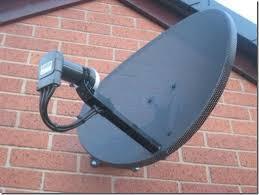
- 18Why do communications satellites use microwave radiation to transmit information?Communication satellites use microwave radiation to send signal because microwave radiation can pass through the atmosphere.
- 19How long would it take a TV signal reach a satellite dish on your house roof, after the signal has been broadcast from a TV transmitter on Earth to a communication satellite in orbit 36,000 km above the Earth? (All electromagnetic waves travel at 300,000 km/s in a vacuum)time = distance ÷ speed
(NOTE: The signal must travel from Earth up to the satellite and then BACK down to Earth again, so we must DOUBLE the distance)
time = (36,000 x 2) ÷ 300,000
time = 0.24 s
Informationen
- Beschreibung
- Year 11 Physics Karteikarten am UNIT 3.5 - FEATURES OF WAVES, erstellt von Mr S Lee am 29/03/2018.
- Erstellt von
- Mr S Lee
- Aufrufe
- 739
- Bewertung