
Karteikarten
Ohne Titel
Karten in diesem Stapel (54)
- 1shining light of high enough frequency (usually in the UV range) on a metal's surface can release _________electrons
- 2free electrons on the surface of the metal _________ energy from the light. If it ________ enough energy, the ________ holding it to the metal break and the electron is _________. This = the ____________________ and the electrons emitted = ___________free electrons on the surface of the metal absorb energy from the light. If it absorbs enough energy, the bonds holding it to the metal break and the electron is released This = the photoelectric effect and the electrons emitted = photoelectrons
- 3what are the 3 conclusions drawn from the experiment into the photo electric effect?1. no photoelectrons are emitted if the radiation has a frequency below the threshold frequency
2. the photoelctrons emitted vary in Ek from 0 to max value. max Ek increases with the frequency of the radiation and is unaffected by the intensity of the radiation
3. the number of photoelectrons emitted per second is proportional to the intensity of the radiation - 44 points according to wave theory?1. for a particular freq of light, the energy carried is proportional to the intensity of the beam
2. the energy carried by the light would be spread evenly over the wavefront
3. each electron on the surface of the metal would gain a bit of energy from each incoming wave
4. gradually, each electron would gain enough energy to leave the metal - 5the _______ the intensity of the wave, the _______ energy it should transfer to each electron - the kinetic energy should also _________ with intensitythe higher the intensity of the wave, the more energy it should transfer to each electron - the kinetic energy should also increase with intensity
- 6what did Einstein say would happen if a photon had a one-to-one interaction with an electron on the surface of a metal?the photon would transfer all its energy to the one specific electron
- 72 points according to the photon model1. when light hits its surface, the metal is bombarded with photons
2. if one of these photons collides with a free electron, the electron will gain energy equal to hf - 8before an electron can leave the surface of a metal it must have enough energy to break the bonds holding it there. what is this energy called?the work function, Ф
- 9the photon model explain the _________ __________ and the ____________________threshold frequency and the maximum kinetic energy
- 10if the energy gained by an electron is ________ than the work function then the electron is emittedgreater
(if it isnt, the metal will heat up but no electrons will be emitted) - 11since, for electron to be released, hf > Ф what is the equation for work function?f = Ф/h
- 12equation for the kinetic energy the electron is carrying when it leaves the metalEk = hf - energy lost on the way out
- 13what is the minimum amount of energy which can be lost in leaving the metal so... what is the max Ek equation?the work function
Ek max = hf - Ф
where Ek max = 0.5mv^2 - 14the Ek of the electrons is ___________ of the intensity, as they can only absorb _____ photon at a timeindependent
one - 15intensity definitionnumber of photons per second
- 16what does the stopping potential givethe max kinetic energy
- 17the emmitted electrons are made to lose their energy by doing _______ against an applied _________________work
p.d - 18stopping potential definitionthe pd needed to stop the fastest moving electrons with Ek(max)
- 19the work done by the pd in stopping the fastest electrons is = to ???the energy they were carrying
eVs =Ek(max)
where e = charge on electron
Vs = stopping potential - 20in energy levels, what does n=1 representthe ground state
- 21how can electrons move down energy levels? (de-excitation)emitting a photon
- 22definition of the electron voltthe kinetic energy carried by an electron after it has been accelerated through a potential difference of 1 volt
- 23energy gained by electron (eV) = ________________________accelerating voltage
- 24equation for change in energy when moving from n=2 to n=1△E = E2 - E1 = hf = hc/λ
- 25how can electrons move up energy levels & what is this calledabsorbing photons with the exact energy difference between the 2 levels.
Excitation. - 26what do we say happened when an electron is removed from an atomwe say it has been ionised
- 27what is the ionisation energy of an atomthe energy needed to completely remove an electron from the atom from the ground state (n=1)
- 28what does the energy of each energy level representthe amount of energy needed to remove an electron in that level from the atom
- 29what are energy levelsthe energy of an electron in an electron shell of an atom
- 30name an example of excited electronsflorescent tubes use them to produce light
- 31florescent tubes contain ______________, across which an initial ______ voltage is applied. This ______ voltage accelerates fast-moving electrons that _______ some of the ________ atoms, producing _______ free electronsflorescent tubes contain mercury vapour, across which an initial high voltage is applied. This high voltage accelerates fast-moving electrons that ionise some of the mercury atoms, producing more free electrons
- 32in florescent tubes, what happens when the free electrons collide with electrons in other mercury atoms?the electrons in the mercury atoms are excited to higher energy levels
when these excited electrons return to their ground states, they emit photons in the UV range - 33what does the phosphorus coating on the inside of the florescent tube do?absorbs the photons, exciting its electrons to higher orbits. These electrons then cascade down the energy levels, emitting many low energy photons in the form of visible light
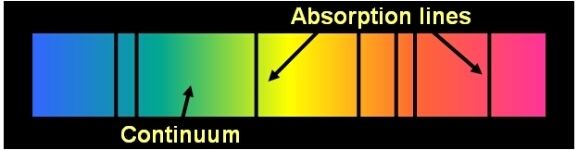
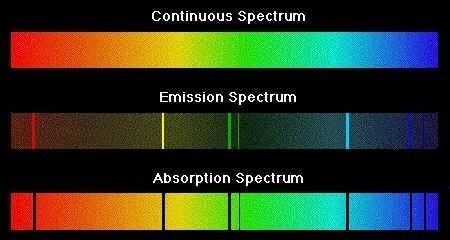
- 34what does shining white light through a cool gas give?an absorption spectrum
- 35continuous spectra contain all possible _________________ if you split white light with a prism, the colours ________ into each otherwavelengths
(white light is continuous)
merge - 36hot things emit a continuous spectrum in the _______ and ____________visible and infrared
- 37in a continuous spectra, why are all wavelengths allowed?the electrons are not confined to energy levels in the object producing the continuous spectrum. the electrons are not bound to atoms they are free
- 38cool gasses _______ certain __________ from the continuous spectrumremove
wavelengths - 39when do you get a line absorption spectrumwhen light with a continuous spectrum of energy passes through a cool gas
- 40at low temperatures, most of the electrons in gas atoms will be _____________in their ground states
- 41the electrons absorb photons with energies = to the different between energy levels. Photons of corresponding wavelength are absorbed by the electrons to excite them to higher energy levels. These wavelengths are then _________ from the continuous spectrum when it comes out the other end of the gasmissing, the black lines correspond to the absorbed wavelengths
- 42if you compare the absorption and emission spectra of a particular gas, what can you see?the black lines of the absorption spectrum and the bright lines of the emission spectrum match up:
- 43what do interference and diffraction show light as?a wave
- 44what are interference and diffraction patterns and how are these explained?alternating bands of dark and light. can only be explained using waves interfering constructively (when 2 waves over lap in phase) or interfering destructively (when the 2 waves are out of phase)
- 45what does the photoelectric effect show light behaving as?a particle
- 46what was DeBroglie's wave-particle duality theory?if 'wave-like' light showed particle properties (photons), 'particles' like electrons should be expected to show wave-like properties
- 47what does electron diffraction showthe wave nature of electrons.
electrons are accelerated in a vacuum tube and then interact with the spaces in a graphite crystal. - 48according to the wave theory, the spread of lines in the diffraction pattern _________ if the wavelength of the wave is _______increases
greater - 49in electron diffraction experiments, a __________ accelerating voltage, gives more ______________ ringssmaller
widely-spaced - 50increase the electron speed (and therefore momentum) and the diffraction pattern circles __________ towards the middle. This fits debroglie's equation as if momentum is _________, the wavelength is ________ and the spread of lines is ________squash together
momentum is greater, wavelength is shorter and the spread of lines is smaller - 51what is the wavelength for electrons accelerated in a vacuum tube about the same size as?EM waves in the x-ray part of the spectrum
- 52if particles with a greater mass were travelling at the same speed as the electrons, they would show are ________________________ diffraction pattern. Thats because a neutrons mass (and therefore its momentum) is much ________ than an electrons, and so a neutron has a __________ de broglie wavelengthmore tightly-packed diffraction pattern
greater
shorter - 53do particles show wave-particle duality all of the time?no, you only get diffraction is a particle interacts with an object of about the same size as its de broglie wavelength
- 54what did other scientists have to do before de broglie published his hypothesis of wave-particle duality (through observing light as both a particle and a wave)?they had to evaluate his theory by peer review and then it was tested with experiments. once enough evidence was found to back it up, the theory was accepted as validated by the scientific community.
Informationen
- Beschreibung
- Karteikarten am Ohne Titel, erstellt von Caitlin Kerr am 12/05/2018.
- Erstellt von
- Caitlin Kerr
- Aufrufe
- 0
- Bewertung