
Karteikarten
Einführung in die Englische Fachdidaktik
Karten in diesem Stapel (101)
- 1skillsbasic abilities one needs to use a language
effectively for a variety of purposes (Reading, Listening, Speaking, Writing and Mediation) - 2competencea broader concept that describes a more complex ability which requires the completion of several actions (includes reading, writing and speaking skill)
- 3CommonEuropeanFramework of Reference for Languages-set of requirements for language learning
in European countries
- focuses on communication skills and competences
- are rated on a scale of 6 levels based on testable output
- criticized for ignoring other goals of education like character formation, appreciation for art/literature or certain values in life - 4holistic learninga concept (supported by Johann Comenius) that emphasizes the importance of using different senses for learning a
language - 5hybrid Englishesvariants of English that have been
modified for local purposes, especially in the outer
and expanding circle - 6immersionlearning a language by being exposed to it
all the time, either by staying in this
country or attending lessons which are
monolingual - 7key to empowermentEnglish is regarded as a language that opens doors around the globe, allows
exchange across the world and therefore offers great opportunities to the people
who speak it. - 8killer languageEnglish has been accused of suppressing other, regional languages and dialects,
especially during the colonial period - 9lingua francaa language used for communication between groups of people who speak different languages (Latin was the first one)
- 10linguistic imperialismsome scholars argue that English is not simply a language, but also transports Western/US values such as liberal economy and western ideology
- 11action research- philosophical assumptions: people within social situations can solve problems through self-study and intervention
- purpose: to develop solutions to problems identified within one’s own social environment
- main methods: qualitative, interpretive; cases studied reflectively through cyclical observational and non-observational means
- outcome: action to effect change and improvement, and deeper understanding of one’s own social situation
- criteria for judgment: subjectivity, feasibility, trustworthiness, and resonance of research outcomes with those in the same or similar social situation - 12principles of good teaching I
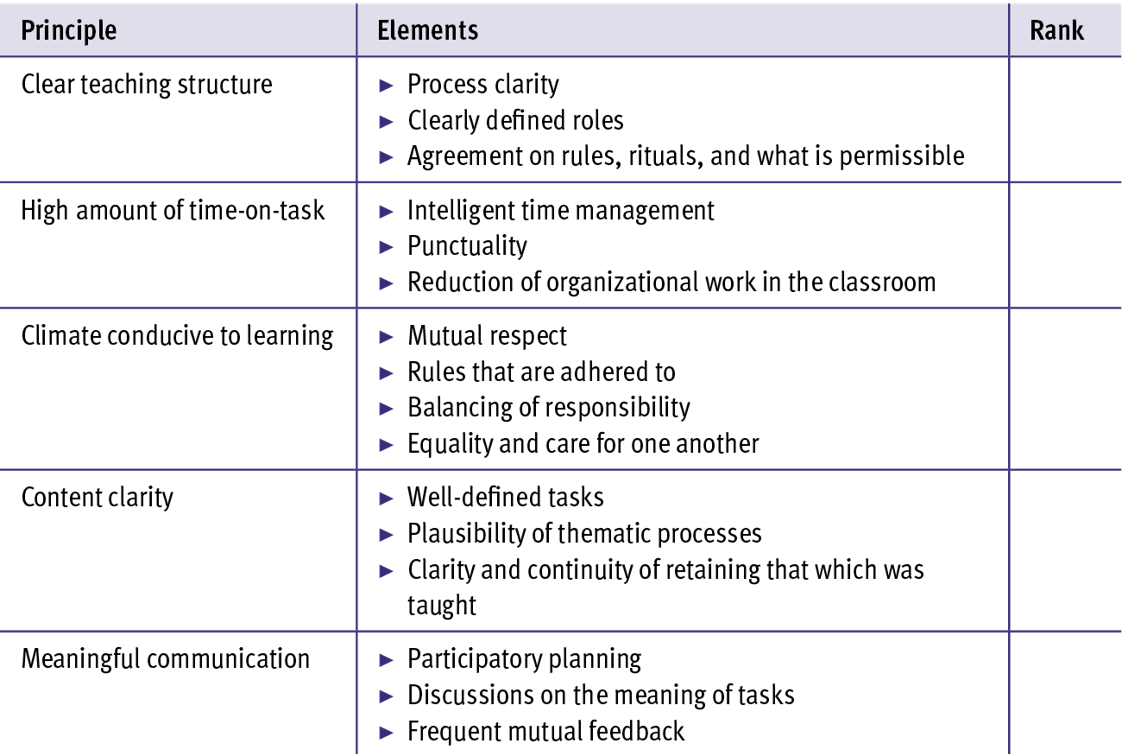
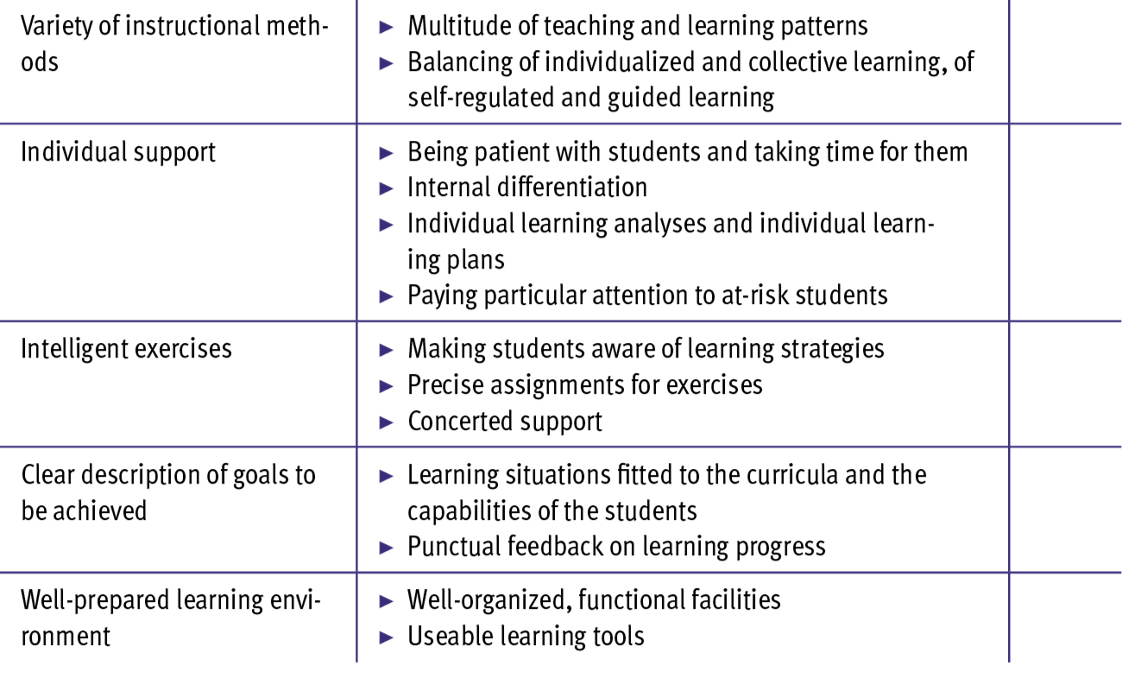
- 13principles of good teaching II
- 14reflective practice model
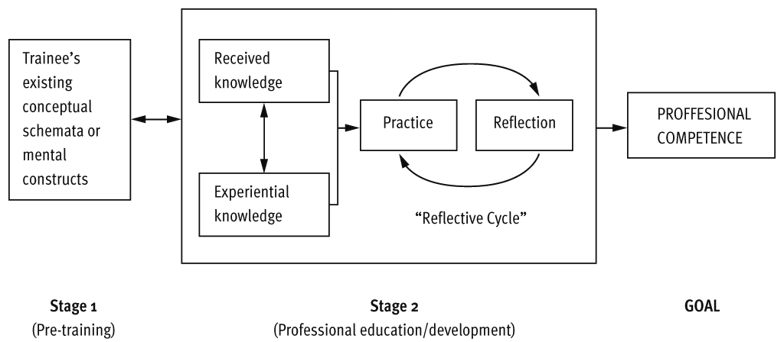
- 15knowledge and competences of reflective teachers - oneself- reflection upon one’s own values
and views
-> views of teaching and inherent values of
formal education
-> political, educational, and socio-cultural
values and views
- sound knowledge of oneself
- interpersonal skills - 16knowledge and competences of reflective teachers - learners- child and adolescent patterns and
stages of development
- individual learning histories
- social status, ethnicity, and gender
- students’ views of English as a
school subject - 17knowledge and competences of reflective teachers - content- subject-specific content and curricula
- principles of liberal education
- other subject-specific curricula - 18knowledge and competences of reflective teachers - pedagogy- sound knowledge of pedagogy
-> reflect on classroom interaction
- knowledge of a variety of methods
- forms of assessment - 19knowledge and competences of reflective teachers - context- knowledge of school forms and their
educational principles
- infrastructure, organization,
management, colleagues, student
populace
- purposes and conditions of formal
education - 20natural VS. instructional setting
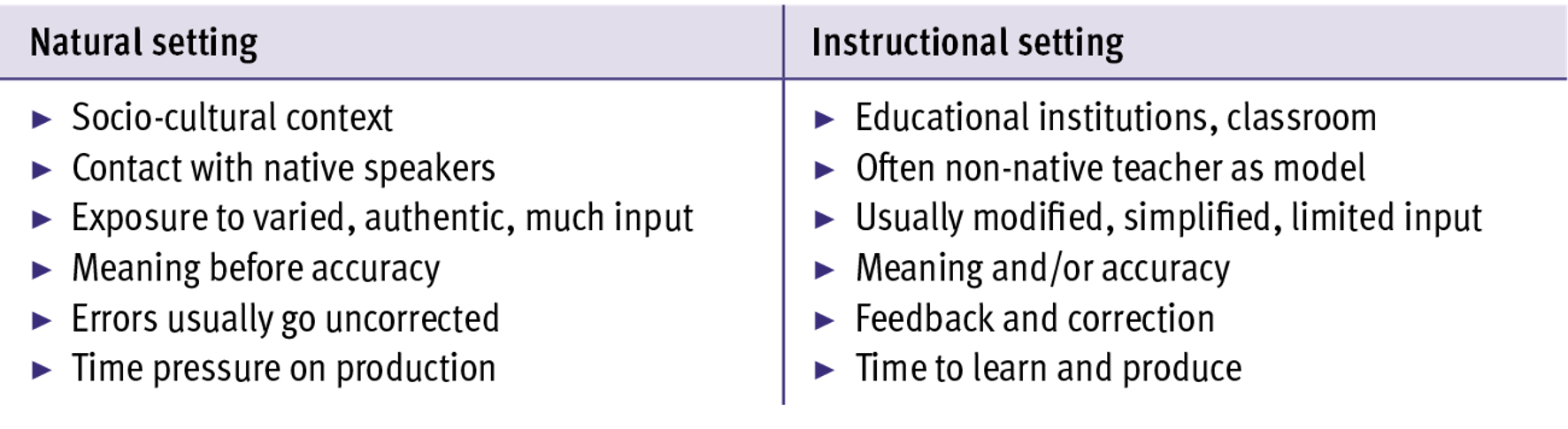
- 21approaches to language acquisition- the Empiricist (Behaviorist) approach
-> learning based on the experience and imitation of the language used in the learner’s environment
- the Nativist approach
- > a specific genetic or innate capacity enables language acquisition
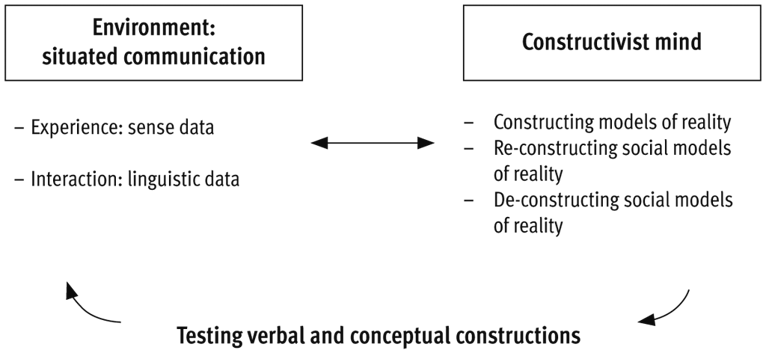
- cognitive, social, or radical constructivist approaches
-> language learning a result of the individual’s interaction with the world - 22language acquisition VS. language learningdeveloping implicit knowledge in a subconscious way VS. explicit and conscious appropriation of language items and rules
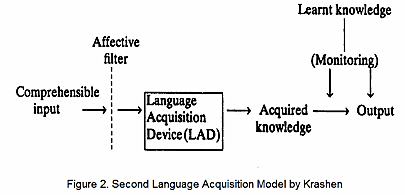
- 235 hypotheses on language learning (Krashen)1. acquisition-learning hypothesis:
- students unconsciously acquire a FL rather than consciously learn it
2. natural order hypothesis
- students learn features of L2 in the same order as in L1 [plural -s before third person -s; ‘no+verb’ (*‘I no like.’) in negation before ‘auxiliary+negation+verb’ (‘I don’t like.’)]
3. monitor hypothesis
- explicit learning of rules does not contribute to acquisition
4. comprehensible input hypothesis
- input needs to be comprehensible if somewhat challenging = a little above the level of the learners
- learners need a silent period in order to process input
5. affective filter hypothesis
- supportive, anxiety-free learning atmosphere and learner motivation relevant for input to get through to the student
- negative affect clogs the filter of language input - 24LanguageAcquisitionDevice
- 25constructivism
- 26sociolinguistic approaches

- 27grammar-translation-method- grammar and vocabulary
-> explicit and teacher-fronted instruction
- roles of teacher and student
-> teacher = master, student = apprentice
- comparison and contrast of L1 and L2
-> highlighting the particular structures of the L1 and L2
- declarative knowledge, accuracy
rules and patterns explicitly taught, memorized
- translating discrete written samples
-> models of good language
-> preparing learners to read texts from the target culture
-> writing compositions: grasp of the target language and culture
- canonical literary, philosophical texts
-> cultivation of the individual - 28direct method- training in what learners actually need
-> oral communication skills
- more ‘natural’
-> ‘direct’ use of target language as medium of instruction
- objects, pictures, demonstrations
-> directly connecting words with meaning
- vocabulary
-> chunks and sentences
- grammar
-> not central
-> inductive: from examples to rule
- oral skills
-> imitation, immediate correction of errors
-> embedded in everyday situations - 29audiolingual/-visual method- language as formal system of sounds, words, sentences (structural linguistics) and habit formation (Behaviorism)
-> imitating / practicing sounds, words, and syntactic patterns
-> capitalization
- listening, speaking in dialogs preferred to reading, writing
- instruction
-> monolingual teaching: L1 should not interfere with habit formation in L2
-> stimulus – response – reinforcement (correct usage: positive feedback,
mistake: immediate correction)
- input
-> teacher, audio files: language model
-> language laboratory: repeating, practicing dialogs
- practicing
-> rote learning, repetition drills, transformation exercises, substitution drills - 30CommunicativeLanguageTeaching- focus on:
-> meaningful & appropriate communication
-> flexibility
-> language awareness
-> fluency & comprehensibility before accuracy
- communicative competence - the ability
to...
- ...interact in meaningful ways
- ...express one’s intentions in a socially appropriate form in specific situations and within a framework of cultural norms
- basic principles
-> communication is the means to and the purpose of language learning
-> conveying meaning is the aim of communication
-> meaning should be negotiated among learners with little intervention by teachers - 31Task-BasedLanguageTeaching- focus on:
-> communicative tasks
- often considered a strong version of CLT
-> authentic and ‘natural’ language learning
-> learner-driven interaction
- avoids practice of specific forms
-> more comprehensive and holistic tasks
- tasks focus on:
-> meaningful and appropriate interaction (how to travel to New York, where to stay, what to do there)
-> process- and product-oriented performance
- learner as social agent - 32collaborative language teaching- focus in:
-> cooperation
- interaction, controversy, cooperation
- cooperation before competition
-> reasoned judgments
-> higher-level reasoning
-> critical thinking processes
- structured controversy
-> negotiating pros and cons
-> respectful but challenging controversy
(involving learners; stimulating cognitive processing, social skills; facilitating greater mastery and retention of subject matter;
facilitating greater ability to generalize the principles learned to a wider variety of situations) - 33participatory/critical language teaching- focus on:
-> participation
-> critical agency
- insights into politics of power, language, and knowledge
- learner participation
-> topics of education (relevance for life -> motivation; improving their living conditions and society)
- raising awareness
-> social injustice
-> economic discrepancies
- empowering learners
-> change inequality and discrimination
- critical discourse analysis
-> bias often implied in language use
(manipulation & domination;
‘human capital’, ‘problem of migrants’) - 34individual differences and factors
- 35interlanguage- language of students between their L1 (mother tongue) and L2 (second language)
- changes during the process of learning
- contains errors
- L1 of a learner influences his L2 - 36teachability hypothesis- a teacher can only convey what the student is already able to understand
- orientation on student's knowledge
- teachability is constrained by processability - 37processability hierarchy- learners need to master one stage of learning before they can enter the next one
- stages on the hierarchy cannot be skipped
- easier constructions before more complex ones - 38developmental error- error because processability hierarchy-stage is not yet reached
-> correction will be ineffective for specific learner
-> but: beneficial for others who have already entered this ph-stage - 39variational mistake- mistake although PH-stage already entered
-> must receive corrective feedback
(to help him/her along the developmental path and prepare him/her for the next stage;
to avoid the fossilization of a simplified interlanguage version) - 40fossilization (interlanguage)process in which the learner has more and more difficulty furthering his fluency in the language, until eventually, he can learn no more
- 41deductive approach to grammar-a grammar rule is presented by the teacher
-practiced by the learners
-often tested at the end of the grammar teaching sequence - 42inductive approach to grammar- rich input is provided in which a grammatical structure is repeated several times
- students discover the rule on their own from the examples provided - 43reactive focus on forma grammatical structure comes into focus only if the need arises
- 44proactive focus on formteachers prepare instructional materials that facilitate the elicitation of a grammatical structure
- 45declarative knowledgeknowledge "about sth."/the "WH-questions" (e.g.: facts, world or personal history, and rules for mathematics operations); easy to express in the form of words or symbols; is explicit (you know that you know it)
- 46procedural knowledgeknowledge about "how sth. is done" (e.g.: driving a car, throwing a boomerang); hard to explain verbally; is implicit (once you gained it, you are no longer consciously aware of the knowledge)
- 47linguistic treshold hypothesis- certain degree of language proficiency
-> to be able to read and enjoy texts - 48linguistic interdependence hypothesis- reading strategies and habits acquired in the mother tongue
-> applied to those in the FL - 49mental schemataeverybody has a different "picture" in mind,
when they encounter a particular concept
-> based on our previous experience of the
world around us (habits, culture, typical phrases/chunks/expressions) ->
exist for all things we encounter in our daily
life -> trigger certain expectations what is about to happen -> are either fulfilled or contradicted - 50bottom-up-processYou recognize the words/sentences/pictures
you see. - 51top-down-processYou compare your schemata with that of the
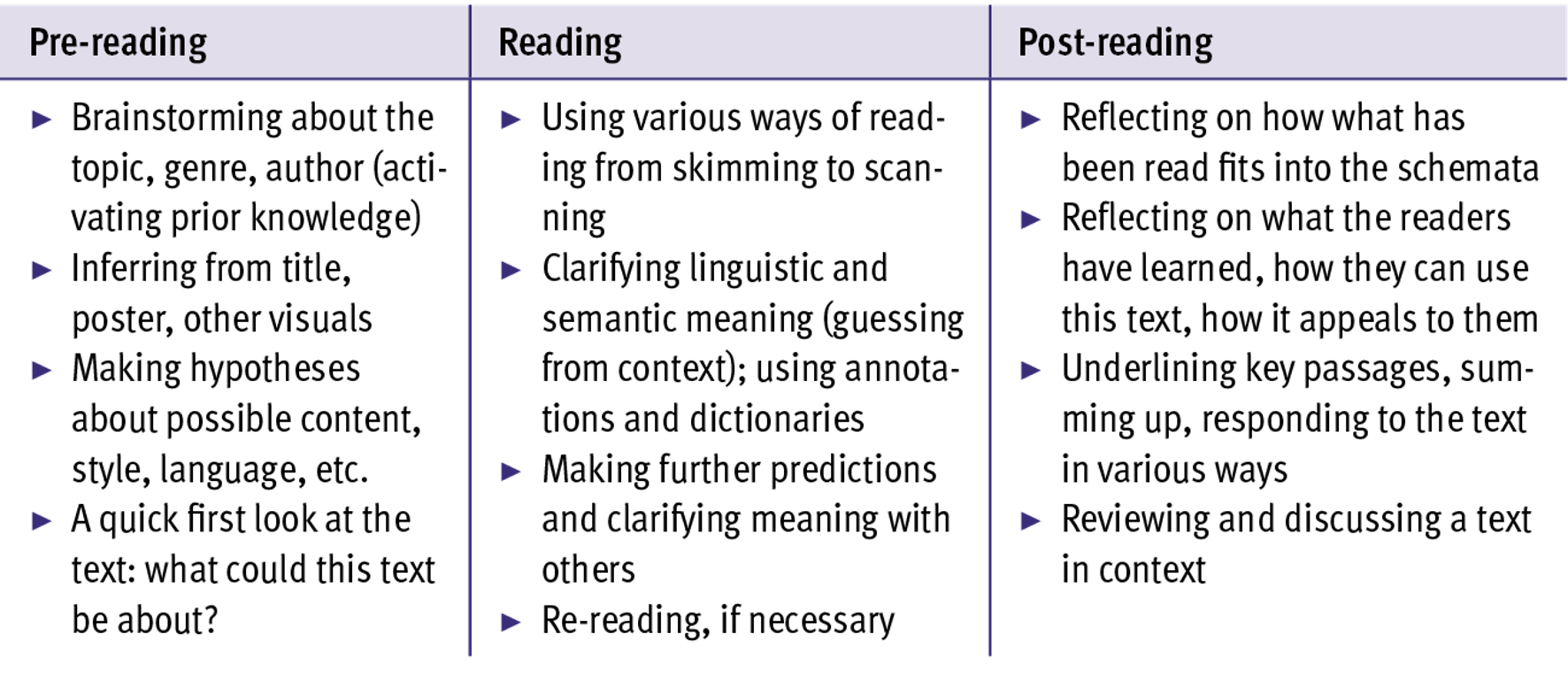
text/film. - 52reading (pre/while/post)
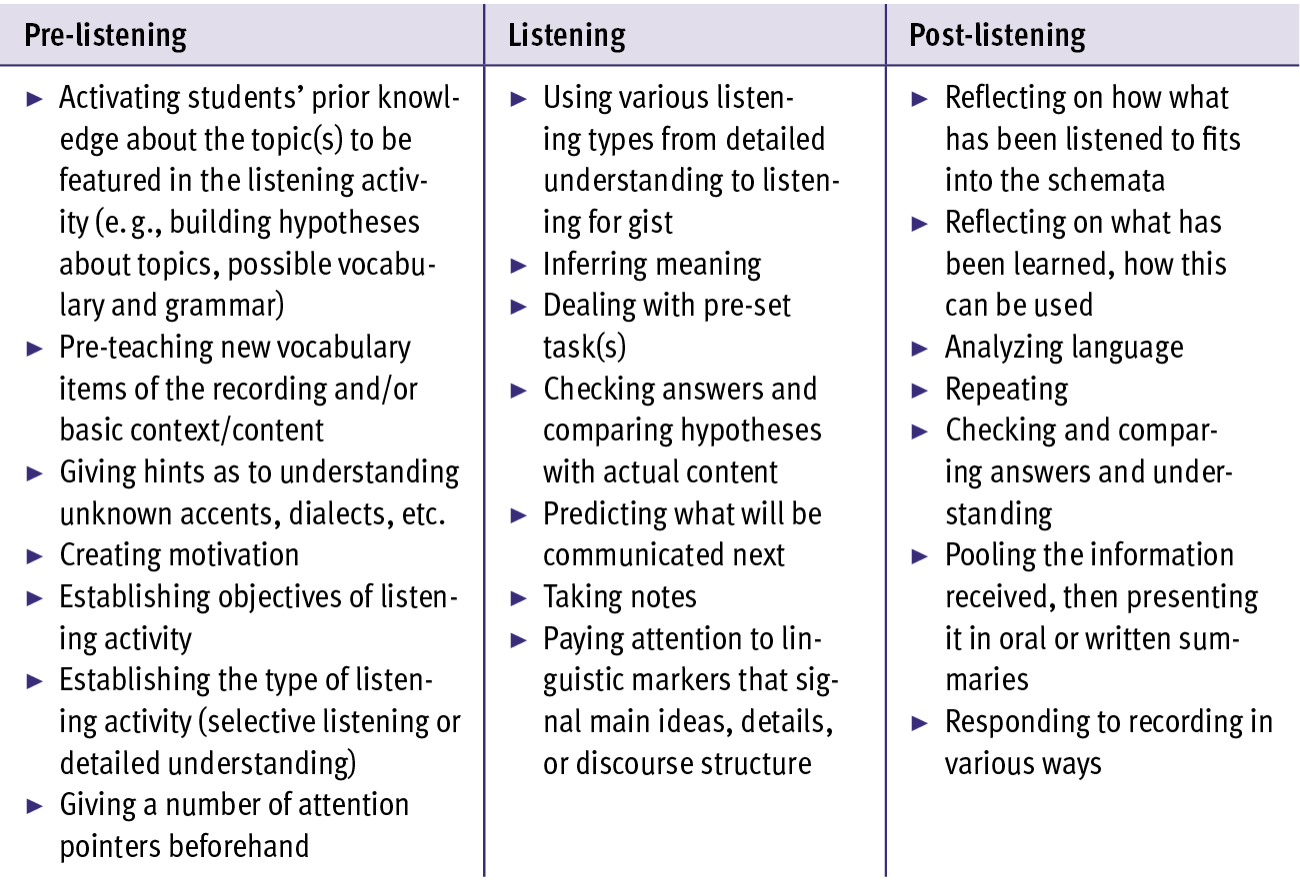
- 53listening (pre/while/post)
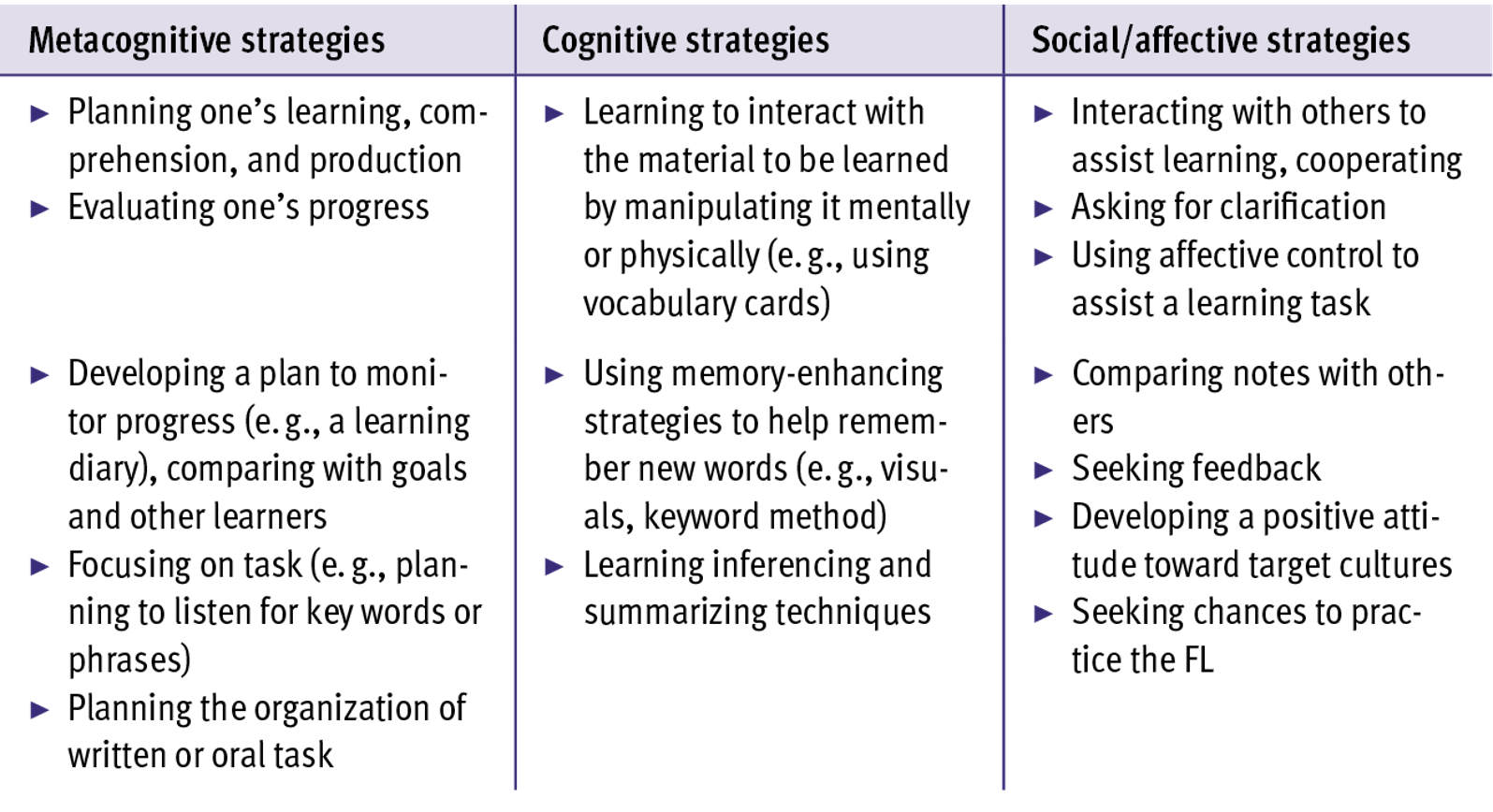
- 54learning strategies
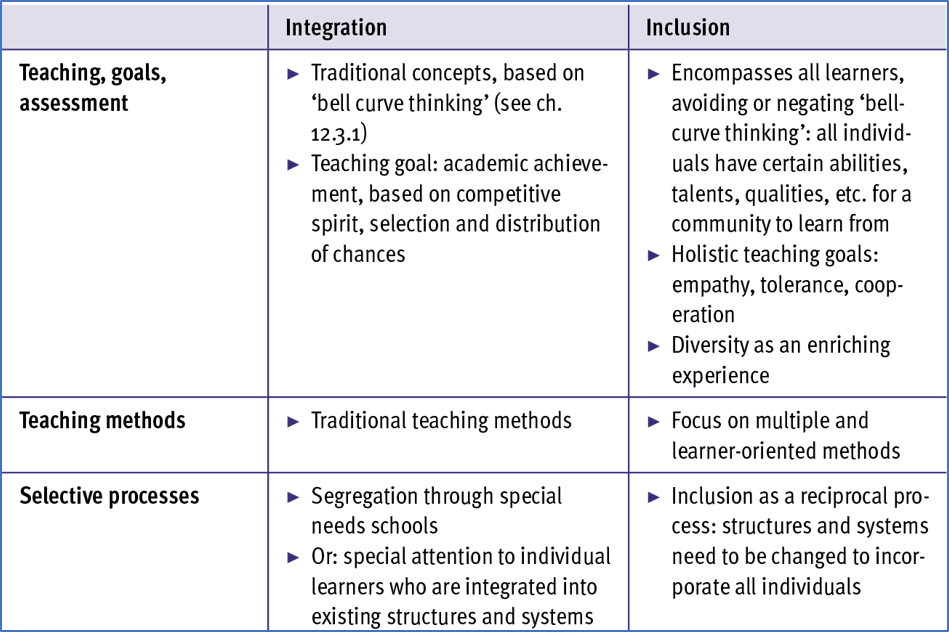
- 55integration VS. inclusion I
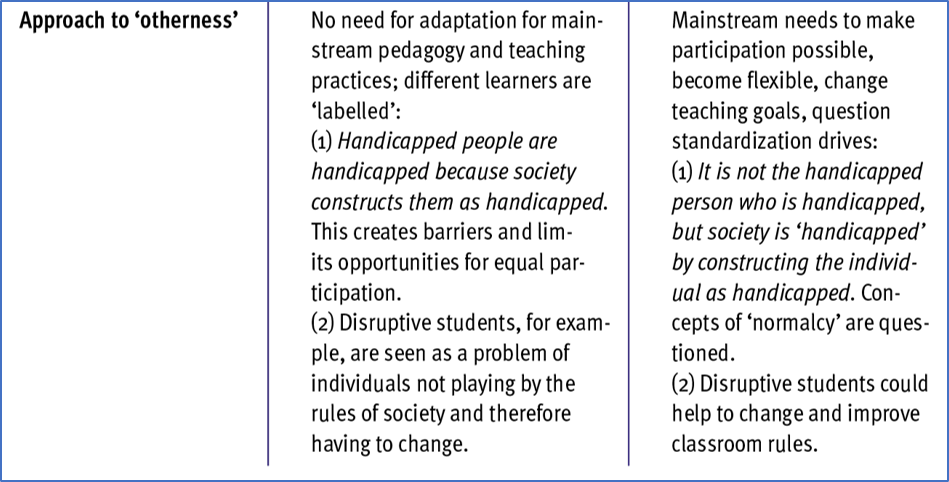
- 56integration VS. inclusion II
- 57area/background studies (Landeskunde)- traditional teaching approach that teaches knowledge about another country, focusses on facts and declarative knowledge, tourist-kit approach, capital-C-culture
- topics covered: use of language, history, art, science, economics, social culture, political institutions, religion/ideologies/"creeds", minorities, geography/regionalism, codes of behaviour - 58cultural studies- a field of science dealing with different aspects of life in a society and collective identities
- 59inter- & transcultural learning- more modern teaching approach originating from multi-cultural societies
like the US
- goal: learning to live in a diverse society with many different cultures and ethnicities
- intercultural learning: teaching learners a specific target culture
- transcultural learning: deals with topics and issues that are relevant for people from different cultures (global issues) - 60concepts of intercultural competence
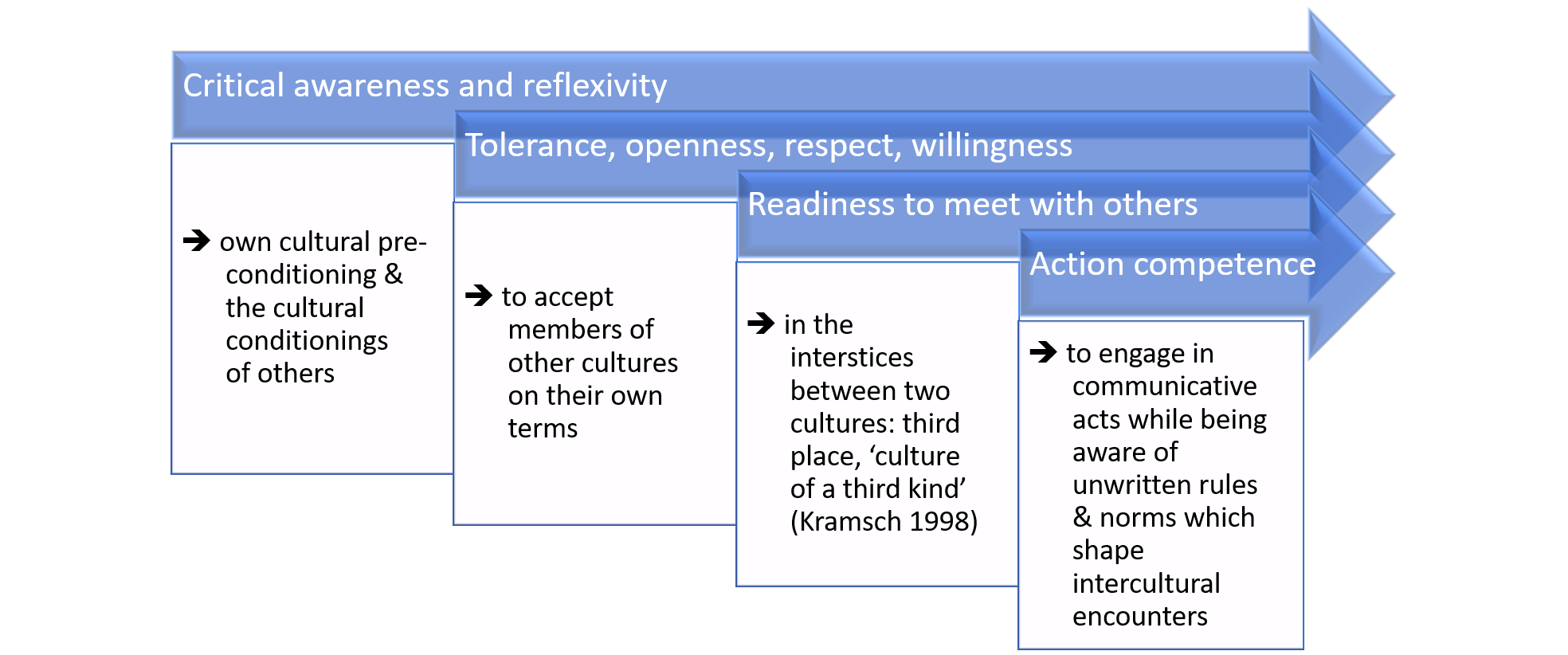
- 61critical incidents- a misunderstanding caused by a "collision of cultures", two different cultures may have completely different way of thinking about the same thing or topic
- 62global issues(local) environmental problems that affect the whole world (e.g.: acid rain, global warming, population growth etc.)
- 63Fremdverstehen (Bredella 2010)redefinition of cultural learning -> intercultural processes of meaning creation -> students as self-reflective co-constructors of cultural meanings -> comparison of horizons rather than blending of such horizons
- exchanging information between different cultures in order to expand the knowledge of both sides and to achieve mutual understanding - 64skimming/reading for gist- reading the text to gain an overall impression what it is about
- after skimming, you are able to give a short summary, often based on the 5 W's - 65scanning- reading the text very carefully, often to find answers to specific questions
- when scanning, you often look for certain keywords that tell you which part of the text is especially important for a particular task or goal - 66approaches to teaching literature - intrinsic analytical (only the text)-text as timeless artifact that needs to be analyzed in intensive, close readings
- task e.g.: identify the rhyme
scheme of the poem - 67approaches to teaching literature - subjective response (individual and text)- there is a dynamic interaction between
reader and text
-different people understand the same
text in different ways due to their individual
beliefs, world views and cultural
backgrounds
- task e.g.: Note your opinion about the character's actions in a log. We will then discuss our findings in class. Did you enjoy reading the text? Which aspect do you
consider most relevant? - 68approaches to teaching literature - contextual and cultural (culture and text)- literature is always
influenced by the cultural
backgrounds, beliefs and
world views of the people
who produce it
- whenever we deal with literature, we
also deal with that influence
- task e.g.: How is the British Empire
presented in the story XY. Compare that to book XY/knowledge from history classes/your own opinion. Which historic backgrounds of the author do we need to know order to understand the text? - 69approaches to teaching literature - task-based and creative- solving a complex task by reading a text
- the pre-, while-, post-model is used for that
purpose
- Big task:
What can we learn about love from Romeo and Juliet?
Pre: What do you know about R&J already?
While: Outline the development of R&J'
relationship.
Post: Comment on the message of the play.
Discuss what importance that
message has today. Explain what R&J can
teach us about love in our modern society. - 70intertextuality- texts usually contain references to other texts/ media
-> only if you understand these references,
you comprehend the text completely - 71efferent reading (=sinnentnehmendes Lesen)- reading a non-fictional text for the purpose of retrieving the pieces of information it contains
- with efferent reading, every reader should take more or less the same bits of information from the text - 72aesthetic reading- reading a fictional text in a way that you enjoy reading and appreciate literature's aesthetic quality
- 73principles for selecting literature- motivation
- comprehensible input
- rich input
- qualifying L2 communication only if necessary
- addressing prior knowledge
- metalinguistic knowledge
- creative interlanguage
- accurate pronounciation
- tolerating structural errors
- alternating proceedings
- authentic spreech production
- positive atmospheres - 74media pedagogy1. media education: ways of using media sensibly
2. media didactics: functions of media & how to use it for teaching and learning
3. media studies: knowledge about media e.g.: historical development, power
of media...
4. media research: scientific exploration of e.g.: use of media in daily life, TV consumer habits... - 75media literacyability to...
- ...use media in a self-determined, communicative, creative and responsible way
- ...to use it for learning purposes
- ability to use media properly is vital for survival in today's world - 76multiliteracies model- every medium contains various aspects of meaning that have an impact
on the consumer (e.g. music, sound effects, gestures, symbolic items, geographic or
spatial relations etc.)
- users/learners should be aware of these different aspects as consciously designed elements of media products in order to fully understand them - 77educational goals/objectives of media studies- information
- communication and cooperation
- production and presentation
- analysis and evaluation
- reflection
- legal issues - 78blended learning- using a combination of traditional and mediated forms of teaching and learning -> one course contains periods of mediated/online/computer-assisted learning on the one hand plus times where students and teachers are together in the same place at the same time on the other hand, such as in a traditional classroom setting
(=face-to-face scenario) - 79frameworks (forming and shaping a lesson)the factors determine the planning of a lesson (teacher, students, topic, learning environment, time, space, curricula)
- 80education- character formation
- critical & reflective competences
- language awareness
- inter-/transcultural competences
- literary & aesthetic competences - 81training- comprehensibility
- fluency
- accuracy
- functional communicative competence - 82media package (Lehrwerk)- student's book/textbook
- workbook
- audio/video files
- grammar/vocabulary aids
- sometimes teacher’s manual - 83other material- realia
- newspapers/journals/literature
- signs/pictures/maps
- speeches, announcements
- podcasts, recordings
- self-designed worksheets - 84planning a lesson I
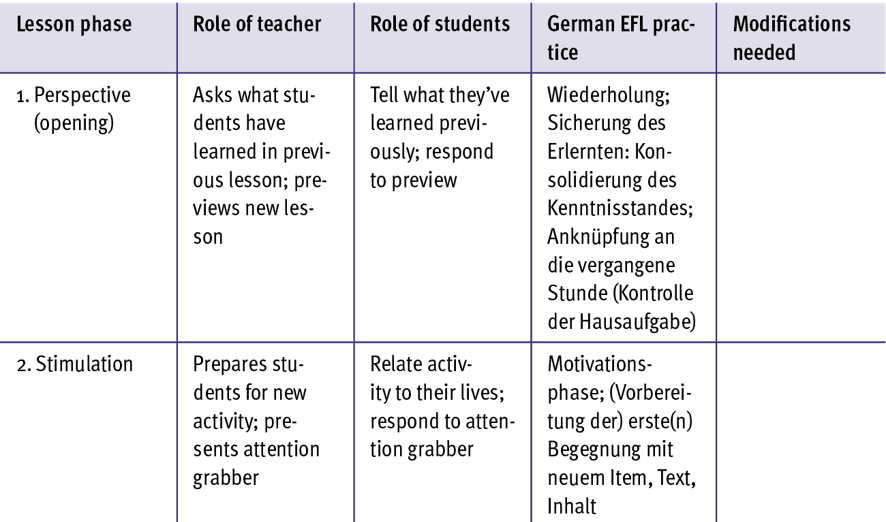
- 85planning a lesson II
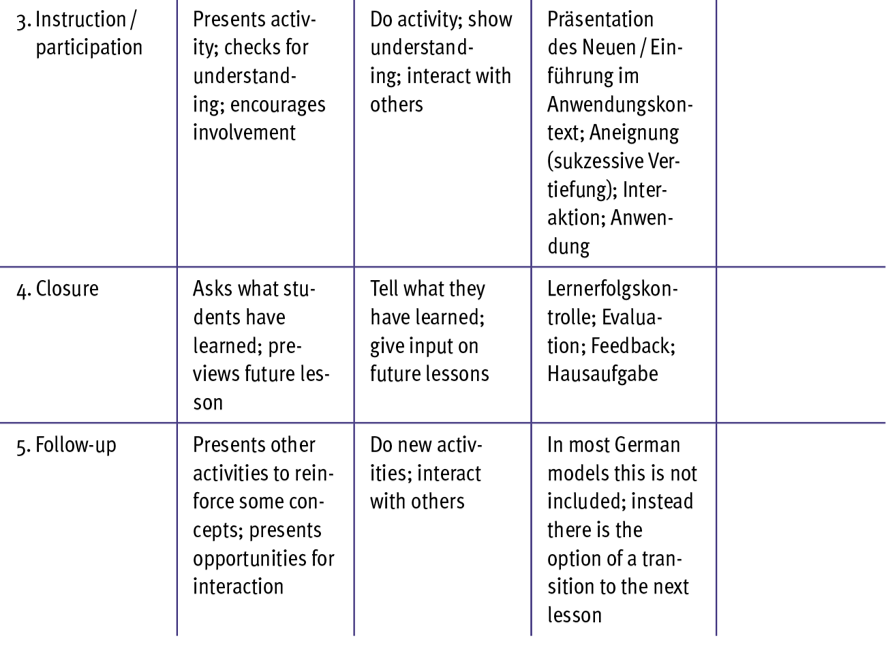
- 86generic lesson planperspective -> stimulation -> instruction -> closure -> follow-up
- 87models for lesson planning - PPPpresentation -> teacher-centered introduction of new item
practice -> short responses to teacher questions
production -> more complex exercises, integrating new item into learner's mind - 88models for lesson planning - pre-while/during-postpre -> before encountering the text/source of information
while/during -> while encountering the text or other medium/material
post -> after encountering the text - 89IRE patterntypical procedure that occurs in most lessons:
- initiation: teacher asks a question
- response: short students answers
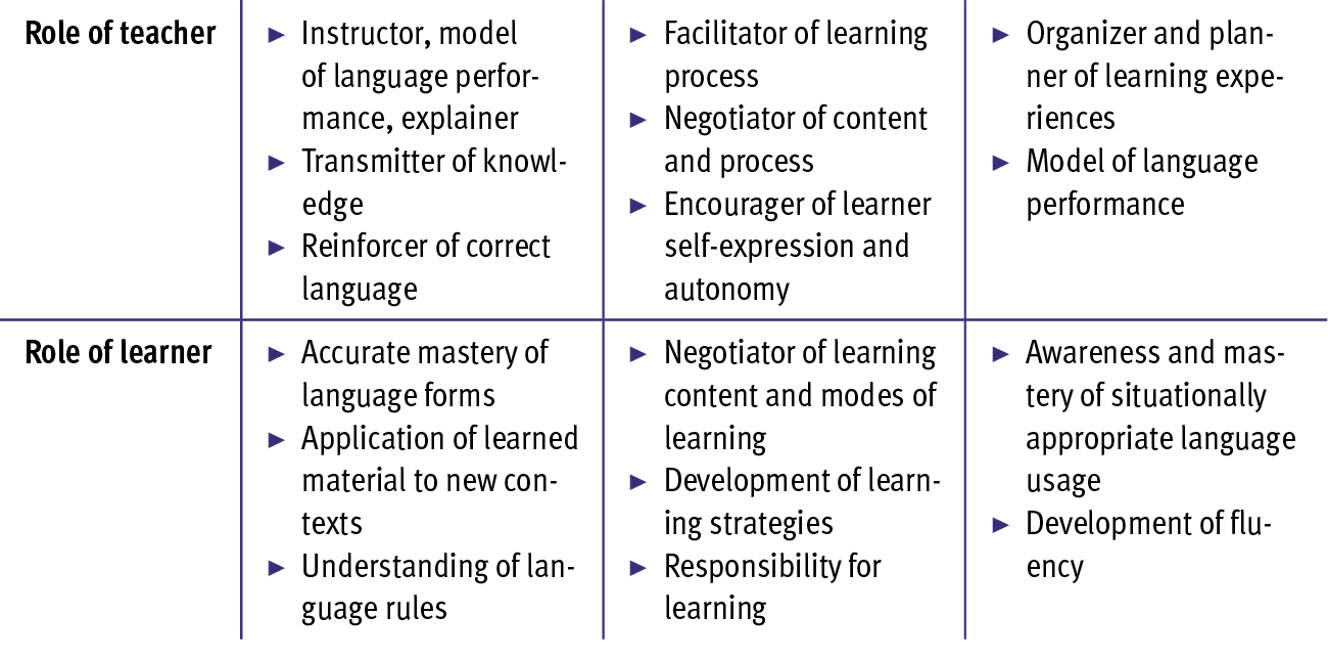
- evaluation: teacher evaluates answer/reacts to it - 90syllabus design I
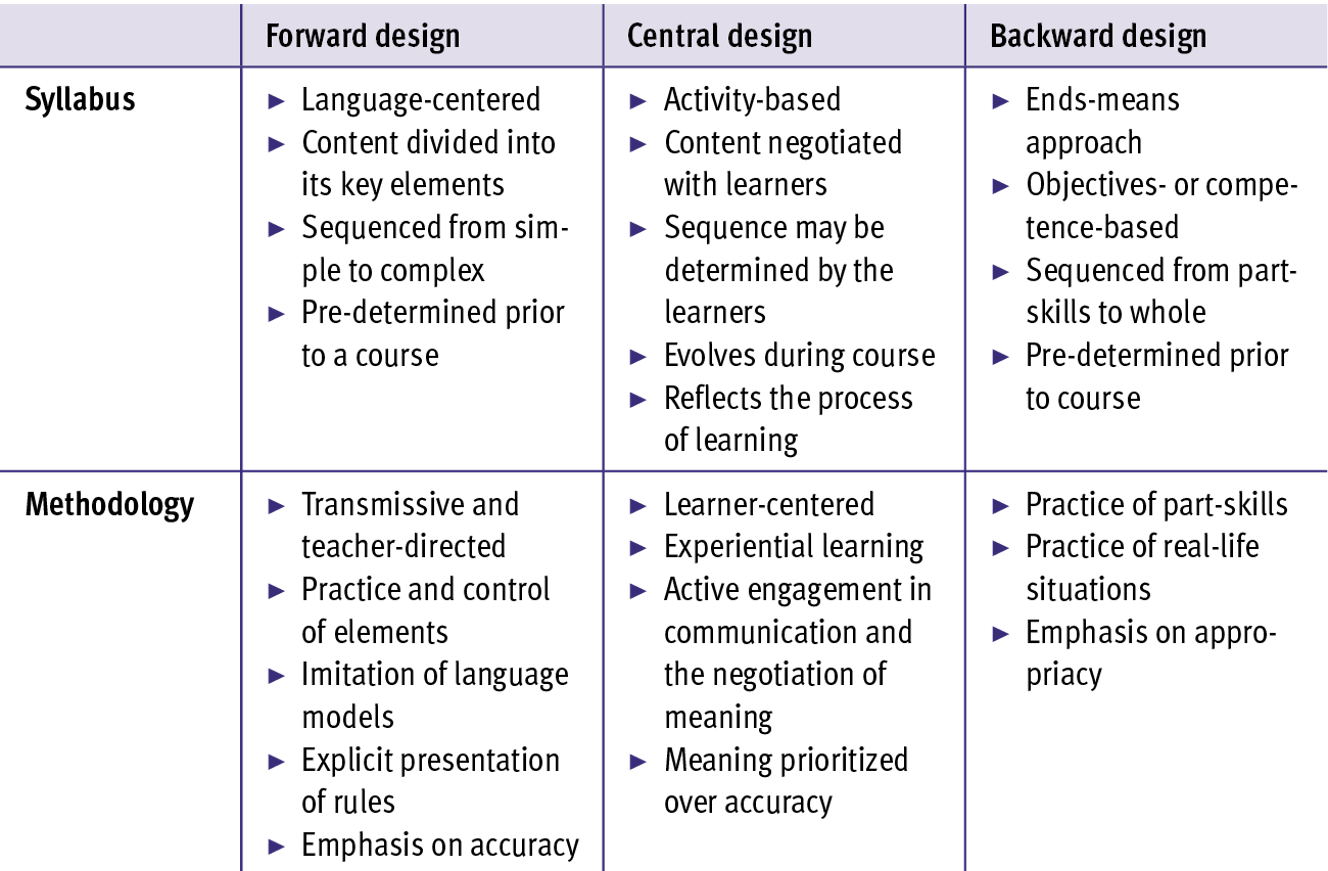
- 91syllabus design II
- 92hidden curriculum- because textbooks are designed, developed and approved of by the federal authorities (Bildungsministerien der Länder) based on the requirements of the state curriculum, they are often used as a guideline for planning lessons and syllabi throughout the entire school year
- in some cases they even seem to replace the official curriculum during the planning process of teachers
- that is why the textbook has been called “hidden curriculum” when teachers use it
exclusively, without ever looking into the actual curriculum
- whereas the curriculum is legally binding
for the teacher, textbooks and their content are not
- the problem here is, that suddenly publishing companies “secretly” or indirectly determine what is taught and no longer official, democratic authorities (e.g. Department of Education) - 93deskilling of teachers- textbooks come as all-inclusive packages with all kinds of additional material
including precise instructions for the teacher, which makes it easy and often times seems very efficient and attractive to follow them exactly
- using the textbook and/or its media package all the time without any additional (self-designed) materials can lead to the problem of teachers losing their
own teaching style, their abilities to plan a lesson and design their own materials
- such teachers on “autopilot” can make lessons very predictable, boring and also insufficient to individually prepare
students for the real world
- always sticking to the textbook can narrow down the creative potential of individual teachers and also their commitment to their own teaching as well as their motivation for
personal professional development - 94discrete point testing- testing that provides effective and
objective information on isolated
skills/items of knowledge
- is reliable and objective, but provides little
context and is not very similar to realworld
communication. (e.g. multiple
choice) - 95communicative testing- testing that imitates real-world
communication and involves complex tasks that require a variety of skills
- is somewhat time-consuming and
more subjective on part of the
teacher who evaluates it - 96closed task- tasks with no room for individual
solutions (multiple choice, matching, crossword, yes/no-questions, substitution,…) - 97semi-open task- task with some room for individual solutions within a set of criteria (summing up texts, mediation, writing a description, paraphrasing…)
- 98open task- tasks with much room for individual solutions or opinions, simulation of real-life communication (comment, essay, statement, role play…)
- 99alternative assessment formats- focus on interaction and real-life tasks
- testing of interactional skills
- evaluation of cooperation in group work
- evaluation of media skills
- self- and peer-assessment
- assessment of the learning process - 100mistakea lapse in performance
- 101errorgap in the learner‘s competence
Informationen
- Beschreibung
- Karteikarten am Einführung in die Englische Fachdidaktik, erstellt von Aaron Priedigkeit am 15/07/2018.
- Erstellt von
- Aaron Priedigkeit
- Aufrufe
- 15
- Bewertung