
Karteikarten
Introduction to Bioenergetics
Karten in diesem Stapel (18)
- 1ThermodynamicsCells appear to violate through high order
1st law = energy cannot be creates or destroyed
2nd law = in spontaneous process processes, entropy of universe increases - 21st law impactChange in internal energy = heat energy absorbed - work done by system
Places upper limit on energy cost - energy store less than or equal to energy coming in to system - 32nd law impactEntropy = degree of disorder
At equilibrium, no change in entropy
When all reach equilibrium, entropy death
Entropy hard to measure experimentally - 4Gibbs Free EnergyFree energy = change in energy - temp x change in entropy
- 5Impact of GibbsFor spontaneous reactions, change <0 - through high temperature/ large increase in entropy/ highly exothermic
If >0. not spontaneous hence energy needed - 6ΔG'Standard Gibbs energy change for reaction at pH 7
Can measure by measuring equilibrium constant
ΔG' = -RT ln [product]/[reactant] - 7State functionChange processes same regardless of pathways
- 8Couple reactionsCan do this to make ΔG <0
Reaction thermodynamically unfavoured coupled to one that is to drive reaction - 9ATP is driving forceCoupled to reactions to make thermodynamically favourable
ΔG' = -30.4kjmol-1
Energy of hydrolysis depends on concentration of reactants nadproducts and concentration of Mg2+ and Ca2+ ~50jkmol-1 under typical conditions - 10Calculating ΔG value-30.5 + RT ln [ADP][Pi][H+]/[ATP]
- 11Why exothermic?Phosphate and ADP more resonance stabilisation than ATP
Electrostatic repulsion in phosphate
More water can bind ADP and Pi than ATP - 12Phosphorylation potentialphosphorylation potential between biologically important phosphorylated molecules
Can be phosphorylated by those with lower potentials
Phosphorylates those with higher potentials
Phosphocreatine phosphorylates ADP - energy store to safeguard ATP - 13Measuring ATP changesTurnover of 0.5kj/min in exercise
ATP buffered by phosphocreatine in many mammalian tissues
In high energy demand/ lack of oxygen, Pcr decrease in concentration prior to depletion of ATP - 14Coupling ATP hydrolysis to chemical reactionsPhosphorylates glucose so can be broken down
ATP used to build peptides
Join 2 nucleic acids to synthesise DNA
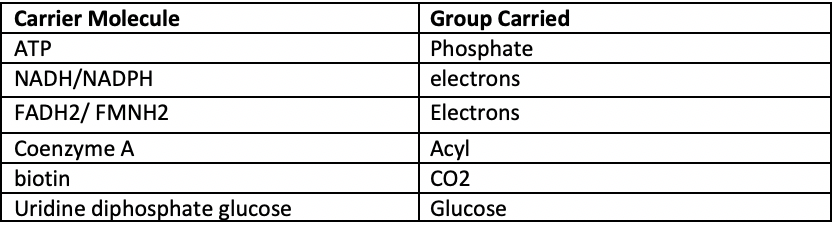
ATP changes equilibrium constant by 10^5 - shifted to form product - 15Activated carriers
- 16Reduction and oxidationIn reduction, NAD+ receives H+ and 2e
NADP+/NADPH used in biosynthesis
Phosphate group acts as tag to allow recognition of redox system by enzymes
Can achieve 2 redox potentials - ATP synthesis and metabolites - 17ACetyl Co AReactive sulphur bonds
CoA needed to catalyse acylation
Hydrolysis G'=-31.5kjmol-1. Activated acyl group
Universal acyl group carrier e.g. fatty acids - 18Activated CoenzymesDrive thermodynamically unfavourable reactions
All contain adenine base - may have been used as reaction motif by early RNA catalysts
Informationen
- Beschreibung
- Biology of Cells IA (Chemistry of Life) Karteikarten am Introduction to Bioenergetics, erstellt von Alice Hathaway am 09/01/2019.
- Erstellt von
- Alice Hathaway
- Aufrufe
- 10
- Bewertung