
Karteikarten
Embedded systems part 1
Karten in diesem Stapel (28)
- 1In your own words, describe what an embedded system is.An embedded system is a computer inside something that is not a PC. It has a dedicated function within a larger system.
- 2An embedded system inside a washing machine might for example control the chosen washing program. Describe an input and output to/from such an embedded system that is not human-centric. What type of peripheral devices could be used to generate these inputs and outputs?An input could be a sensor that detects whether the door is properly closed or a thermometer to detect water temperature. Outputs could include motors for centrifugation or a thermostat for temperature regulation.
- 3Provide an own example of an embedded system. Describe its function, inputs, outputs and potential peripheral device that can generate the inputs and outputs.Electric kettle
Function: heat water
Input: buttons, temperature sensors
Output: lights - 4List at least three properties that differ between embedded systems and general purpose computers.Embedded systems...
...have a specific purpose and a limited number of tasks.
...often interface to other systems instead of humans.
...are more resource limited. - 5Describe the program execution within a computer by explaining the concept of the fetch-execute-cycle.The only two things that computers do:
1. Fetch the next command from memory.
2. Execute what is said in the command. - 6An airbag in a car can be implemented with an embedded system. Describe the input and output to/from the system and exemplify peripherals that could be used to generate this input and output.Input: changes in speed (needs to notice a sudden stop). Measured by accelerometer.
Output: blow up airbag. Actuated by filling the airbag with gas. - 7Describe what a microcontroller is.A microcontroller is an integrated circuit that has a specific task in an embedded system. It is a chip containing the essential components of a computer.
- 8What are some of the design factors to keep in mind when designing an embedded system? Which are most important? Why?Resources, size, time, speed, purpose lifetime, reliability etc.
The most important ones are cost and reliability because we want it to perform the task without mistakes and using available materials. - 9List the essential components of a computer system.Memory, CPU, inputs and outputs.
- 10Describe the difference between a microprocessor and a microcontroller.A microcontroller is less bulky because it has all key components on one chip. A microprocessor needs to be assembled from several different components.
- 11Motivate why microcontrollers might be preferred for embedded systems over microprocessors.Because they take up less space and use less resources than microprocessors.
- 12Explain what is meant by “memory-mapped IO".Memory-mapped IO means IO peripherals are accessed using the same address bus as the memory and get their own memory address. So IO registers are read & written as if they are in the memory.
- 13Describe the difference between program memory and data memory.Program memory (ROM) is kept when power is turned off. This is where programs are stored. The data memory (RAM) stores what the computer is working on right now. This disappears once power is lost.
- 14Explain the term "instruction set" and how an instruction is executed.An instruction set is a set of actions that a specific CPU can perform. It is executed by fetching operands from the memory and manipulating them accordint to the instruction in the op-code.
- 15Describe which two operating modes a GPIO pin can be configured to and what differentiates these two modes.Outout: the microcontroller controls how the rest of the system views the pin.
Input: the microcontroller monitors how the rest of the system changes the pin. - 16An LED could be connected to a GPIO pin in order to control the LED's state. Describe how the LED's state can be controlled by using the GPIO pin.When the pin's state is 1 there is a current over it. When that current goes through the LED it lights up. When the pin goes to 0 the voltage drops and the LED goes dark again.
- 17A microcontroller manufacturer will provide you with a value for Voh. Explain what this parameter represents and in what way its value can be significant for you.VOH means Voltage Output High. It means that at a specific voltage the output from the controller will be 1. This is important when you connect it to other units, you need them all to interpret these values in the same way.
- 18An I2C interface contains (besides GND) two other connections. Describe what these two connections are used for.SDA/Data line: Used for transporting data
SCL/clock: Clock signal provided my the master. This is the timing on which information is sent and received. - 19Explain why I2C is suitable to connect multiple sensor devices to the same microcontroller.Because it only uses two wires that connects to all other devices. This way it takes up less space and we have more microcontroller pins left for other things.
- 20I2C is referred to as a master-slave interface. Describe what this means.This means that there is a leading device that dictates the communication between it and it's followers.
- 21Describe the difference between serial and parallel communication interfaces.In a serial interface, all bits in a word are transported on the same line one after another. In a parallel interface, every bit in a word has it's own line.
- 22Motivate why serial interfaces are more commonly used in embedded systems than parallel interfaces.Because a serial interface is more resource efficient. A parallel one requires more wires.
- 23An SPI interface contains (besides GND) a number of connections between the master and the slave devices. Typical names for these connections are MISO, MOSI, CLK, CS/SS. Describe what each line is used for.MISO: Master Input, Slave Output
MOSI: Master Output, Slave Input
CLK: Clock signal (synchronous)
CS: Chip Select
SS: Slave Select - 24SPI is a synchronous communication protocol. Explain what the word synchronous refers to in this context.It means that both master and slave use the same clock signal that is provided by the master device.
- 25Explain what advantage a synchronous communication protocol has over an asynchronous one.A synchronous protocol does not need any stop/start bits and has a higher data transfer rate.
- 26Motivate why SPI would not be so well suited if your goal is to connect many devices to the same interface at the same time. What protocol would be more suited?It requires a lot of wires for each device, taking up more space and using up valuable resources. An I2C protocol would be better as it only uses two wires to connect to all devices.
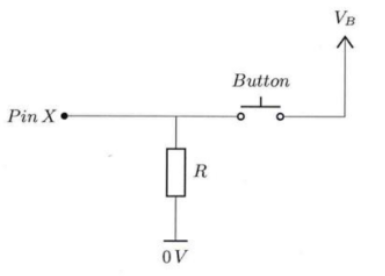
- 27In this circuit, Pin X shall be connected to a GPIO pin of a microcontroller and VB is a voltage considerably larger than 0V. (a) In order to monitor the state of the pin, what operating mode should the GPIO pin be configured to? (b) Based on the circuit above, explain how the information about the GPIO pin's state can be used to deduct if the button is pressed or not. (c) Motivate why the resistor R is included in the circuit. What is its function and what would happen if it was not there? (d) Assuming that your microcontroller operates with a supply voltage of 3 V, what is the minimally acceptable VB, if the microcontrollers datasheet defines ViH > 0.7V? Motivate.a) Input mode
b) If the button is pressed, the current will reach the pin. When there is current over the pin (VB) the pin will be set to 1.
c) R is a pull down resistor. If it wasn't there all the current would got to ground before it could reach the pin.
d) At least 2.1V. Because the voltage needs to be at least 70% of the supply voltage to be interpreted as high. - 28An embedded system is in many cases considered to be more cost sensitive than a general purpose computer. Motivate why. What consequences does that have on the implementation of an embedded system?An embedded system often needs to be cheaper because it is part of a larger product. This means that style and functionality sometimes need to be sacrificed for lower production costs.
Informationen
- Beschreibung
- Embedded systems Karteikarten am Embedded systems part 1, erstellt von Emma Alamaa am 13/10/2019.
- Erstellt von
- Emma Alamaa
- Aufrufe
- 0
- Bewertung