
Karteikarten
Physics-20
Karten in diesem Stapel (37)
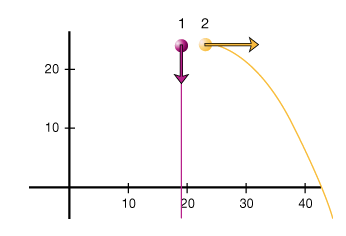
- 1which ball will hit the ground first?they will hit the ground at the same time.
REASONING: the vertical acceleration component of both balls is the same, regardless of the initial horizontal velocity of each ball.
(ball 2's horizontal velocity has no affect on its vertical velocity.) - 2what is the Cartesian method?a system for measuring directions (in terms of angles) using the x- and y-axis
- 3displacementa change in the position of an object including magnitude AND direction
- 4navigator methoda system for measuring directions using compass bearings
EG. 45 degrees south of east. - 5positionthe straight-line distance and direction of an object from the origin
NOTE: different from the displacement in that displacement is a change in position. - 6what is a scalar quantity?a measurement that has only magnitude
- 7what is a sign convention?a system for designating directions along a straight line; one direction is positive and the other is negative
EG. a compass rose - 8what is a vector quantity?a measurement that has a magnitude and a direction
EG. velocity - 9what is acceleration?a measure of the rate of change of velocity, in relation to time
- 10what is distance?the length of the path taken to move from one place to another. not necessarily a straight line.
- 11what is speed?a measure of the distance travelled per unit of time.
EG. m/s - 12what is velocity?a measure of the rate of change of position in relation to time
EG. m/s [N] - 13what is one-dimensional motion?motion in a straight line
- 14what is uniform motion?motion at constant speed in a straight line
- 15what is accelerated motion?motion of an object that is either increasing or decreasing in speed or changing direction
- 16what is the instantaneous velocity?the velocity of an object at an instant of time
- 17what is kinematics?the study of motion without concern for forces, masses, or energy
- 18what is the parallelogram method?a method of adding vectors:
the two vectors’ tails start at the same point and form sides of a parallelogram. the diagonal of the parallelogram that starts where the tails meet is the resultant (blue).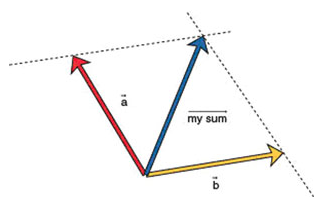
- 19what is the resultant?a vector sum of two or more other vectors.
- 20what is the tip-to-tail method?a method of adding vectors:
the second vector (yellow) begins at the end of the first vector (red). the resultant (blue) is from the tip of the first vector to the tail of the second vector.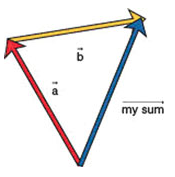
- 21what is a projectile?a moving object acted on by no forces other than gravity
- 22Newton's First Lawan object at constant velocity remains in constant velocity until an unbalanced force is applied
- 23Newton's Second Lawthe net acceleration is proportional to the net force
thus, Fnet = m(anet) - 24Inertia (2 points)a measure of mass
the amount of resistance to acceleration - 25Centripetal Forcethe sum of all forces acting towards the centre.
not always the same as net force. - 26what does it mean when there is 0 tension at the top of a rope during centripetal motion?Fc = Fg
- 27what does Fc = Fg mean? (centripetal motion) (2 points)you're at the top of the circle
you're going at the minimum speed required to stay on track - 28centripetal force will not change as long as—the object is moving in a circle at at constant velocity
- 29"an object at rest stays at rest until another force acts on it" is an example of which law?Newton's First Law
- 30"Fnet = m(anet)" is an example of which law?Newton's Second Law
- 31Law of Elliptical Orbitsplanets orbit the sun in elliptical orbits with the sun at one of the foci
(there is nothing at the other focus) - 32Law of Equal Areasplanets trace out equal areas in equal times
- 33Newton's Third Lawfor every action force, there exists a reaction force that is equal in magnitude but opposite in direction.
- 34net force vs total forcenet force is the sum of the forces acting on an object, including direction.
net force is a vector.
total force disregards the direction. - 35In Newton’s third law, the two forces not only act in different directions, they also act on different ________.objects
- 36How can it be possible that objects exert forces on each other without contact?Gravity!
- 37If everything exerts a force on each other, how come things fall to Earth instead of Earth coming to them?Magnitude of acceleration is inverse to mass, so the rate of acceleration of such a huge object is negligible.
Informationen
- Beschreibung
- Unit I: Kinematics
- Erstellt von
- j zed · Mär 2015
- Aktualisiert
- 19 Feb 2016
- Aufrufe
- 29
- Tags
- Bewertung