
Karteikarten
AP Macroeconomics: Chapter 16 - Aggregate Supply and Aggregate Demand
Karten in diesem Stapel (18)
- 1What is the average growth rate of the United States economy? What is the reality of this growth rate?Just over 3%.
The reality is, that there are very few instances where the economy has grown at the average rate. It typically grows faster than average in some years, and then real GDP may fall or negative growth my occur. - 2What are the two different phases in business cycles? What do they mean?Expansionary phase - when the GDP is rising
Contractionary phase - when the GDP is declining - 3What is the classical economic theory?The theory is based on Say's law, which states that supply generates demand and it is impossible to ever produce too much. Since production always produces the equivalent income, demand is always there.
- 4What are the classical economists' answer to the question "What if the employees choose to save their money instead of spending it?"The economists argue that when this happens, the demand curve will shift left, and then inventories will swell with products. In order to get rid of these products, producers will sell products at a lower rate.
- 5Why is supply always there for classical economists?Supply is composed of resources and technology, which means that as long as the resources and technology in an economy is abundant, there will be no issue.
- 6What did we get from the Keynesian theory?AS/AD model
- 7Aggregate supplyThe total goods and services produced by all producers in an economy for all consumers
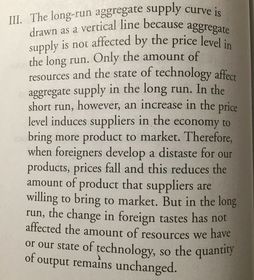
- 8Describe the graph of a long-run aggregate supply curve, and why it is drawn so.this curve is a vertical line. At the point where the line crosses the horizontal axis is where the real GDP is, or the quantity supplied by all suppliers. The reason why the line is vertical is because regardless of how high or low the prices of these goods are, they have no effect on how many resources and technology is in the economy. As long as the resources and technology is a permanent part of the economy (not a short-term addition/subtraction) it will be used towards the real GDP.
- 9Describe the graph of a short-run aggregate supply curve, and explain why this is so.this curve is upwards sloping. This is due to the fact that when suppliers expect prices to be lower in the future, they try to sell as much of their goods and services as possible, at a lower price to attract consumers. When suppliers expect prices to be higher in the future, they choose to withhold their inventory to realize bigger profits in the future.
- 10What are the three factors that affect the aggregate supply curve? Give an example for each.Changes in resource availability - discovery of oil fields
Changes in productivity - the government relaxes its policies which encourages large production
Changes in expected price level (only short term) - 11Aggregate demandThe total demand for all products and services all consumers are willing and able to purchase
- 12What are the three effects that help explain the inverse relationship in AGGREGATE demand?The Wealth Effect, the Interest Rate Effect, the Foreign Purchases Effect
- 13Explain the wealth effect and how it impacts aggregate demandPrice increases erode financial wealth. Any money they put in a savings account a couple years ago can buy them less goods/services now than it could back then. This encourages households to cut back on spending and save more for the goods and services they want/need.
- 14Explain the interest rate effect and how it affects aggregate demand.When the price rises, lenders are expecting inflation to ensue. This increases any interest rate they charge, modelling after the Fisher's Hypothesis. These higher interest rates leads to lower aggregate demand because the spenders often borrow the funds to make purchases.
- 15Explain the foreign purchases effect and how it affects the aggregate demandAs the prices of goods and services in the U.S. increase, it will generate less international interest. This will lower the exports the U.S. makes. In addition, the higher domestic prices will encourage more imports from other countries. This will increase U.S. exports. Therefore, the net exports will decrease. Furthermore, the prices of other foreign goods would be competitively priced, therefore less interest would go to U.S. goods
- 16What would shift the aggregate demand curve?Essentially, anything that affects the C, I, G, and net exports of a country.
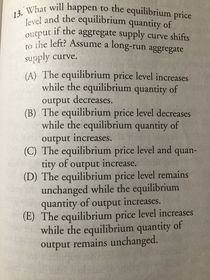
- 17—A
- 18FRQ III. Explain why the long-run aggregate supply curve is drawn as a vertical line and the short-run aggregate supply curve is drawn upward sloping. Explain why the long-run effects of a change in foreign tastes are different from the short-run effects.
Informationen
- Beschreibung
- Karteikarten am AP Macroeconomics: Chapter 16 - Aggregate Supply and Aggregate Demand, erstellt von bxyp am 11/03/2015.
- Erstellt von
- bxyp
- Aufrufe
- 1
- Bewertung