
Karteikarten
Art Midterm Exam

Karten in diesem Stapel (142)
- 1ModernismThe various strategies and directions employed in the 20th century - Cubism, Futurism, Expressionism, etc. - to explore the particular formal properties of any given medium
- 2IdeologyAll the ways we are brain-washed to believe things (i.e. propaganda, convention); a system of ideas and ideals
- 3ConventionBehavior that is considered acceptable or polite to most members of a society
- 4Critical ThinkingCritical thinking is that mode of thinking in which the thinker improves the quality of his or her thinking by skillfully analyzing, assessing, and reconstructing it.
- 5Sayre's Four Roles of the artist1. See the world in new and innovative ways.
2. Make a visual record of the people, places, and events of their time/place.
3. Give form to the immaterial (hidden or universal truths, spiritual forces, and personal feelings).
4. Give meaning and aesthetic value to functional objects. - 6Hermeneutic Circle of UnderstandingCycle of understanding > explanation > comprehension.
Accepts that one's first impression is neither fixed nor final, but that understanding is a continuous process of inquiry. - 7SemioticsThe study of signs; signifier, signified, sign
- 8SignThe pairing of signifier and signified; (i.e. the stop sign)
- 9SignifierThing that refers to signified; (i.e. the word "stop")
- 10SignifiedThing to which the signifier refers; (i.e. that you must stop at the stop sign)
- 11Denotation vs. ConnotationDenotation: Direct or literal meaning of an image
Connotation: Meaning associated with or implied by an image - 12MimesisRepresentation or imitation of the real world in art
- 13The Great Chain of BeingThe chain starts from God and progresses downward to angels, demons (fallen/renegade angels), stars, moon, kings, princes, nobles, men, wild animals, domesticated animals, trees, other plants, precious stones, precious metals, and other minerals.
- 14Steps of art criticismDescription, interpretation, evaluation and theorizing.
- 15Representational ArtPortrays natural objects in recognizable form
- 16Hierarchy of FormsForm of God > Higher Forms > Lower Forms > Material Objects > Images
- 17Abstract ArtThe less a work resembles real things, the more "abstract" it becomes
- 18Nonobjective/nonrepresentational artArt that does not refer to the natural world at all
- 19EthnocentrismWhen one judges another culture by the standards of one's own culture, leading us to make false assumptions about cultural differences, generalizations, and misinterpretation.
- 20FormThe shape, colour, medium, etc. of an artwork
- 21Hierarchy of Genres1. History Painting
2. Portraiture
3. Genre Painting
4. Landscape Painting
5. Animal Painting
6. Still Lifes - 22RomanticismA dramatic, emotional, and subjective art arising in the early 19th century in opposition to the strict discipline of Neoclassicism
- 23History PaintingHistory painting is the painting of scenes with narrative content from classical history, Christian history, and mythology, as well as depicting the historical events of the far or near past. These include paintings with religious, mythological, historical, literary, or allegorical subjects
- 24PortraiturePaintings of people that are to show the character and virtues, the qualities of good attributions ("godliness"), allow to see the figure as "a real person", and show the level or status of those in history. Functional objects are always used, often along with gestures, suggestion, and props.
(Because the artists were often paid by the patrons, it might not always turn out as a true depiction since they want to look better than they are) - 25Genre PaintingA style of painting depicting scenes from ordinary life, esp. domestic situations. Genre painting is associated particularly with 17th-century Dutch and Flemish artists
- 26Animal PaintingAn artist who specializes in or is known for their skill in the portrayal of animals, essentially up to about 1900
- 27Still LifeA painting or other two-dimensional work in which the subject matter is an arrangement of inanimate objects, brought together for their pleasing contrasts of shape, color, and texture.
- 28Traditional Themes- Art, Politics, and Community
- Art and Spiritual Belief
- Art and the Passage of Time
- Art and Beauty
- Art, Gender, and Identity
- Art, Science, and the Environment - 29The Formal Elements of Art- Line
- Space
- Light and Color
- Texture
- Pattern
- Time and Motion - 30LineOne of the most fundamental elements of art, it can possess direction, divide things, and reflect movement in nature.
- 31OutlineThe edge of a shape, depicted by actual line
- 32Contour LineThe perceived line that marks the border of an object in space.
- 33Implied LineA line in an artwork that is not physically there but suggested by points in the artwork; created by movement or direction
- 34Expressive LineA kind of line that seems to spring directly from the artist's emotions or feelings; loose, gestural, metaphorical and energetic
- 35Autographic LineLine that is distinct to the artist; signature or recognizable
- 36Classical/Analytic LinePrecise, logical, result from conscious reflection and application; in a deliberate and controlled manner.
- 37Line of SightAn imaginary straight line along which an observer looks
- 38CompositionThe organization of the formal elements in a work of art
- 39Two-Dimensional SpaceFlat with width and length, no depth
- 40Figure vs. GroundFigure = shape that appears to be resting on ground (positive space)
Ground = flat plane upon which lies a figure (negative space) - 41Picture PlaneIn perspective, the imaginary plane corresponding to the surface of a picture, perpendicular to the viewer's line of sight
- 42Three-Dimensional SpaceUses width, length, and depth, like objects in real life
- 43ScaleThe comparative size of an object in relation to other objects and settings
- 44Three-Dimensional IllusionIllusion of depth and perspective of objects like in the natural world
- 45Atmospheric/Aerial PerspectiveSuggests 3D space in the 2D space of the picture plane, and in which forms and objects distant from the viewer become less distinct, often bluer or cooler, and contrast among the various distant elements is greatly reduced
- 46Linear/Analytic PerspectiveThings perceived as far away are smaller, and all lines converge to a single vanishing point
- 47One-Point Linear PerspectiveOne vanishing point
- 48Two-Point Linear PerspectiveTwo vanishing points
- 49Vanishing PointThe point on the horizon line where parallel lines appear to converge
- 50Vantage PointThe point where the viewer is positioned
- 51Frontal vs. Diagonal PerspectiveVanishing point directly across from vantage point vs. Vanishing point off to the side of vantage point
- 52Axonometric vs. Oblique projectionAxonometric = all lines remain perpendicular, no vanishing
Oblique = buildings parallel on angle to each other - 53ForeshorteningPortray or show (an object or view) as closer than it is or as having less depth or distance, as an effect of perspective or the angle of vision
- 54Light and ColourThe property possessed by an object of producing different sensations on the eye as a result of the way the object reflects or emits light
- 55Additive vs. Subtractive ColourAdditive = when adding light hues together, the resulting mixture will be lighter in key and brighter
Subtractive = when adding pigment hues together, the resulting mixture will be lower in key and duller - 56HueA color, as found on a color wheel
- 57ShadeA color modified by the addition of another color, resulting in a hue of a darker value
- 58TintA color modified by the addition of another color, resulting in a hue of a lighter value
- 59Colour Wheel
- 60TextureThe surface quality of a work
- 61Actual vs. Implied texturePhysical texture vs. Texture within the painting (i.e. lines of grass)
- 62PatternA repetitive motif or design
- 63Principles of Design- Balance
- Emphasis and Focal point
- Scale and Proportion
- Repetition and Rhythm
- Unity and Variety - 64BalanceThe even distribution of weight in a composition
- 65Radial BalanceA circular composition in which the elements project outward from a central core at regular intervals
- 66Visual WeightThe apparent heaviness or lightness of a shape or form
- 67Focal PointThe center of visual attention
- 68Afocal ArtArt with no particular focal point
- 69RhythmEffect achieved when shapes, colors, or a regular pattern of any kind is repeated over and over again
- 70RepititionWhere a pattern is repeated over and over again.... creates rhythm
- 71Symmetry vs. Bilateral Symmetry vs. AsymmetryTwo halves correspond vs. Overall effect suggests absolute symmetry, while there are clear differences from side to side vs. Neither side reflects the other
- 72ProportionThe relationship between the parts to each other and to the whole
- 73Divine Proportion

- 74Classical Composition

- 75Sayre's 7 Steps to Thinking Critically1. Identify the artist's decisions and choices
2. Ask questions. Be curious
3. Describe the object
4. Question your assumptions
5. Avoid an emotional response
6. Don't oversimplify or misrepresent the art object
7. Tolerate uncertainty - 76Arms-LengthKeeping at a distance, avoiding political influence
- 77Venus of Willendorf

- 78Romulus and Remus
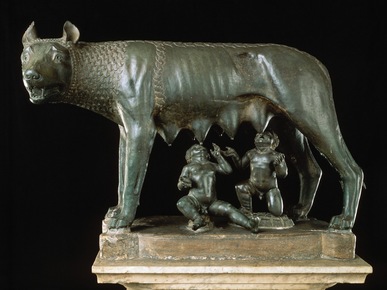
- 79Chartres Cathedral/Rose Window

- 80Assumption of a Virgin: Line of Sight

- 81The Last Supper: One-Point Perspective

- 82Geurilla GirlsAnonymous feminists who speak activism through art, often with humor
- 83Canada Council for the Arts- Established in 1957 to act as an arts council of the government of Canada
- Created to foster and promote the study and enjoyment of, and the production of works in, the arts
- Funds Canadian artists and encourages the production of art in Canada
- Has supervisory authority over Art Bank - 84Kumano Mandala: Oblique Projection

- 85Subject matter vs. ContentWhat images literally depict vs. What images mean
- 86The Six Major Art Themes1. Art, Politics, and Community
2. Art and Spiritual Belief
3. Art and the Passage of Time
4. Art and Beauty
5. Art, Gender, and Identity
6. Art, Science, and the Environment - 87Visual LiteracyThe ability to recognize why you like a certain piece of art and how it communicates to you, and be able to communicate those reasons.
- 88Chief form of Islamic artThe fine art of handwriting (i.e. sacred texts)
- 89RealismRepresentations that closely resemble what the eye sees in the natural world
- 90PhotorealismArt so realistic that it appears to be a photograph
- 91SublimeCaptures an immensity so large that it could hardly be comprehended by the imagination
- 92NaturalismDescriptive of an artwork that closely resembles forms in the natural world.
- 93IconographyA system of visual images in which the meaning is widely understood by a given culture or cultural group
- 94SymbolsImages that represent something more than their literal meaning
- 95Creative Process of SeeingReception, extraction, inference
- 96The Four Steps to Criticizing Art1. Describe - internal/external sources of info
2. Interpret - from info into meaning, opinion based on criteria
3. Evaluate
4. Theorize - 97The Art SystemExamples are:
- individuals making art objects
- cooperatives
- artist-run-centres
- municipal and public galleries
-major museums
-commercial galleries
- art fairs
-auction houses - 98Cooperatives and Artist Run Centres- run by artists
- serves artist and public audience
- valued for experimentation
- peer jury
- might have certain themes
- new artists may get experience, may not necessarily sell any art - 99Municipal and Public Galleries- run by arts administrators through the gov't
- serves public, broad range of usually contemporary artists (local to international)
- values art by ability to inspire public to see the world in new ways - 100Major Museums-run by "big shots" (world experienced)
- serves public collections of culturally important art works, by known living and non-living artists
- value for regional/national/global cultural legacy, "excellence", understanding and advancement of knowledge. - 101Commercial Galleries- run by private business people
- serves art buyers, represent both living and dead artists, the commercial owner (for monetary purposes)
- sometimes media or regional specific
- valued for ability to be bought and sold - 102Art Fairs- run by countries, states, museums, private organizations
- serves countries, states, art dealers, art buyers, and sometimes the artist
- valued for being "ground-breaking", or for profit-making capacity - 103Auction Houses- charge people commission (rates based on what is being sold)
- 15% to auction house when buying art pieces
- very expensive, for very wealthy people - 104Who funds Cooperatives?Artist membership holders and public arts funding bodies
- 105Who funds artist-run-centres?Primarily, arts funding bodies
- 106Who funds municipal and public galleries?Arts funding bodies, cities, and municipalities
- 107Who funds major museums?Governments and cities
- 108Who funds Commercial galleries?Owners, artists (50%), and private/corporate companies
- 109Who funds Art Fairs?Governments and corporate sponsors
- 110Who funds Auction Houses?Very wealthy buyers
- 111What is to "value art for art's sake"?To value art as an aesthetic object, to value the beauty of its forms rather than its functional practicality or impact on society
- 112LandscapeThe depiction of natural scenery, which can evoke different feelings, such as freedom of space, paradise, enlightenment, or warmth.
- 113Group of Seven1. Franklin Carmichael
2. Lawren Harris
3. A. Y. Jackson
4. Frank Johnston
5. Arthur Lismer
6. J. E. H. MacDonald
7. Frederick Varley
(Unofficial members included Tom Thomson and Emily Carr) - 114Art and BeautyWe find beauty in art that is "not of this world", that gives beauty to everyday life (the "good life"), that gives aesthetic value to functional objects (that we might otherwise not find beauty in), and things that we might consider to be for an aesthetic purpose, while other cultures may not (i.e. the kimono)
- 115Art and ReligionArt that involves religious rituals and stories, recognizes or celebrates the connection between earth and "heaven", gives religious value to material things, indicates myths of origin and afterlife, or is created as an offering or "thanks" to gods.
- 116IconicUses images perceived or known in reality to represent higher beings.
- 117AniconicUses images, symbols, or allusional depictions
- 118IconoclasticTotal rejection of figural or symbolic images to represent higher beings
- 119Art and PoliticsArt that shows social achievements and control (propaganda), symbolizes political beliefs or ideologies, celebrates lives and cause (i.e. soldiers), and praises nations values and politics. This can be through literal depictions (i.e. paintings of battles) or abstract depictions). These are images that speak to the wealthy nations and reuse imagery or themes from the past to express a point.
- 120Identity and SubjectivityMovements in sexuality, ethnicity, lifestyle, change gaze from women to men, specific things to say about humanity
- 121Pop culture and Consumer societyAdvertising, graffiti, debate between "high art" and "low art", everyday forms that highlight our lives and experiences
- 122Mass MediaTransmits information to huge masses of people
- 123Post-ModernismMoved further from tradition, new ideas with traditional forms, theories of philosophies, critical thinking, anthropology
- 124TechnologyVideo and performance art, still frames, sometimes video exclusive, virtual environments, sensory, auditory
- 125Art and Social EngagementRepresent current social situations, "repair" social issues, interaction, collaboration, asks questions, fosters human relationships
- 126Passive LineMoves across in a regular and undisturbed way
- 127Gestural LineEmotive line in no particular form
- 128ShapeA 2D area measured in terms of length and width; the form of any object or figure
- 129MassA 3D area measured in terms of length, width, and height
- 130RelativityShows the depth, shadows, and relative positioning (3D illusions)
- 131ChiaroscuroUse of dark and light to create depth
- 132PerspectiveThe art of drawing solid objects on a two-dimensional surface so as to give the right impression of their height, width, depth, and position in relation to each other when viewed from a particular point
- 133Baroque
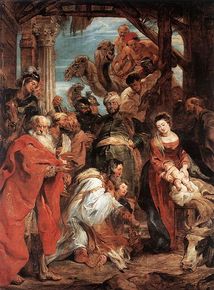
- 134Contrapposto

- 135Cubism

- 136ExpressionismAn art that stresses the psychological and emotional content of the work, associated particularly with German art in the early 20th century
- 137FuturismAn early 20th century art movement, characterized by its desire to celebrate the movement and speed of modern industrial life
- 138NeoclassicismA style of the late 18th and early 19th centuries that was influenced by the Greek Classical style and that often employed Classical themes for its subject matter
- 139Post-ImpressionismPaintings working with widely different styles, in France during the last decades of the 19th century
- 140Post-ModernismA term used to describe the willfully plural and eclectic art forms of contemporary art
- 141RenaissanceThe period in Europe from the 14th to the 16th century characterized by a revival of interest in the arts and sciences that had been lost since antiquity
- 142SurrealismA style of art of the early 20th century that emphasized dream imagery, chance operations, and rapid, thoughtless forms of notation that expressed the unconscious mind
Informationen
- Beschreibung
- ART 100 Karteikarten am Art Midterm Exam, erstellt von chipaway am 11/10/2013.
- Erstellt von
- chipaway
- Aufrufe
- 397
- Tags
- Bewertung