
Karteikarten
SBR - Chapter 1
Karten in diesem Stapel (52)
- 1'Fair presentation''Fair presentation' is the term used in IAS 1 Presentation of Financial Statements equivalent to the
concept of 'true and fair view'. - 2In order to achieve fair presentation, an entity must comply with (IAS 1: para. 15):
International Financial Reporting Standards (IFRSs). - 3These comprise (IAS 1 para. 7):– International Financial Reporting Standards (IFRSs)
– International Accounting Standards (IASs)
– Interpretations of Standards; and
The Conceptual Framework for Financial Reporting. - 4) The objective of general purpose financial reportingThe objective of general purpose financial reporting is to provide financial information about the reporting entity that is useful to existing and potential investors, lenders and other creditors in making decisions about providing resources to the entity. Those decisions involve buying, selling or holding equity and debt instruments, and providing or
settling loans and other forms of credit.' ( - 5Three aspects are relevant to the user of the financial statements here (CF: paras. OB17–21): Financial performance reflected by accrual accounting
Financial performance reflected by past cash flows
Changes in economic resources and claims not resulting from financial
performance, eg a share issue. - 6Reporting entityThis section is addded by IASB as soon as before
- 7Fundamental CharacteristicsRelevance
Faithful representation - 8Enhance QualitativeComparability
Verifiability
Timeliness
Understandability - 9Cost Constraint on useful financial reportingBenefit of reporting information should justify the cost
- 10Underlying assumptionFinancial statements are normally prepared on the assumption that an entity is a going
concern and will continue in operation for the foreseeable future (CF: para. 4.1). - 11ELEMENTS OF FINANCIAL STATEMENTS ASSETA resource controlled by the entity
as a result of past events and from
which future economic benefits
are expected to flow to the entity. - 12LIABILITYA present obligation of the entity
arising from past events, the
settlement of which is expected to
result in an outflow from the entity
of resources embodying economic
benefits. - 13EQUITYThe residual interest in the assets
of the entity after deducting all its
liabilities. - 14INCOMEIncreases in economic benefits
during the accounting period in the
form of inflows or enhancements
of assets or decreases of
liabilities that result in increases in
equity, other than those relating to
contributions from equity
participants. - 15EXPENSEDecreases in economic benefits
during the accounting period in the
form of outflows or depletions of
assets or incurrences of
liabilities that result in decreases in
equity, other than those relating to
distributions to equity
participants. - 16Recognition of the elements of financial statementsAn item that meets the definition of an element is recognised if (CF: para. 4.38):
It is probable that any future economic benefit associated with the item will flow to or from the entity; and
The item has a cost or value that can be measured with reliability. - 17(iv) Measurement of the elements of financial statementsDifferent bases of measurement of the elements of financial statements can be used
Historical cost;
Current cost;
Realisable (settlement) value; and
Present value. - 18Concepts of capital and capital maintenanceThis section discusses alternative capital maintenance concepts and determination of
- 19RevenueThe core principle of IFRS 15 Revenue from Contracts with Customers is that an entity recognises revenue to depict the transfer of promised goods or services to customers in an amount that reflects the consideration to which the entity expects to be entitled in exchange for those goods or services (IFRS 15: para. IN7).
- 20Income:increases in economic benefits during the accounting period in the form of inflows or
enhancements of assets or decreases of liabilities that result in an increase in equity, other than those relating to contributions from equity participants. - 21Revenue:i ncome arising in the course of an entity's ordinary activities.
- 22Contract:an agreement between two or more parties that creates enforceable rights and
obligations. - 23Contract asset:an entity's right to consideration in exchange for goods or services that the entity has transferred to a customer when that right is conditioned on something other than the passage of time (for example the entity's future performance).
- 24R eceivable:an entity's right to consideration that is unconditional – ie only the passage of time is required before payment is due.
- 25Contract liability:an entity's obligation to transfer goods or services to a customer for which the
entity has received consideration (or the amount is due) from the customer. - 26Customer:a party that has contracted with an entity to obtain goods or services that are an output
of the entity's ordinary activities in exchange for consideration. - 27Performance obligation: a promise in a contract with a customer to transfer to the customer either:(a) A good or service (or a bundle of goods or services) that is distinct; or
(b) A series of distinct goods or services that are substantially the same and that have the same
pattern of transfer to the customer. - 28Stand-alone selling price:he price at which an entity would sell a promised good or service
separately to a customer. - 29Transaction price: the amount of consideration to which an entity expects to be entitled in
exchange for transferring promised goods or services to a customer, excluding amounts collected on
behalf of third parties. - 30Approach to revenue recognition1) Identify contract with the customer
2) Identify performance obligation(s)
(3) Determine transaction price
(4) Allocate transaction price to performance obligations
5) Recognise revenue when (or as) performance obligation satisfied - 311) Identify contract with the customerThe model applies where a contract exists
and all of the following criteria are met :
The parties have approved the contract The entity can identify each party's rights The entity can identify payment terms The contract has commercial substance It is probable that entity will collect the consideration - 322) Identify performance obligation(s)At contract inception, an entity shall assess the goods and services promised in a contract with a customer and shall identify as a performance obligation each promise to transfer to the customer either (IFRS 15: para. 22): A good or service (or a bundle of goods or services) that is distinct (ie the customer can benefit from good or service on its own or together with other readily available resources and the entity's promi (se is separately identifiable from other promises in the contract); or A series of distinct goods or services that are substantially the same and that have the same pattern of transfer to the customer. Note. If a promised good or service is not distinct, an entity shall combine that good or service with other promised goods and services until it identifies a bundle of goods or services that is distinct. (IFRS 15: para. 30)
- 33(3) Determine transaction priceThe amount to which the entity expects to be 'entitled'
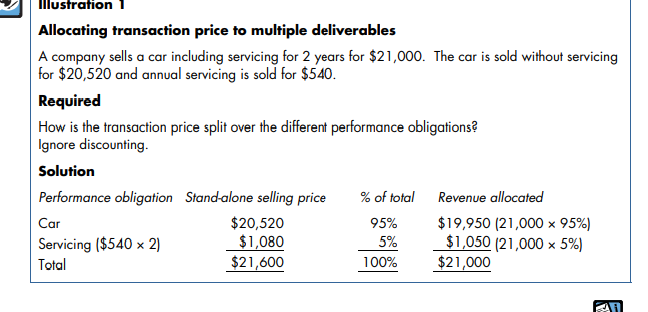
Includes variable consideration if highly probable that significant reversal of cumulative revenue will not occur (IFRS 15: para. 56). Measure variable consideration at (IFRS 15: para. 53): Probability-weighted expected value (eg if large number of contracts with similar characteristics); or Most likely amount (eg if only two possible outcomes). Discounting is not required where consideration is due in less than one year (where discounting is applied, present interest separately from revenue) (IFRS 15: para. 63) - 34(4) Allocate transaction price to performance obligationsMultiple deliverables: transaction price allocated to each separate performance obligation in proportion to the stand-alone selling price at contract inception of each performance obligation
- 35(5) Recognise revenue when (or as) performance obligationsatisfied A performance obligation is satisfied when the entity transfers a promised good or service (ie an asset) to a customer (IFRS 15: para 31). An asset is considered transferred when (or as) the customer obtains control of that asset (IFRS 15: para 31). Control of an asset refers to the ability to direct the use of, and obtain substantially all of the remaining benefits from, the asset (IFRS 15: para 33).
- 36Example
- 37Transfer of control of a good or serviceSatisfaction of a performance obligation over time An entity transfers control of a good or service over time and, therefore, satisfies a performance obligation and recognises revenue over time
- 38if one of the following criteria is met(a) The customer simultaneously receives and consumes the benefits provided by the entity's performance as the entity performs;
(b) The entity's performance creates or enhances an asset (eg work in progress) that the customer controls as the asset is created or enhanced; or
(c) The entity's performance does not create an asset with an alternative use to the entity and the entity has an enforceable right to payment for performance completed to date. For each performance obligation satisfied over time, revenue should be recognized by measuring progress towards complete satisfaction of that performance obligation - 39Satisfaction of a performance obligation at a point in time To determine the point in time when a customer obtains control of a promised asset and an entity satisfies a performance obligation, the entity would consider indicators of the transfer of control that include, but are not limited to, the following (IFRS 15: para. 38):(a) The entity has a present right to payment for the asset;
(b) The customer has legal title to the asset;
(c) The entity has transferred physical possession of the asset;
(d) The customer has the significant risks and rewards of ownership of the asset; and
(e) The customer has accepted the asset. - 40Costs of obtaining a contractIncremental costs of obtaining a contract are recognised as an asset if the entity expects to recover them (IFRS 15: para. 91).
- 41Costs to fulfil a contractIf the costs to fulfil a contract are not within the scope of another standard (eg IAS 2 Inventories, IAS 16 Property, Plant and Equipment or IAS 38 Intangible Assets), they should be recognised as an asset only if they meet all of the following (IFRS 15: para. 95):
- 42Folowing(a) The costs relate directly to a contract or an anticipated contract that the entity can specifically identify;
(b) The costs generate or enhance resources of the entity that will be used in satisfying (or in continuing to satisfy) performance obligations in the future; and
(c) The costs are expected to be recovered. Amortisation and impairment of costs recognised as an asset The asset should be amortised (to profit or loss) on a systematic basis consistent with the pattern of transfer of the goods or services to which the asset relates (IFRS 15: para. 99). For the costs of obtaining a contract, if the amortisation period is estimated to be one year or less, the costs may (as a practical expedient) be recognised as an expense when incurred (IFRS 15: para. 94). - 43Amortisation and impairment of costs recognised as an assetThe asset should be amortised (to profit or loss) on a systematic basis consistent with the pattern of transfer of the goods or services to which the asset relates (IFRS 15: para. 99). For the costs of obtaining a contract, if the amortisation period is estimated to be one year or less, the costs may (as a practical expedient) be recognised as an expense when incurred (IFRS 15: para. 94).
- 44impairment lossrecognised in profit or loss to the extent that the carrying amount exceeds (IFRS 15: para. 101):
(a) The remaining amount of consideration that the entity expects to receive in exchange for the goods or services to which the asset relates; less
(b) The costs that relate directly to providing those goods or services that have not yet been recognized as expenses. 2.6 Presentation When either party to a contract has performed, an entity shall present the contract in the statement of financial position as a contract asset (eg if entity transfers goods or services before customer pays) or as a contract liability (eg if customer pays before entity transfers goods or services) (IFRS 15: para. 105). - 45PresentationWhen either party to a contract has performed, an entity shall present the contract in the statement of financial position as a contract asset or as a contract liability Any unconditional rights to consideration should be shown separately as a receivable (IFRS 15: para. 105).
- 46Sale with right of returnRecognise all of (IFRS 15: para. B21): (a) Revenue for the transferred products in the amount of consideration to which the entity expects to be entitled (ie revenue not recognised for products expected to be returned); (b) A refund liability; and (c) An asset (and corresponding adjustment to cost of sales) for its right to recover products from customers on settling the refund liability
- 47WarrantiesIf customer has the option to purchase a warranty separately, treat as separate performance obligation under IFRS 15 (IFRS 15: para. B29). If customer does not have the option to purchase a warranty separately, account for the warranty in accordance with IAS 37 Provisions, Contingent Liabilities and Contingent Assets (IFRS 15: para. B30). If a warranty provides the customer with a service in addition to the assurance that the product complies with agreed-upon specifications, the promised service is a performance obligation (IFRS 15: para. B32).
- 48Principal versus agentIf the entity controls the specified goods or service before transfer to a customer, it is a principal (IFRS 15: para. B35) Revenue = gross amount of consideration If the entity arranges for goods or services to be provided by the other party, it is an agent (IFRS 15: para. B36) Revenue = fee or commission Indicators that an entity controls the goods or services before transfer and therefore is a principal include (IFRS 15: para. B37): (a) The entity is primarily responsible for fulfilling the promise to provide the specified good or service; (b) The entity has inventory risk; (c) The entity has discretion in establishing the price for the specified good or service.
- 49Non-refundable upfront feesIf it is an advance payment for future goods and services, recognise revenue when future goods and services provided (IFRS 15: para. B49)
- 50Interim financial report (IAS 34):a financial report containing either a complete set of financial statements (as described in IAS 1) or a set of condensed financial statements (as described in IAS 34) for an interim period.
- 51The minimum components of an interim financial report prepared in accordance with IAS 34 are:A condensed statement of financial position;
A condensed statement of profit or loss and other comprehensive income;
A condensed statement of cash flows; A condensed statement of changes in equity;
and Selected explanatory notes. - 52(a) The stated purposes of the Conceptual Framework are as follows.(i) To assist the Board in the development of future IFRSs and in its review of existing IFRSs.
(ii) To assist the Board in promoting harmonisation of regulations, accounting standards and procedures by reducing the number of alternative accounting treatment permitted by IFRSs.
(iii) To assist national standard-setting bodies in developing national standards.
(iv) To assist preparers of financial statements in applying IFRSs and in dealing with topics that have yet to form the subject of an IFRS.
(v) To assist auditors in forming an opinion on whether financial statements comply with IFRSs.
(vi) To assist users of financial statements in interpreting the information contained in financial statements prepared in compliance with IFRSs.
(vii) To provide those who are interested in the work of the IASB with information about its approach to the formulation of IFRSs
Informationen
- Beschreibung
- Karteikarten am SBR - Chapter 1 , erstellt von D A am 21/11/2020.
- Erstellt von
- D A
- Aufrufe
- 0
- Bewertung