
Karteikarten
Waves
Karten in diesem Stapel (15)
- 1Physics Unit 2: WAVESKey Points:
- superposition and standing waves
- the electromagnetic spectrum
- refraction
- polarisation
- diffraction
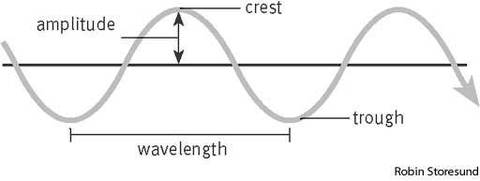
- pulse-echo techniques - 2—Amplitude: max displacement from normal
Wavelength: from the point on 1 wave to the same point on the next wave - 3Key wave definitions: Frequency: number of oscillations per second/number of wave fronts passing a point per second Time period: the time taken for one complete oscillation to occur SpeedT = 1
f
v = f λ - 4Transverse waves: waves oscillate at 90˚ to the direction of travel e.g. light, radio (electromagnetic spectrum) Longitudinal waves: waves oscillate along the direction of travel e.g. sound

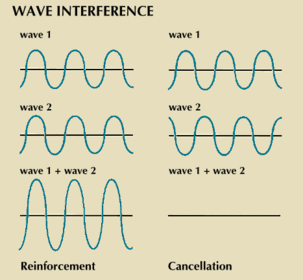
- 5When 2 waves interfere, superposition occurs. The resultant displacement of the point on the 'new' wave is the sum of the displacement at that point of the other two waves, which interfere.If the 2 waves are in phase (crests occurring at the same places), then constructive interference occurs
If the 2 waves are out of phase, or in antiphase, then destructive interference occurs - 6—Interference patterns are formed when the waves are coherent: they have the same frequency, a constant phase difference and similar amplitudes. The path difference dictates the interference pattern - see Young's Double Slit experiment
- 7Stationary waves These are created when 2 waves of the same amplitude, frequency and speed are superimposed. They have nodes (points of no displacement) and antinodes (points of max displacement). e.g. a guitar stringProgressive waves travel and transfer energy along the wave. They do not have nodes and antinodes
- 8Stationary waves - all points within 1 wavelength have the same phase - all points in one loop are in antiphase with the next loop - amplitude depends on position - all points oscillate with the same frequency (except the nodes) - energy remains in the system and does not travelProgressive waves
- all points within 1 wavelength have different phase
- amplitude is the same for all points
- there are no nodes. All points oscillate
- energy is transferred with the wave - 9The electromagnetic spectrum: Type Wavelength(x10^)Frequency (x10^) Gamma -16 ➡️ -10 24 ➡️ 19 X-rays -12 ➡️ -8 24 ➡️ 18 Ultraviolet -10 ➡️ -7 19 ➡️ 16 Visible -8 ➡️ -6 16 ➡️ 13 Infrared -6 ➡️ -3 13 ➡️ 11 Microwaves -4 ➡️ -1 11 ➡️ 9 Radio waves -1 ➡️ 4 12 ➡️ 3Radio waves: for radio and TV transmissions. Very long wavelength, so diffraction not much of an issue
Microwaves: used for mobile phone signals
Visible light: Is a spectrum (ROYGBIV)
X-rays are penetrating& have medical uses
Gamma rays: dangerous! - 10The Doppler Effect When waves are emitted from a moving source/received by a moving boundary, the detected frequency differs from the emitted frequency. The shift in frequency is proportional to the relative speed of the motion.

- 11—Pulse-echo techniques, such as RADAR and Ultrasound, rely on waves reflecting from a boundary between 2 media. The time the wave takes can be used to find the distance to the boundary, and so build up a picture.
v = fλ and s = vt
- 12Refraction Waves refract when they travel into a different medium. The refractive index is a measure of how much the velocity changes and therefore how much the direction changes.Snell's Law
μ = sin i˚
sin r˚
or μ v i
v r
- 13Total Internal Reflection It is possible that the wave reflects inside the denser medium, rather than refracting. This occurs when the angle of incidence is greater than the critical angle C˚μ = 1
sin C˚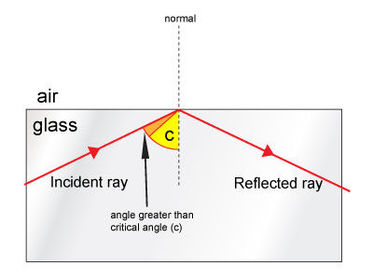
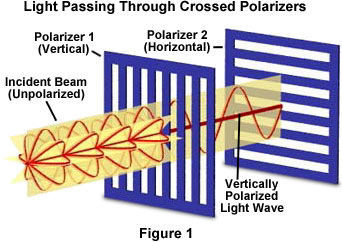
- 14Polarisation Unpolarised waves have oscillations occurring in all planes. Waves can be polarised, and this means that oscillations occur in only one plane. These waves (transverse only) are said to be plane polarised.
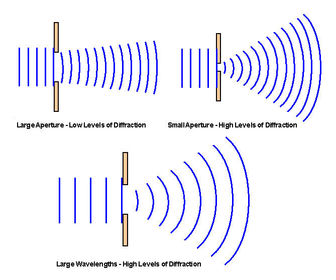
- 15Diffraction When a waves encounters an obstacle or a gap, it diffracts, This means that the wave fronts spread out. Wave diffraction is greatest when the obstacle is of similar size to the wavelength
Informationen
- Beschreibung
- Cue cards on Edexcel Physics Unit 2: Waves
- Erstellt von
- Niamh Walsh
- Aufrufe
- 135
- Tags
- Bewertung