
Karteikarten
Reaction Rates
Karten in diesem Stapel (22)
- 1Collision theory- Molecules must collide in order to react.
- The collision must disrupt the existing bonds of the reactants so that new bonds can form between colliding particles.
- The greater the no. of collisions per unit time, the faster the reaction rate.
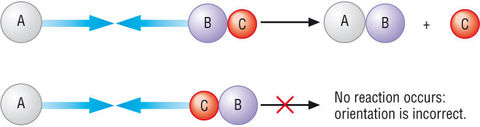
- Only effective collisions will result in a reaction taking place. - 2Reactants must collide with:1) Sufficient kinetic energy
2) A correct orientation - 3Sufficient kinetic energy- Approaching molecules have negatively charged electron clouds.
- Molecules must have sufficient Ek to overcome the force of repulsion between clouds. - 4Correct orientationEnd to end collisions are not as effective as no permanent rearrangement of electrons can take place.
- 5Correct orientation
- 6Factors that affect the reaction rate are:1. Temperature
2. Concentration
3. Catalyst
4. Surface area
5. Nature of reactants - 7Temperature- As temperature increases, the average Ek of the particles increases.
- More effective collisions occur with energy greater than the activation energy.
- Inrease in temperature affects an endothermic reaction more than an exothermic. - 8Surface Area- The greater the surface area, the more molecules that are exposed to effective collisions and the faster the reaction rate.
- 9Catalyst- It increases the rate of the reaction by decreasing the activation energy, resulting in more collisions colliding with the sufficient energy to be effective.
- 10Concentration- Increase in concentration increases the number of particles per unit volume, resulting in more effective collisions per unit time and a faster reaction rate.
- 11Nature of reactants- Complex molecules and ions react slower than simple molecules and atoms as the interpenetration of the electron cloud is more difficult.
- 12Graphs- The faster the rate, the steeper the gradient.
- When the gradient is 0, the reaction has stopped because the reagent is NOT in excess.
- All experiments will level out at the same point as the quantity of the reactants used. - 13Types of reactions1) Combustion
2) Photochemical - 14Combustion- Combustion of fuels in oxygen produces heat energy.
- Combustion of hydrocarbons produces carbon dioxide and water.
- Combustion of fuels is vital for industry (e.g. oil, coal, natural gas/methane). - 15Fossil Fuels1) Non-renewable.
2) Increase percentage of greenhouse gases in the atmosphere. - 16Hydrogen- Used as a fuel in rockets and cars.
- Clean fuel (water is the only product formed). - 17Sources of hydrogen1. Natural gas (methane)
2. Electrolysis of water - 18Disadvantages of hydrogen (fuel)1. Difficult to store.
2. Costly/expensive.
3. Explosive when mixed with oxygen - 19Explosive combustion- Occurs when activation energy is small but enthalpy change is large.
- A large amount of energy is given off and it occurs in flour mills. - 20Photo-chemical ReactionLight provides the energy for the chemical reactions to occur.
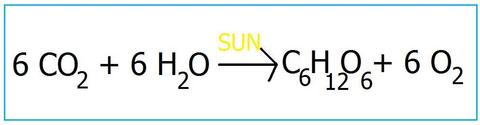
- 21PhotosynthesisChlorophyll uses light to convert water and carbon dioxide into glucose and oxygen.
- 22Black and white photography- Silver salts darken when exposed to light.
- Silver chloride and silver bromide will darken when exposed to light.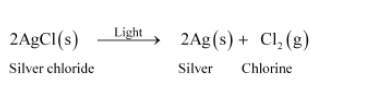
Informationen
- Beschreibung
- Cambridge IGCSE Chemistry, Biology and Physics Karteikarten am Reaction Rates, erstellt von Taylor Smith am 28/05/2015.
- Erstellt von
- Taylor Smith
- Aufrufe
- 3
- Bewertung