
Karteikarten
Physics 2 webworks
Karten in diesem Stapel (44)
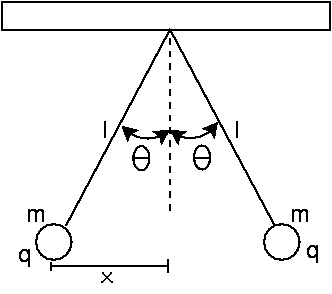
- 1Two identical balls of are suspended from threads of length and carry equal charges as shown in the figure. Each ball is from the centerline. Assume that the angle is so small that its tangent can be replaced by its sine. This is called the small angle approximation and means that for small angles . Find the magnitude of charge on one of the balls.sqrt[(4x^3*m*g)/k*l]
- 2Electric forces between two charged objects tend to be much stronger in magnitude than the attractive gravitational force between them. Two particles of masses m1, m2 and charges q1, q2 respectively are separated by a distances d. Find the magnitude of the ratio of the gravitational to electric forces between them.(Gm1m2)/(kq1q2)
- 3We have three charges, Q1, Q2, and Q3, arranged in a straight line. Q2 is d1 to the right of Q1. Q3 is d2 to the right of Q2. Assume that the charges are arranged as before, and that they have the following sizes. Calculate the total force on Q2. If the net force is to the left, enter it as a negative number. Otherwise, enter it as a positive number.kQ1Q2/d1^2 +kQ3Q2/d2^2
- 4A non-uniformly charged semicircle of radius R lies in the xy plane, centered at the origin, as shown. The charge density varies as the angle θ according to λ, where λ has units of microcoulombs per meter. 1) What is the total charge on the semicircle? 2) What is the y component of the electric field at the origin1) (λ*R* pi^2)/2
2) -λkpi/R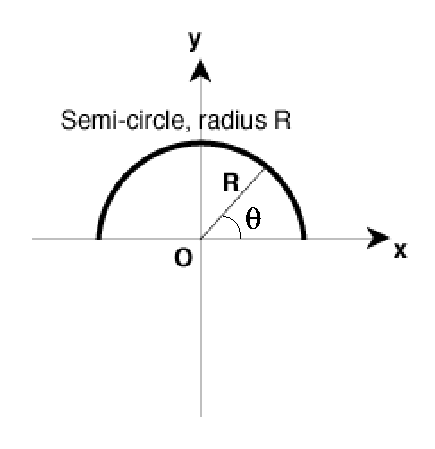
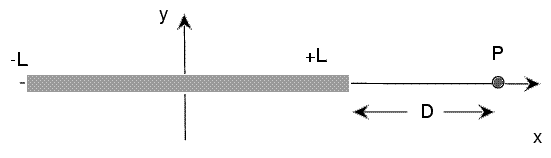
- 5A charged rod of total length L lies centered on the x axis as shown. The rod has a charge density which varies according to λ =ax^2. 1) What is the total charge on the rod?1) 1/3*a*2L^3
- 6We have an electric flux of magnitude B passing through a flat horizontal surface with an area of A. The flux is due to a uniform electric field, which points theta degrees above the horizontal. Find the magnitude of the electric field.B/Asin(theta)
- 7We have point charge of size Q sitting a distance d/2 directly above the center of a square of side length d. What is the magnitude of the electric flux through the square?1/6 * Q/eps0
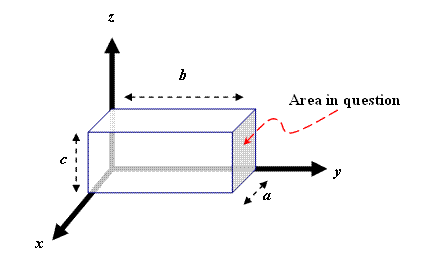
- 8What is the magnitude of the electric flux passing through the shaded area?wsub2*a*c^3*(1/3)
- 9We have a nonconducting solid sphere of radius R carrying a uniformly distributed positive charge of Q. 1) What is the magnitude of the electric field at a point r, where rR?1) kQr/R^3
2) kQ/r^2 - 10A long insulating cylindrical shell has an inner radius of a and an outer radius of b. The shell has a constant charge density of ρ.. The picture shows an end-on cross-section of the cylindrical shell. 1)What is the magnitude of the electric field at a distance of r where r>b? 2) What is the magnitude of the electric field at a distance of r where a1) ρ(b^2-a^2)/2*r*eps0
2) ρ(r^2-a^2)/2*r*eps0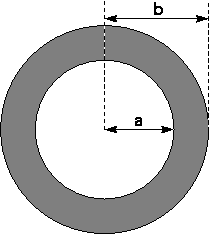
- 11An infinitely long solid cylinder of radius r has a non-uniform volume charge density given by ρ=4r^3. 1) Calculate the magnitude of the electric field at a distance at point R where Rr1) 4R^4/5eps0
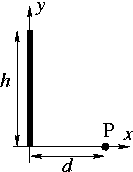
2) 4r^5/5Reps0 - 12A line of charge with a non-uniform charge density λ=ay lies along the y axis with one end at the origin and the other at y=h. 1) What is the total charge? 2) Calculate the electric potential of this line of charge at point P on the axis a distance of d from the origin. Assume the potential equals zero at infinity.1)(a*h^2)/2
- 13The potential difference between two parallel plates is V. An alpha particle with mass of m and charge of q is released from rest near the positive plate. What is the speed of the alpha particle when it reaches the other plate? The distance between the plates is d.sqrt[(2*q*V)/m]
- 14A spherical rain drop carries a charge of q and has a potential of V at the surface. Find the surface area of the drop assuming that the potential equals zero at infinity.r=kq/V, A=4pi*r^2
- 15A long cylindrical insulating shell has an inner radius of a and an outer radius of b . The shell has a constant charge density of ρ. . The picture shows an end-on cross-section of the cylindrical shell. 1) What is the magnitude of the electric field at a point r where r>b? 2) What is the magnitude of the electric field at a point where r1) ρ(b^2-a^2)/2*r*eps0
2) ρ(r^2-a^2)/2*r*eps0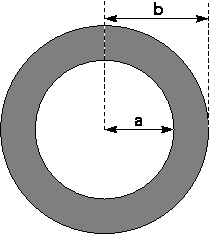
- 16The diagram shows two wires; wire 1 and wire 2. The charge carriers in wire 1 (of circular cross section and radius have a drift speed down the wire that is not constant across the wire. Instead, the drift speed rises from zero at the outer edge to at the center ( ), according to . The second wire (wire 2) has the same radius, the same density of charge carriers and a constant drift speed given by . Evaluate the ratio of the current carried by wire 2 to the current carried by wire 1, when .3f
- 17—R = ρ*ln(b/a)/2*PI*L
I=v/R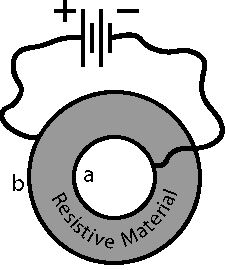
- 18A metal wire of length L has a circular cross section of radius r and an end-to-end resistance of R. Ohms. The metal wire is then stretched uniformly so that its cross-section is still circular but its total length is now L2. What is the resistance of the wire after stretching? Use "ohm" for the units (lower case o). =R2 = R/[(L1*r1^2)/(L2*r2^2)
- 19A parallel-plate capacitor with plates of area A is charged to a potential difference V and is then disconnected from the voltage source. When the plates are moved d farther apart, the voltage between the plates increases by V Volts. 1)What is the charge on the positive plate of the capacitor? 2) how much does the energy stored in the capacitor increase due to the movement of the plates?1) Q = V*eps0*A / d
2) U=Q*V - 20The diagram below depicts a cross section of coaxial conductor with an inner wire of diameter and an outer conducting sheath of inside diameter , and some material placed in the space between the two wires. Suppose that you have a coaxial wire with and , and we put polystyrene ( ) in the space between the two wires. If there is a potential of 1 kV between the wires, how much energy is stored in a 10 piece of cable?u = (2*pi*epsk*L*r)/(2*ln(do/di)) * V^2
- 21Derive an expression for the capacitance of two concentric hollow spherical conductors of radii r and R . What value do you get for the capacitance when R>rC=(4*pi*eps0)/(1/r - 1/R)
- 22—Ctotal = C1*C2 / C1 +C2
C1 = (k1*eps0*A) / (d/2)
C2 = (k2*eps0*A) / (d/2)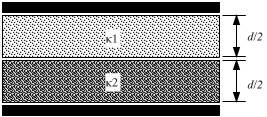
- 231) What is the voltage drop/ about the resistor at time t? 2) How much energy will be dissipated by the resistor total?1) V=Vb*e^-t/RC
2) U = 1/2 CV^2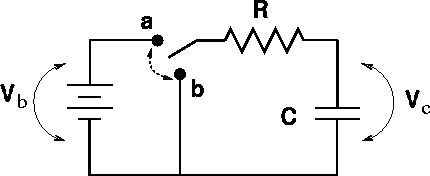
- 24What is the smallest capacitor needed in a computer power supply in order to produce at least V volts for t seconds after the power goes off? Assume that the resistance of all the components of the computer motherboard is R and that the capacitor and motherboard are powered with a supply V0vb*e^-t/RC = V
solve for C - 25The closed loop shown in the figure below carries a current of I in the counterclockwise direction. The radius of the outer arc is R, and that of the inner arc is r. Find the magnitude of the magnetic field at point P with angle theta.B = (mu0*I)/12 * (1/r - 1/R)
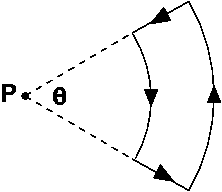
- 26A long hairpin is formed by bending an infinitely long wire as shown. If a current of I is set up in the wire, what is the magnitude of the magnetic field at the point a?[B = mu0*I/2*R] * (1/2 + 1/pi)
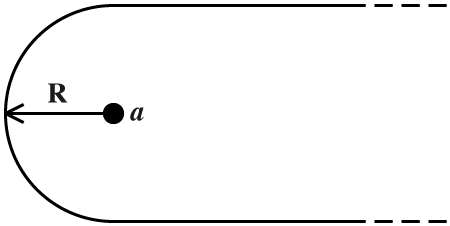
- 27B field?B = mu0*I*R / 2*pi*a^2
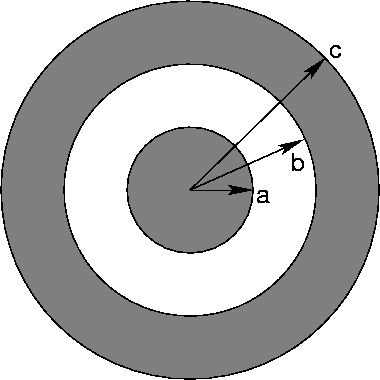
- 28B field where aB = mu0*I*(R^2-a^2) / 2*pi*(b^2-a^2)
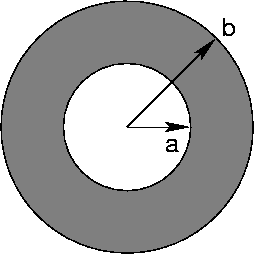
- 29The circular particle accelerator at CERN has a radius of about . The accelerator uses strong magnetic fields to steer charged particles in a circle, while electric fields give them more and more energy every time around. Suppose we're steering protons using magnetic fields of magnitude . What would be the magnitude of the momentum, , of a proton under those conditions? You may assume that the magnetic field involved is perpendicular to the motion of the charges (that's the most efficient configuration).momentum = qrb
- 30fy?fy = I*B0*((2*pi^2) / 2)
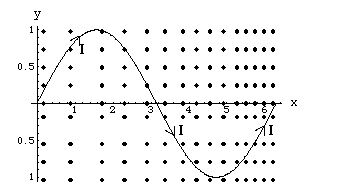
- 31—I = m*g*r / A*B*N
A = 2*r*l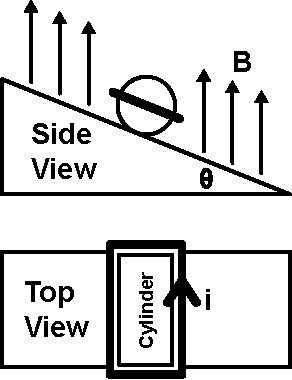
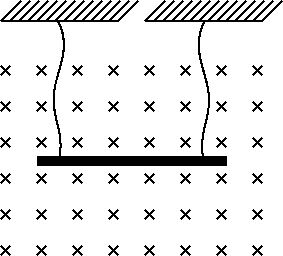
- 32—I = m*g/L*b
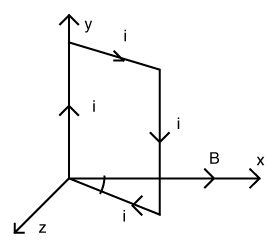
- 33—torque = I*A*N*B*cos(theta)
- 34Calculate the average induced voltage between the tips of the wings of a Boeing 767 flying at v above Golden, Colorado. The downward component of the earth's magnetic field at this place is B (Assume that the wingspan is L)emf = VBL
- 35—emf = (v*mu0*I / 2*pi) * ln(b/a)
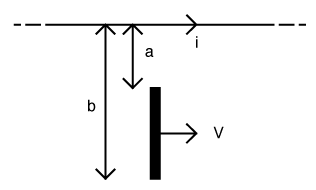
- 36—emf = V*B*L*cos(theta)
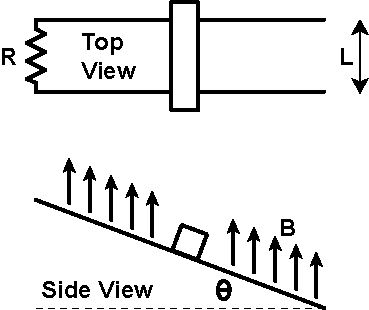
- 37—mutual inductance = mu0*I*Na*Nb*pi*ra^2*rb^2 / 2(L^2+ra^2)^3/2
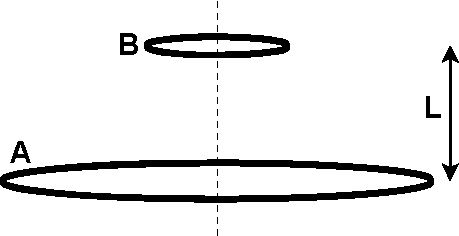
- 38An L long solenoid has N windings and a circular cross section of radius a. The solenoid goes through the center of a circular coil of wire with N windings and radius b. M=?Mutual inductance = (mu0*N1*N2*pi*a^2 / L)
- 39—L = mu0*N^2*t*ln(b/a) / 2*pi
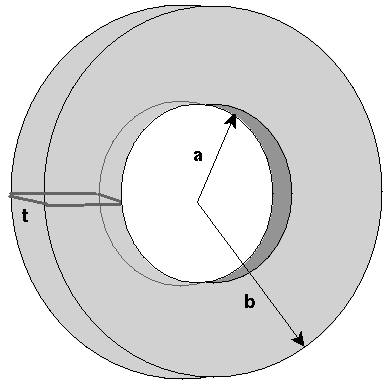
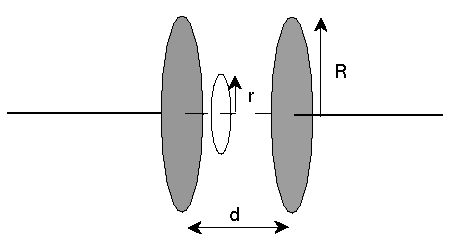
- 40—Displacement current out = (dq/dt * r^2) / R^2
- 41One of the highest power lasers in the world sits on a table in the General Research Lab Building at Colorado School of Mines. It emits pulses that last approximately t, and contain of energy u. "fs" indicates a femtosecond, which is seconds. 1) What is the power? 2) pulse length?1) P = u/t
2) lambda = c*t - 42A radio broadcast antenna is located at the top of a steep tall mountain. The antenna is broadcasting 104.3 FM (in Megahertz) with a mean power of P kilowatts. What is the intensity of the received signal distance d away?I = P/4*pi*d^2
- 43—sin^-1(n*sin(45-sin^-1(1/n)))
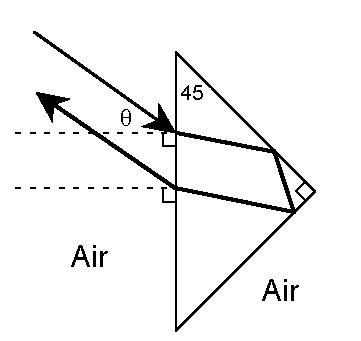
- 44A point source of light is located h below the surface of a large lake of clear, but contaminated, water (Lake Ontario, with n = n). Find the radius of the largest circle on the lake's surface through which light coming from the source can emerge into the air.r = h/(n^2-1)^1/2
Informationen
- Beschreibung
- Karteikarten am Physics 2 webworks, erstellt von Connor Brueske am 04/05/2023.
- Erstellt von
- Connor Brueske
- Aufrufe
- 2
- Bewertung