
Karteikarten
BISC 100 - Lecture 24:Regulation of Gene expression
Karten in diesem Stapel (28)
- 1p53 geneBPDE binds to a gene
within these cells called p53.
BPDE causes mutations
in the p53 gene that deactivate the protein
p53 CODES FOR A PROTEIN TO HELP SUPPRESS TUMORS - 2How and Why Genes Are Regulated?Cells with the same genetic information can develop into
different types of cells through gene regulation,
mechanisms that turn on certain genes while other
genes remain turned off.
• Regulating gene activity allows for specialization of
cells within the body - 3What does it mean to say that genes are turned on or off?Genes determine the nucleotide sequence of specific
mRNA molecules, and mRNA in turn determines the
sequence of amino acids in proteins
(DNA → RNA → protein)
• A gene that is turned on is being transcribed into mRNA,
and that message is being translated into specific
proteins.
• The overall process by which genetic information flows
from genes to proteins is called gene expression. - 4The Regulation of DNA PackingCells may use DNA packing for long-term inactivation of
genes.
• X chromosome inactivation
• occurs in female mammals,
• takes place early in embryonic development, and
• is when one of the two X chromosomes in each cell is
inactivated at random - 5The Initiation of TranscriptionThe initiation of transcription is the most
important stage for regulating gene expression - 6RNA Processing and BreakdownWithin a eukaryotic cell, transcription occurs in the
nucleus, where RNA transcripts are processed into mRNA
before moving to the cytoplasm for translation by the
ribosomes.
• RNA processing includes the
• addition of a cap and tail,
• removal of any introns, and
• splicing together of the remaining exons - 7Gene regulation affects two important processes1. cloning and
2. cancer. - 8The Genetic Potential of Cells• All body cells contain a complete complement of genes,
even if they are not expressing all of them.
• A single differentiated plant cell can undergo cell division
and give rise to a complete adult plant. - 9Plant cloningnow used extensively in agriculture.
For some plants, such as orchids, cloning is the only commercially
practical means of reproducing plants.
In other cases, cloning has been used to reproduce a plant with
specific desirable traits, such as high fruit yield or resistance to
disease.
Seedless plants
(such as seedless grapes, watermelons,
and oranges) cannot reproduce sexually,
leaving cloning as the sole means
of mass-producing
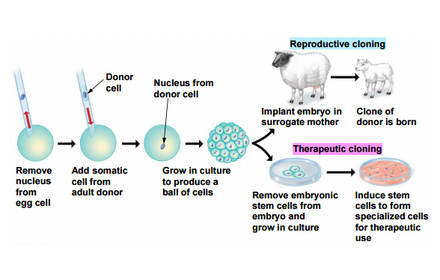
these common foods. - 10Reproductive Cloning of AnimalsNuclear transplantation involves replacing the nucleus of
an egg cell or a zygote with a nucleus removed from an
adult body cell.
• If the animal to be cloned is a mammal, further
development requires implanting the early embryo
into the uterus of a surrogate mother.
• This type of cloning is called reproductive cloning
because it results in the birth of a new animal. - 11Reproductive CloningFirst mammal cloned was in 1996, cloned from an adult cell. A sheep named Dolly
- 12Practical Applications of Reproductive CloningSince the first success in 1996, researchers have cloned
many species of mammals, including mice, horses, dogs,
mules, cows, pigs, rabbits, ferrets, camels, goats, and
cats.
(a) The first clone
(b) Cloning for medical use
(c) Clones of
endangered
animals - 13Why is reproductive cloning used?In agriculture, farm animals with specific sets of
desirable traits might be cloned to produce
identical herds.
• In research, genetically identical animals can
provide perfect “control animals” for experiments.
• Reproductive cloning is used to restock
populations of endangered animals. - 14Conservationists argue that cloningmay detract from efforts to preserve natural
habitats.
• does not increase genetic diversity, and
• is therefore not as beneficial to endangered
species as natural reproduction. - 15Practically, cloning of mammals is extremely difficult and inefficient.Only a small percentage of cloned embryos develop
normally and
• they appear less healthy than naturally born kin. - 16Embryonic Stem CellsIn mammals, embryonic stem cells (ES cells) are obtained
by removing cells from an early embryo and growing them
in laboratory culture.
Embryonic stem cells can divide indefinitely and, under
the right conditions, can (hypothetically) develop into
a wide variety of different specialized cells. - 17The Genetic Basis of CancerCancer includes a variety of diseases in which cells
escape from the control mechanisms that normally limit
their growth and division.
• This escape involves changes in gene expression. - 18Viruses that cause cancer can become permanent residents in host cells byinserting their nucleic acid into
the DNA of host chromosomes. - 19• A gene that causes cancer is called anoncogene.
- 20A normal gene with the potential to become an oncogene is called aproto-oncogene
- 21• A cell can acquire an oncogene from- a virus or
• the mutation of one of its own proto-oncogenes.
For a proto-oncogene to become an oncogene, a mutation
must occur in the cell’s DNA.
• Three kinds of changes in DNA that can produce active
oncogenes are shown in the next slide.
• In all three cases, abnormal gene expression stimulates
the cell to divide excessively - 22Tumor-Suppressor GenesChanges in genes whose products inhibit cell division are
also involved in cancer.
• These genes are called tumor-suppressor genes because
the proteins they encode normally help prevent uncontrolled
cell growth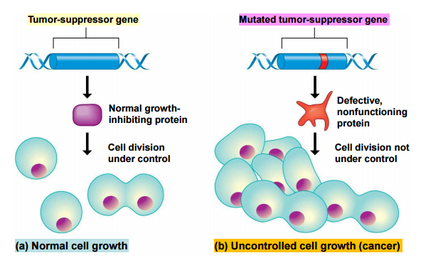
- 23The Process of Science: Are Childhood Tumors Different?Observations: Specific mutations can lead to
cancer.
• Question: Are different kinds of cancer associated
with specific mutations?
• Hypothesis: Young patients with medulloblastoma
(MB) harbor unique mutations. (MB is the most
common pediatric brain cancer and the deadliest
form of childhood cancer.)
• Each tumor had an average of 11 mutations.
• This is 5–10 times fewer mutations than are found
in adult MB patients.
• Young MB patients therefore seem to have fewer, but
deadlier, mutations. - 24The Progression of a CancerThe development of a malignant tumor is accompanied
by a gradual accumulation of mutations that
• convert proto-oncogenes to oncogenes and
• knock out tumor-suppressor genes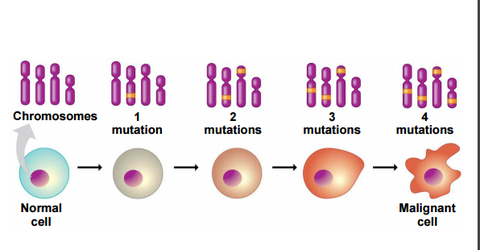
- 25Inherited CancerMultiple genetic changes are required to produce a cancer cell.
• This helps explain the observation that cancers can run in families.
• An individual inheriting an oncogene or a mutant version of a
tumor-suppressor gene is one step closer to accumulating the
necessary mutations for cancer. - 26Most cancers arise frommutations that are caused by
carcinogens, cancer-causing agents found in the
environment, including
• ultraviolet (UV) radiation and
• tobacco products. - 27The Evolution of Cancer in the Body• First, all evolving populations have the potential to produce
more offspring than can be supported by the environment.
Second, there must be variation among individuals of
the population.
• Third, variations in the population must affect
survival and reproductive success - 28—
Informationen
- Beschreibung
- Der Nutzer hat seine Fachbereichs-Information gelöscht. Karteikarten am BISC 100 - Lecture 24:Regulation of Gene expression, erstellt von Gelöschter Nutzer am 10/08/2016.
- Erstellt von
- Gelöschter Nutzer
- Aufrufe
- 31
- Verlauf
-
- Erstellt von Chelsi Souch · 10 Aug 2016
- Kopiert von Chelsi Souch · 10 Aug 2016
- Bewertung