
Karteikarten
FIN2601 - SU4 - Risk and Return
Karten in diesem Stapel (30)
- 1Define 'Risk'Risk relates to the chance of loss;
to the variability of returns associated with a given asset.
The more certain the return, the less variability and the less risk. - 2Give an example of a risk-free assetGovernment Bonds
- 3Define 'Return'It is the total gain or loss experienced on an investment over a given period of time.
- 4How is 'return' calculated?the asset's cash distributions during the period + change in value / its beginning-of-period investment value
- 5Provide the formula for calculating the rate of return earned on any assets over a period of timert = Ct + Pt - Pt-1 / Pt-1
rt -actual, expected or required rate of return
Ct - cash flows received from the investment
Pt - price (value) of asset at time t
Pt-1 - price (value) of asset at time t-1 - 6Explain the difference between a realised and unrealised return.Realised return - asset is purchased and sold during the time measured.
Unrealised return - return that could have been realised if an asset had been purchased and sold during the period measured. - 7What does CAPM stand for?Capital Asset Pricing Model
- 8Explain the a 'risk-averse' financial manager, which most managers are.The increase in possible return does not justify the higher risk because these managers shy away from risk and seek stability.
- 9Explain the a 'risk-indifferent' financial manager.They require no change in return for an increase in risk.
- 10Explain the 'rational investor' type of financial managerThe required return increases for an increase in risk. These mangers require higher expected returns to compensate them for taking greater risk.
- 11How do we assess risks?By looking at expected-returns, as well as scenario analysis and
probability distribution - 12How do we measure risk quantitatively?Using statistical formulas such as
the standard deviation
the coefficient of variation
it measures the variability of assets return. - 13Explain scenario analysisit throws several scenarios at the risk to determine its worst, expected and best outcomes and returns.
- 14How is an asset's risk measured through the use of 'the range'?You would take the optimistic outcome and subtract the pessimistic outcome. The higher the range, he riskier the investment
- 15Explain probability distributionsIt indicate the probability/chance that an outcome could occur.
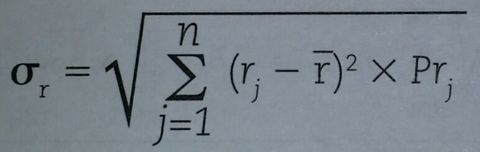
It gives a more quantitative insight into an asset's risk. - 16Explain the statistical indicator, Standard Deviation (σr) Formula includedit measures the dispersion around the expected value
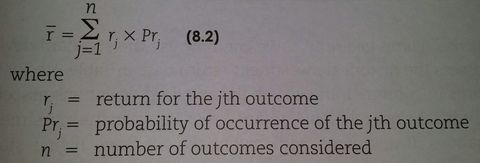
the higher the standard deviation, the greater the risk - 17Explain the expected value of return. Formula includedIt is the most likely return on an asset.
- 18Explain Coefficient of variation. Formula includedIt is a measure of relative dispersion that is useful in comparing the risks of assets with differing expected returns
the higher the CV, the greater the risk, the greater the expected return.
- 19Explain the financial manager's goal with regards to creating an efficient portfolio.He needs to create a portfolio that maximises return for a given level of risk or minimises risk for a given level of return.
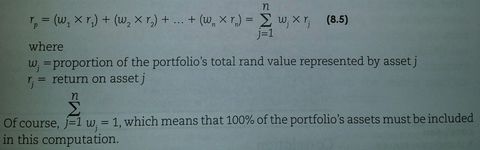
- 20Explain the return on a portfolio. formula includedIt is a weighted average of the returns on the individual assets from which it is formed.
- 21Explain Standard Deviation of a portfolio's returns. Formula includedYou apply the normal formula for a single asset when probabilities are known.
The following formula is used when the outcomes are known and their related probabilities are assumed to be equal.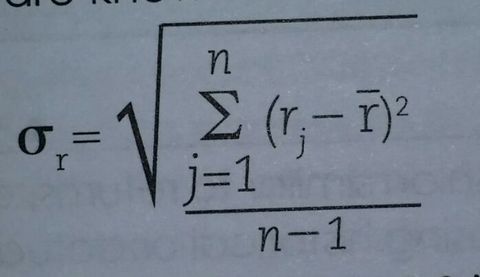
- 22Provide the definition of correlationit is a statistical measure of the relationship between any two series of numbers representing data of any kind.
- 23Explain positive correlationIt describes two series that move in the same direction.
- 24Explain negative correlationDescribes two series that move in the opposite directions.
- 25Explain Correlation Coefficient.A measure of the degree of correlation between two series.
+1 = perfectly positively correlated
-1 = perfectly negatively correlated - 26What is the purpose of Diversification?It assist in reducing the risk in the portfolio.
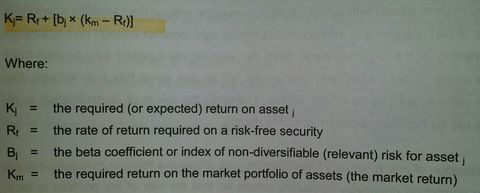
"Not having all your eggs in one basket scenario" - 27Explain Capital Asset Pricing Model (CAPM)It is the basic theory that links risk and return for all assets.
- 28Explain the difference between 'diversifiable risk' and 'non-diversifiable risk'Diversifiable risk - Strikes, litigation, loss of key contracts, etc
Non-diversifiable risk - Ware, inflation, political events, etc - 29Explain Beta or Beta Coefficient (b)It measures non-diversifiable risk.
It is and index of the degree of movement of an asset's return in response to a change in the market return. - 30The equation for the CAPM is
Informationen
- Beschreibung
- FIN2601 - Financial Management Flashcards on FIN2601 - LU4 - Risk and Return, created by Marinda Steenkamp on 10/09/2016.
- Erstellt von
- Marinda Steenkamp
- Aufrufe
- 56
- Tags
- Bewertung