
Karteikarten
Tutorial 3
Karten in diesem Stapel (30)
- 1Representation and Languages what is language? what does it have to do with representation? what is represented?language as an arbitrary system of signs, i.e. it is a matter of convention (“in principle any collection of letters or any sound in any order would do the trick equally well”, Hall 21)
– signifier (form: letters, sounds) and signified (mental concept)
__
languages work through representation
sounds, words, notes, gestures, expressions, clothes-
(it's about what they do, not what they are)
They construct meaning and transmit it. They signify. They don’t have any clear meaning in themselves. - 2What can also eg. work as a signifier (semiotic approach)objects in general:
eg. clothes
simply physical function – to cover the body and protect it from the weather.
BUT
they're also signs as they construct meaning and carry a message
signifier (clothes) + signified (concepts like ‘elegance’, ‘casual-ness’, ‘formality’) - 3Representation and Discourse Sexuality (example)“There have always been sexual relations.
But ‘sexuality’, as a specific way of talking about, studying and regulating sexual desire, its secrets and its fantasies, Foucault argued, only appeared in western societies at a particular historical moment [...] There may always have been what we now call homosexual forms of behaviour. But ‘the homosexual’ as a specific kind of social subject, was produced, and could only make its appearance, within the moral, legal, medical and psychiatric discourses, practices and institutional apparatuses of the late nineteenth century, with their particular theories of sexual perversity.” - 4Interpellation“Hey, you there!”
process of interpellation (hailing): “It all hinges on that moment of recognition where, simply by turning round, or hesitating, or however it is you have reacted, you take on the role offered you – that of the one who is addressed. It doesn’t rely on any particular way of taking on that role, but simply on your responding to the call as if you were the one meant all along: recognizing yourself in it
- “Ideology interpellates individuals as subjects.” (ibid.)
– e.g. motherhood - 5Hegemony why developed by whom?concept by Antonio Gramsci “developed to explain (given the exploitative and oppressive nature of capitalism) the absence of socialist revolutions in the Western capitalist democracies” (82)
- 6What is Hegemony?the process of power in which “a dominant class [...] does not merely rule a society but leads it through the exercise of ‘intellectual and moral leadership’” (82)
• not only coercion (Zwang) and force, but also consensus
another one:
“a social group seeks to present its own particular interests as the general interests of the society as a whole”, i.e. the world view of the dominant class is presented and perceived as natural and beneficial to all - 7Space and Place why important according to Nünning and Nünning?how space and place is ‘semanticized’ (i.e. how it is invested with meaning or “how space becomes a bearer of meaning in its own right” [Nünning & Nünning 99])
- 8Space and Place in drama– word-scenery
– props... - 9Space and Place in narrative Texts– boundaries / thresholds (Schwellen)
– “spatial opposites are construed as models for semantic opposites” (Pfister 257 qtd. in Nünning & Nünning 129)
– e.g. see analysis of Thomas Hardy’s Jude the Obscure in Giles & Middleton (chapter 5: 120-24) - 10Time (3 important factors)-Duration: duration between discourse time and story time
-Order: various possibilities of arranging the events that constitute a
story
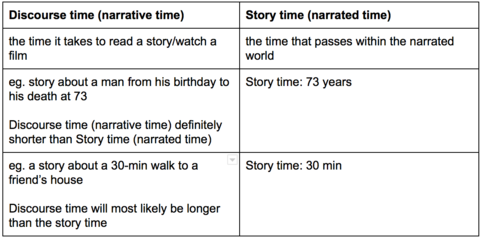
-Frequency - 11discourse time vs. story time?
- 12Time: Duration 5 important thingssummary:
scene:
stretch:
ellipsis:
pause: - 13summarystory time is longer than discourse time: ,,I wandered during the afternoon along the valley of the Thames..''
- 14scenediscourse time and story time are equal
(eg. dialogue) - 15stretchdiscourse time exceeds story time:
For a moment I was staggered, throught the important of his gesture was plain enought. The question had come into my mind abruptly: were these creatures fools? .. - 16ellipsisdiscourse time skips to a later part in story time, i.e. sth is left out
This happened in the morning. In the afternoon I met my little woman. - 17pausestory time comes to a standstill while discourse time continues (often because of a description or comment by the narrator):
After
all, the sanitation and the agriculture of today are still in the rudimentary stage. The science of our time has attacked but a little department of the field of human disease, but, even so, it spreads its operations very steadily and persistently...” (31) - 18Time: order– chronological / achronological
– flashforward (prolepsis) / flashback (analepsis) - 19Time: Frequency– singulative narration: an event happening once is narrated once
– repetitive narration: an event happening several times is narrated several times
– iterative narration: an event happening several times is narrated once - 20Bakhtin's Chronotope“In the literary artistic chronotope, spatial and temporal indicators are fused into one carefully though-out, concrete whole. Time, as it were, thickens, takes on flesh, becomes artistically visible; likewise, space becomes charged and responsive to the movements of time, plot and history.” (84)
--> According to Bakhtin, different genres have specific chronotopes. - 21Terminology: Poetry lineA line is a unit of language into which a poem or play is divided, which operates on principles which are distinct from and not necessarily coincident with grammatical structures, such as the sentence or single clauses in sentences. Although the word for a single poetic line is verse, that term now tends to be used to signify poetic form more generally.[1]
- 22Terminology: Poetry stanzaA distinct numbered group of lines in verse is normally called a stanza.

- 23foot / feetsmallest unit of verse
The unit is composed of syllables - 24lyric persona / lyric ‘I’lyric persona; same as lyric I
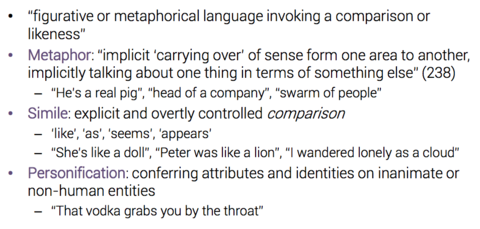
- 25Imagery
- 26Consonancerepetition of consonant sounds with a change in vowels
- 27Assonancerepetition of the same vowel sounds
- 28Versification: Rhythm, Meter and Rhyme

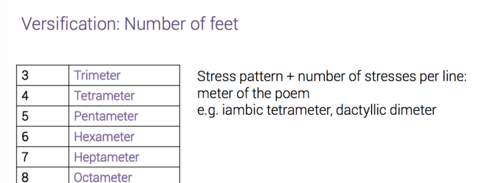
- 29Versification: Number of feet
- 30Versification: Questions?• ir/regular number of stresses per line? How many, how often?
• ir/regular number of syllables per line? What kinds, in what patterns?
• alliteration?
• rhyme?
• break(s) or pause(s) > caesura(e)
Informationen
- Beschreibung
- Culture & Literature (Tutorials) Karteikarten am Tutorial 3, erstellt von Lisza Neumeier am 01/12/2016.
- Erstellt von
- Lisza Neumeier
- Aufrufe
- 22
- Bewertung