
Karteikarten
Flashcards for content: 2.2
Karten in diesem Stapel (33)
- 1Sales ForecastProject of future sales revenue, often based on previous sales data.
- 2Consumer incomeThe amount of income remaining after taxes and expenses have been deducted from wages.
- 3Consumer trendsThe habits or behaviours of consumers that determine the goods and services they buy.
- 4Economic growthThe rise in output of an economy as measured by GDP usually as a percentage.
- 5Economic variablesMeasures within the economy which have effects on businesses and consumers e.g. unemployment, inflation, interest rates ad exchange rates.
- 6ExtrapolationForecasting future trends based on past data.
- 7ForecastingA businesses process, assessing the probable outcome using assumptions about the future.
- 8Time series dataA method that allows a business to predict future levels from past figures.
- 9Average cost or unit costThe cost of producing one unit, calculated b dividing the total cost by the ouput.
- 10Fixed costA cost that does not change as a result of a change in output in the short run. E.g. rent, rates, admin.
- 11Long runThe time period where all factors of production are variable.
- 12ProfitTotal revenue - total costs
- 13Sales revenuePrice x quantity of output
- 14Sales volumeThe quantity of output sold in a particular time period.
- 15Semi-variable costA cost that consists of both fixed and variable elements.
- 16Short runThe time period were at least one factor of production is fixed.
- 17Total costThe entire cost of producing a given level of output.
- 18Total revenueThe amount of money the business receives from selling output.
- 19Variable costA cost that rises as output rises.
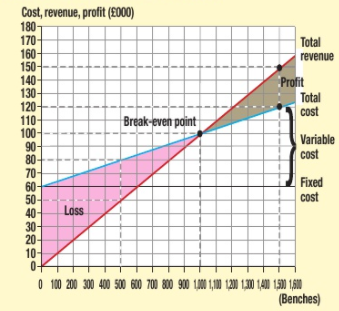
- 20Break-evenWhen a business generates just enough revenue to cover its total costs.
- 21Break-even chart
- 22Break-even outputThe output a business needs to produce so that its total revenue and total costs are the same.

- 23Break-even pointThe point at which total revenue and total costs are the same.
- 24ContributionThe amount of money left over after variable costs have been subtracted from revenue. The money contributes towards fixed costs and profit.
Selling price per unit - variable costs per unit - 25Margin of safetyThe range of output between the break-even level and the current level of output, over which a profit is made.
- 26BudgetA quantitative economic plan prepared and agreed in advance.
- 27Budgetary controlA business system that involves making future plans, comparing the actual results wit the planned results and then investigating the causes of any differences.
- 28Historical figuresQuantitative information based on past trading records.
- 29Production cost budgetA firm's planned production costs for a future period of time.
- 30Sales budgetA firm's planned sales for a future period of time - can be measured in terms of volume or revenue.
- 31VarianceThe difference between actual financial figures and those budgeted
- 32Variance analysisThe process of calculating variances and attempting to identify their causes.
- 33Zero-based budgeting or zero budgetingA system of budgeting where no money is allocated for costs or spending unless they can be justified by the fund holder (they are given a zero value).
Informationen
- Beschreibung
- Karteikarten am Flashcards for content: 2.2, erstellt von J Brookes am 18/06/2017.
- Erstellt von
- J Brookes
- Aufrufe
- 325
- Bewertung