
Karteikarten
3prof Williams
Karten in diesem Stapel (66)
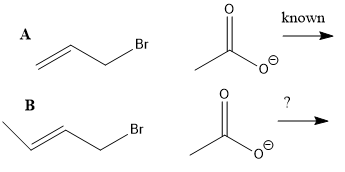
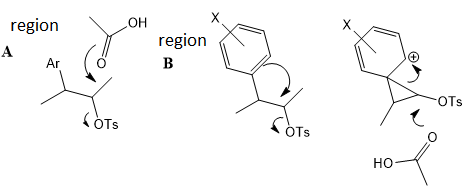
- 1The mechanism of reaction A is known, what do u know about mechanism of reaction B?nothing, the alkenes r chemically v different, Me stabilizes double bond
- 2can u say that the reaction proceeds via Sn1?no, not necessarily, it can be a combination of SN2 and SN2', actually all 3 may be happening, how would u test it?
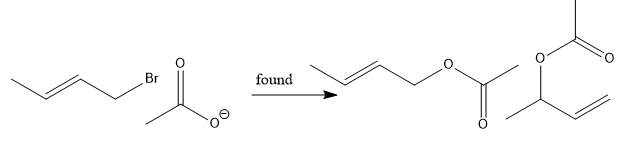
- 3Reaction of CH2=CHCH2Br with acetate gives the same product no matter if the reaction proceeds via Sn1, Sn2 or Sn2’.How to find out which mechanism is taking place? (note what result u would expect in each case and what would u observe in case where more than one mechanism operates
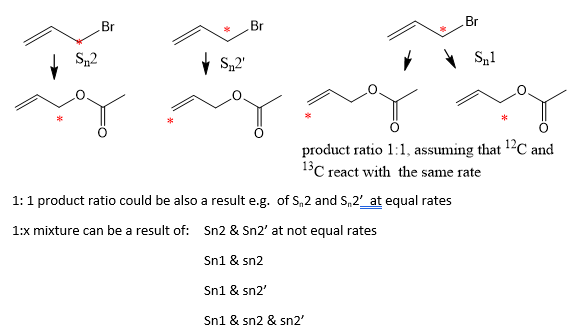
- 4why both of these mechanisms seem reasonable and what test can be done to find out which mechanism takes place?
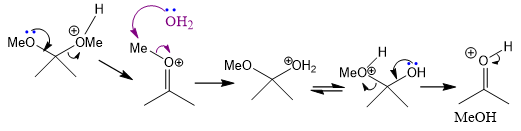
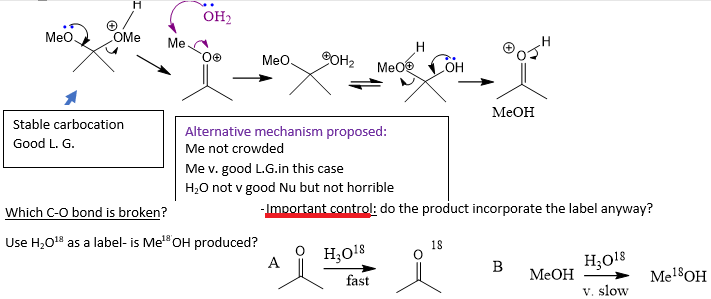
- 5what tests can u suggest? what outcome u expect from each mech. u propose?(only sketch of and answer is provided here)x
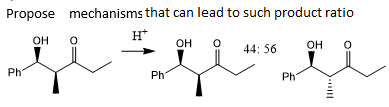
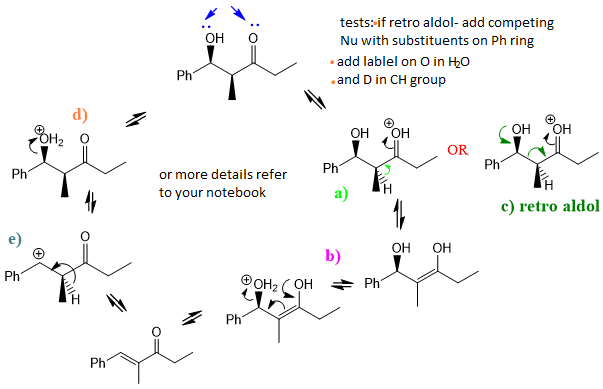
- 6—
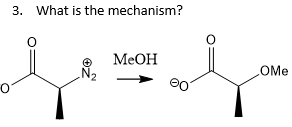
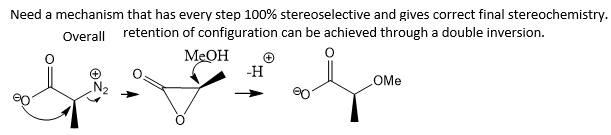
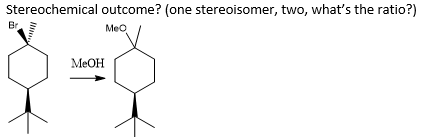
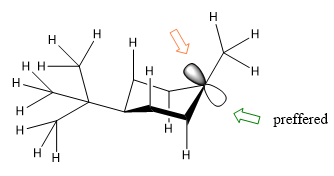
- 7—tertiary alkene, weak Nu- Sn1 the most plausible, sides diastereotopic, less hindered side preferred 1:x ratio expected
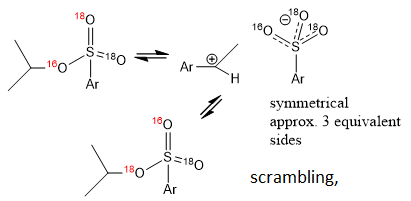
- 8how would u test is a reaction is inter- or intermolecular?scrambling- label half of your reagent and if u get cross label outcome it might suggest that intra molecular reaction is taking place (at least to some extend)
- 9what is e. e. ?enantiomer excess (e.e), which is the percentage excess of the major enantiomer over the minor enantiomer:
e. e. = % Major−% Minor - 10how would u describe the reactions in terms of stereospecificity and stereoselectivity?stereospecific
not 100% stereoselctive (cos u have minor and major, lets describe it as 1:x)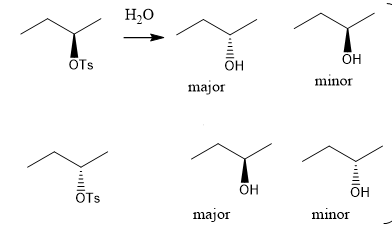
- 11when complete retention of chirality (i.e. a single enantiomer of the product forms) occurs, what can u deduce? (what reaction schemes r consistent with this, which u should exclude?)CONSISTENT:
a)mechanism that involves only totally stereoselective, stereospecific steps
b) bond changes away from any stereogenic centres).
EXCLUDE:
a) mechanisms that involve
achiral intermediates
b) mechanisms where two enantiomers rapid interconvert. - 12what can u deduce about mechanism when there is total loss of chirality? (i.e. racemate of the products forms)mechanism must involve
1) at least one achiral intermediate,
or
2) at least one step where two enantiomers can interconvert easily (faster than continuing to product). - 13Partial loss of chirality (i.e. a mixture of enantiomers of the products forms).Now you cannot propose a mechanism that involved only 100% stereospecific, nor one with an achiral intermediate
• Could be a combination of a racemic pathway and stereospecific pathway (such as Sn1 and Sn2 substitutions)
• Could be due to an intermediate which is almost chiral (such as an ion pair)
• The TS to form each enantiomer could be diastereomeric (such as Sn2’) - 14conditions required for an intermediate1. it must produce exactly the same products as the original reaction mixture (under the same conditions). This include stereochemistry!
2. It must react at least as fast as the overall reaction rate. - 15how would u check if the reactions is intra- or inter molecular?1. Scrambling
2. look at kinetics (1st or 2nd order?)
3. can u observe I? but if u don't it does not mean that there is none
4. add competing Nu or E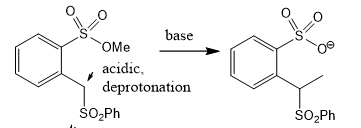
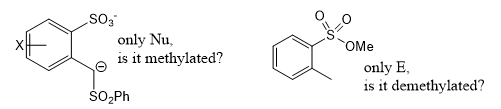
- 16what can u do if u suspect an intermediate?1. observe directly (spectroscopy)
2. trap it
3. isolate
4. make is separately
5. try scrambling (if possible) - 17what does isosbestic point tell u? can u derive a proof? ;Dthat probably there is no intermediates or if they r, they at v low conc.
lack of isosbestic points is more informative: tells u that there must be an intermediate - 18what is TSTS lifetime is less than bond vibration
(10E-13s)
it is the only df of TS that makes me excited :D - 19A. when it is good to use UV to track your reaction?B. how would u find out that u have a mass imbalance in you reaction during UV experiment. C. what would it tell u?A.. when u have some absorbing groups in your SM and P (they do not overlap) B. make a calibration curve (how?). C that u have an intermediate
- 20—can trap with amine and look for A. Why not for acetamide? Why amine is good in this case?
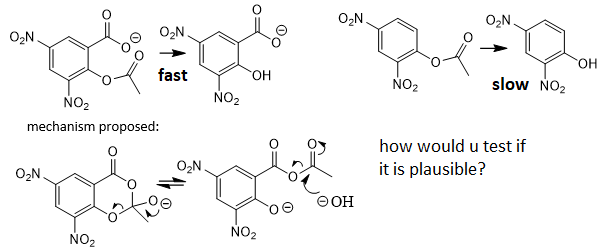
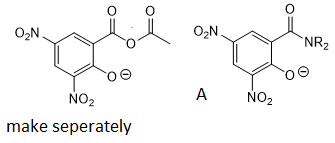
- 21propose mechanism of hydrolysis of 2 consistent with the solvent effect
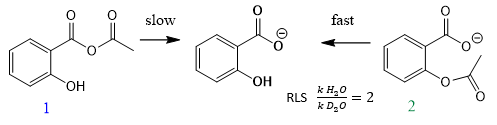
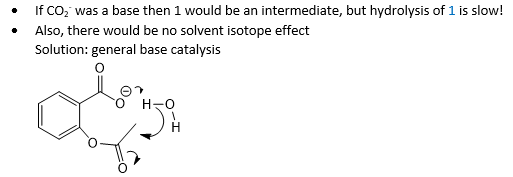
- 22Does the strategy of generating an intermediate separately only hold to stable intermediates? yes? no? can u think of any example?
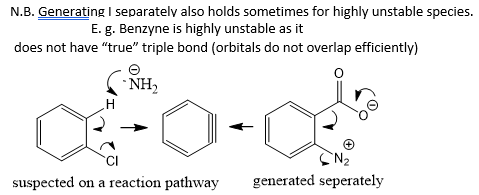
- 23how your u discriminate between these two mechanistic possibilities?
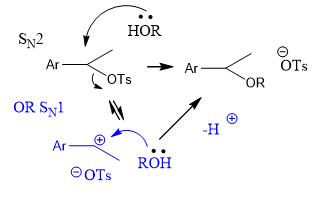
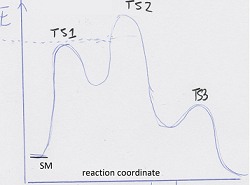
- 24what is Ea in the plot below (from SM to T1/2 or 3?)T2,, RLS is defined by the E difference to from SM to the highest E point on the plot
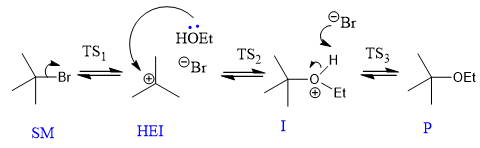
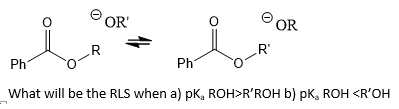
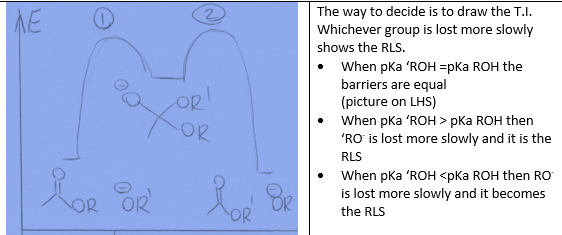
- 25what is the principle of microscopic reversibility?The reaction pathway for the reverse of a reaction is exactly opposite to the pathway for the forward direction (at equilibrium).
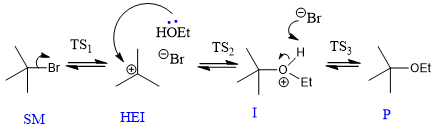
- 26bearing in mind the principle of microscopic reversibility, what is likely to be the RLS in the above reaction?most often u can determine RLS by looking at the HEI and comparing what stabilize it less (going to left or right). Here the charged HEI is more likely to be stabilized by charged Br- so the attract of EtOH on HEI is probably the RLS.
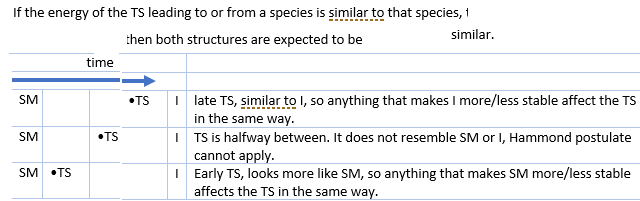
- 27what is Hammond postulate?
- 28what is Curtin-Hammett principle? can u give an example of a reaction when it can be applied? and example where it cannot?The product distribution does not necessarily reflect the distribution of the starting material conformations/isomers/ions. It applies when the equlilibrium is rapid (protonation, deprotonation, or exchange between 2 conformers. Do u remember ex. from the lecture? C.H. P. does not apply with alkene interconversion (barrier ca. 260 kJmol-1!)
- 29—
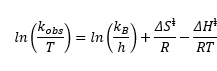
- 30what is Eyring eq,
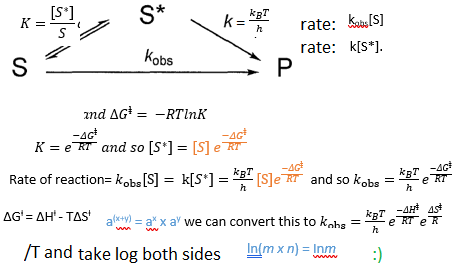
- 31can u derive Eyring eq?
- 32what is enthalpy of activation related to?The enthalpy of activation relates to changes in bonding interactions, (including strain and solvation) as the starting material changes into the transition state.
- 33what information do u get form different values of entropy of activation?
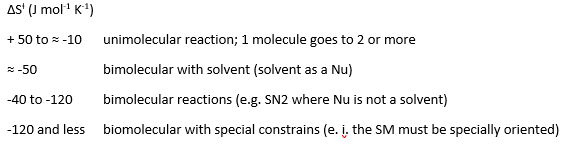
- 34what entropy do u expect if the second step is RL, who would u construct ur argument?
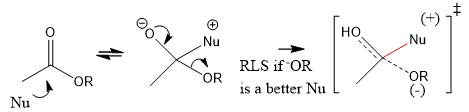
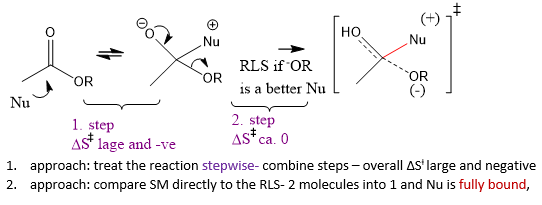
- 35Can species that are taking part in the reaction AFTER RLS appear in the rate law? B. does solvent appear in the rate law?NO! :)
B. Typically no, because it concentration does not change - 36can u have a irreversible step BEFORE the RLS?well, u assume that all steps before the RLS are in equilibrium
- 37how many separate mechnisms u have to propose to explain such a rate law?to explain such rate law at least one mechanism for one term,
however it can happen that each term would need more than one mechanism
- 38for the scheme above derive rate law for SN1 path knowing that 2nd step is RLS
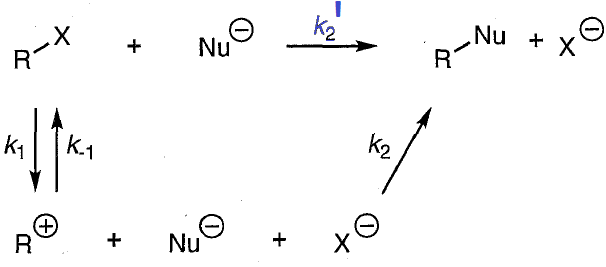
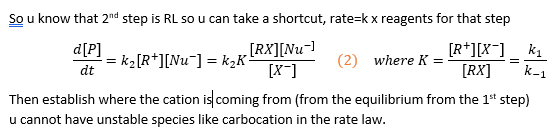
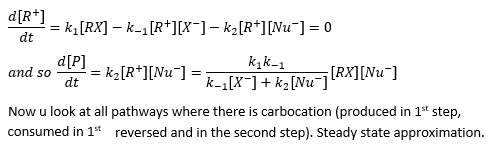
- 39for the scheme above derive a rate law for the SN1 reaction (in general terms, assume that u do not know which step is RLS)
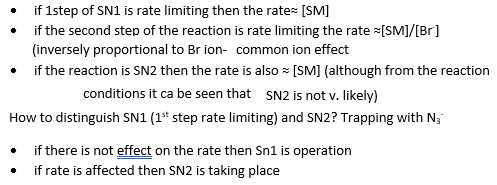
- 40For the reaction below Nu is also a solvent, how would u establish if the mechanism is sn2, sn1 (1step RL or 2nd step RL?)
- 41reasons for change in log kobs?1. Substrate ionisation- is there any proton to deprotonate?
2. Change in the RLS
If nothing in the reaction ionises at the slope transition then this is often the best explanation
3. Diffusion.
(For any bimolecular reaction), The reaction cannot happen quicker than the time required for collision, especially at low concentration. For small molecules k diffusion ca. 1010 M-1s-1 at 25°C - 42what is strange in this profile and how can u explain in?
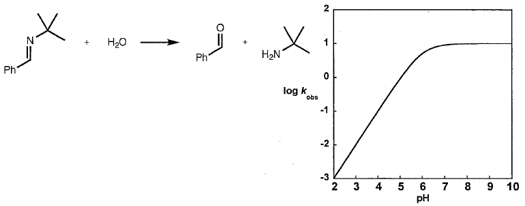
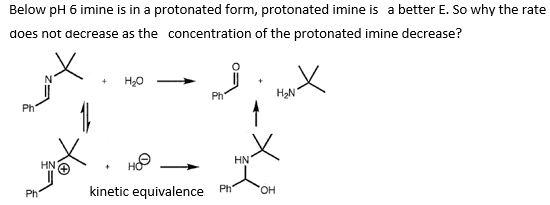
- 43what the magnitude of the primary isotope effect can tell you about the nature of TS?the more symmetrical TS have larger primary isotope effect (H half way between SM and I, early or late TS tend to give smaller kinetic effects
- 44what is a secondary isotope effect? what magnitude u can expect in different cases?If a bond is not broken in the RLS but it is very close to the reacting centre. It arises from changes to the vibrational (bending and stretching) frequencies of the bonds
kH/kD= 1.3 sp3→s p2 “normal” effect
kH/kD= 0.73 sp2→s p3 inverse effect - 45what isotope effect kH/kD u would expect in E1 reaction?most likely the ratio of 1, RLS is the formation of the carbocation
- 46what do different values of isotope effect tell u?
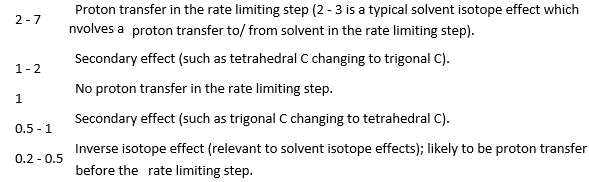
- 47what isotope effect do u expect for the circled H?1 this H is acidic and the deprotonation is reversible
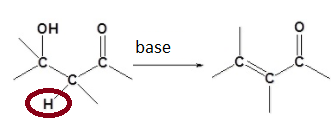
- 48what rho sign and magnitude (very roughly) would u expect for the reaction above?negative sign (electrion density flows out of the ring as a result of +ve chage developing on N in the TS, [which is opposite to what happens in deprotonation of benzioc acid where TS is e rich and e density flows to the ring])
-quite big magnitude, as ther e is conjugation with the ring
experimental value -2.3
- 49what rho sign and magnitude (very roughly) would u expect for the reaction above?negative
very big magnitude (the electron density is pulled directly from the ring- change in electron density happens ON the ring itself
experimental value rho=ca. -7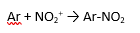
- 50what rho sign and magnitude (very roughly) would u expect for the reaction above?In the TS the positive charge is reduced, electron density flows toward the aromatic ring.
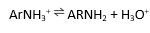
- 51what rho sign and magnitude (very roughly) would u expect for the deprotonation of the above compound?v. small value as the deprotonated group is one sp3 carbon away from the ring
rho =ca. 0.5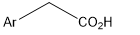
- 52describe steps of constructing a Hammett plot for the above reaction1. synthesis of unsubstituted ethyl benzoate, then synthesis of series of derivatives with different X group
2. measure K or k of hydrolysis of ethyl benzoate and the derivatives
3. plot on y axis logk(substututed ethyl benzoate)/logk(ethyl benzoate),
4. find sigma values for each X and plot on x axis
5. determine rho(slope of the plot)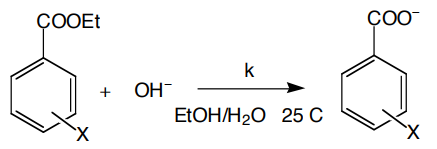
- 53what 2 crucial things u learn form Hammett plots?1. is the plot linear?
Concave upwards=> change in mechanism
Concave downwards=> Change in rate limiting step
2. what is the magnitude and sign of rho value- the extend of which electron density is pulled out or in the ring - 54—conjugation enhances MeO
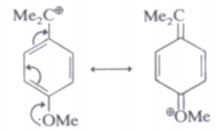
e. donation so u might need to plot against sigma+(sigma values are derived for dep. of benzoic acid where -ve charge cannot delocalize via conjugation) (we assume Sn1 here, but to make the point)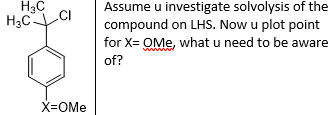
- 55what two main information u get from Bronsted plots?1. About designing your experiment- does the reaction goes faster if you use stronger base (higher pKa), if u get 0 value from a Bronsted plot then just any base will do and it would not make any difference in the speed of ur reaction
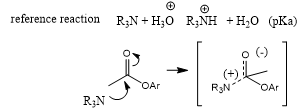
2. You learn about TS, if u get value 0 then it also tells u that u got early TS, value ca. 1- late TS - 56why in the extended Bronsted plots u often get values greater than 1?picking up a H+ and making Nu-H bond is very different than making Nu-C bond
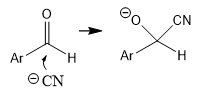
- 57kinetic isotope effect?kH/kD= 0.73 sp2→s p3 inverse effect
- 58why concave downwards plots tell u about change in the RLS?look at this this way: go to the tip point of the lot and look each way- there are two things that make reaction go slower- two RLS, (imine formation loo notes)
- 59kinetic isotope effect?kH/kD= 1.3 sp3→s p2
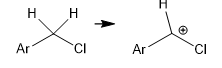
- 60—
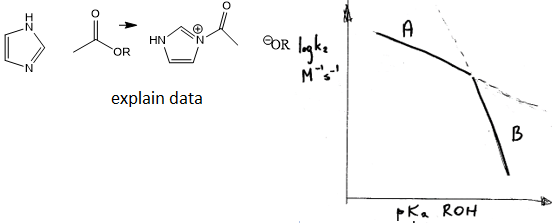
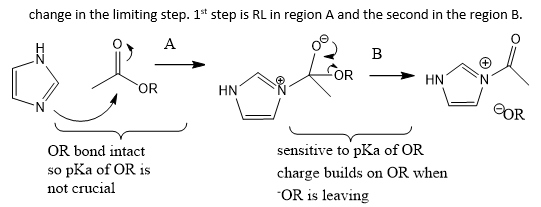
- 61—
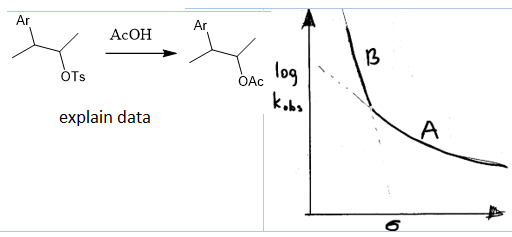
- 62suggests an explanationcannot be Sn1 cos rho -ve, cannot Sn2 cos rho would be very small, so unusula addition elimination with delocalisation onto the ring :D
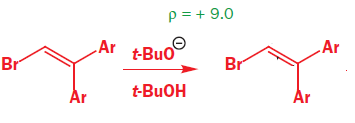

- 63—
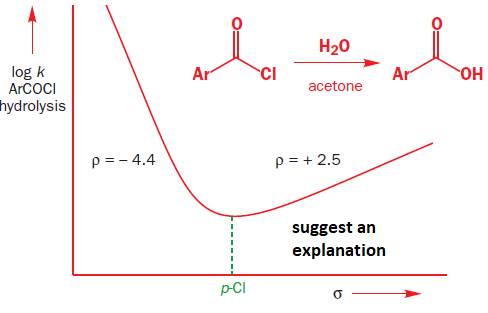
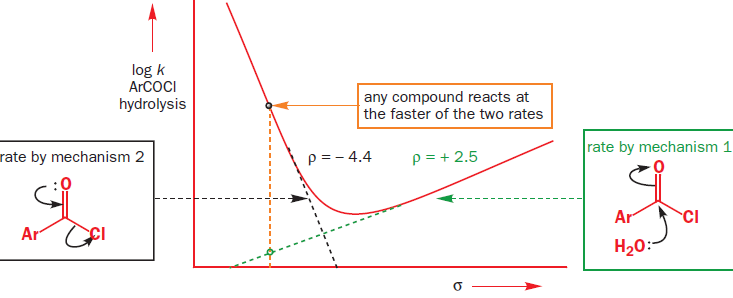
- 64—
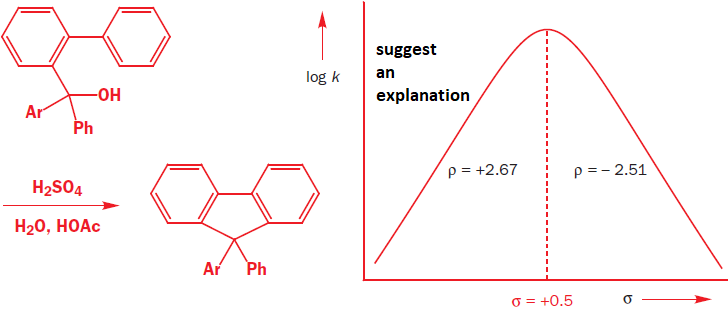
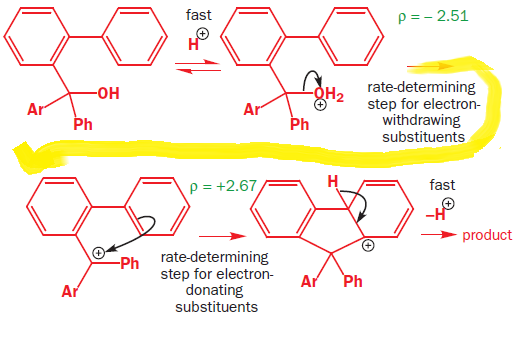
- 65is it likely that removal of a proton form a heteroatom by heteroatom base can be RLS? how about proton removal from carbon?Removal of a proton from heteroatoms by heteroatom bases is always a fast step but removal of a
proton from carbon can be the rate-determining step. - 66advantages and disadvantages of general acid/base catalysisit is a milder type of catalysis, which avoids high energy, charged intermediates, occurs in living beings,
disadvantage: molecularity, all of the substrates must be present in large excess (or in enzymes pockets, where groups are precisely aligned for GA/BC)
Informationen
- Beschreibung
- 3 Williams Karteikarten am 3prof Williams, erstellt von Magda Sroka am 15/10/2017.
- Erstellt von
- Magda Sroka
- Aufrufe
- 346
- Bewertung