
Karteikarten
Capacitors
Karten in diesem Stapel (35)
- 1What is the capacitance of an object?The amount of charge it is able to store per unit potential difference across it.
- 2What is the unit of capacitance? What is this equal to?Farads (F)
1 coulomb per volt (CV^-1) - 3What is the symbol for capacitance?C
- 4What is a capacitor?An electrical component that can store charge, made up of two conducting plates separated by a dielectric.
- 5What are capacitors made up of?Two electrical conducting plates separated by an electrical insulator (a dielectric).
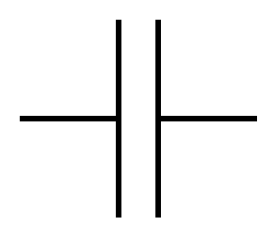
- 6What is the circuit symbol for a capacitor?
- 7What type of power source is a capacitor connected to?A direct current (d.c.) power source.
- 8Explain what happens when a capacitor is connected to a direct current power source.A charge builds up on its plates - one plate becomes negatively charged and the other positively charged. The plates are separated by an electrical insulator, so no charge can move between them. This means that a potential difference builds up between the plates of the capacitor.
- 9What is the voltage rating of a capacitor?The maximum potential difference that can safely be put across it.
- 10What voltage will a capacitor charge up to?The voltage of the power source it is connected to.
- 11How can you use this circuit to investigate the relationship between the potential difference across, and the charge stored on a capacitor using a constant current?Constantly adjust the variable resistor to keep the charging current constant for as long as you can. Record the p.d. at regular time intervals until it equals the battery p.d. Using the fixed charging current and the time taken to charge the capacitor you can plot a current-time graph. Using this graph you can use the equation Q = It to calculate the charge at a given time. You can then plot a graph of charge stored against p.d. across the capacitor at each recorded time interval. You will get a straight line through the origin showing Q and V are directly proportional.
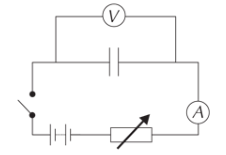
- 12How can you use this circuit to calculate the capacitance of a capacitor?Constantly adjust the variable resistor to keep the charging current constant for as long as you can. Record the p.d. at regular time intervals until it equals the battery p.d. Using the fixed charging current and the time taken to charge the capacitor you can plot a current-time graph. Using this graph you can use the equation Q = It to calculate the charge at a given time. You can then plot a graph of charge stored against p.d. across the capacitor at each recorded time interval. You will get a straight line through the origin. The gradient will be the capacitance.
- 13Why aren't capacitors used instead of batteries?Because they can only store relatively small amounts of charge.
- 14Why are capacitors only used to provide power for a short amount of time?Because it is tricky to prolong the discharge time and the voltage through the circuit decreases as the capacitor discharges.
- 15Why are capacitors useful?Because they can store charge it's needed and then discharge all of their charge in a fraction of a second, whereas a battery might take several minutes.
- 16Why are capacitors dangerous?Because they can discharge all of their charge in a fraction of a second, whereas a battery might take several minutes.
- 17What are three examples of uses of capacitors?In a camera flash - the camera battery charges the capacitor over a few seconds, and then the entire charge of the capacitor is dumped into the flash almost instantly. This allows the camera flash to be very bright for a short time.
'Ultracapacitors' (really big capacitors) can be used in back up power supplies to provide reliable power for short periods of time.
Th smooth out variations in d.c. voltage supplies - a capacitor absorbs the peaks and fills in the troughs. - 18Explain how energy is stored in a capacitor and then released.Like charges repel, so when each plate of a capacitor becomes charged, the charges on the plate are being forced together 'against their will'. This requires energy, which is supplied by the power source and stored as electric potential energy for as long as the charges are held. When the charges are released, the electric potential energy is released.
- 19How can you calculate the energy stored by a capacitor?By using the graph of potential difference against charge for the capacitor. The p.d. across the capacitor is directly proportional to the charge stored on it.
The total energy stored by the capacitor is the area under the graph of V against Q. It is a triangle so E = 1/2QV. - 20How is the energy supplied by the power source in charging the capacitor different to the energy stored by the capacitor?ΔW = VΔQ for the energy supplied by the power source so E = QV. This means the energy supplied by the power source is double the energy stored by the capacitor.
- 21How do you get two new equations for the energy stored by capacitors using the equations E = 1/2QV and C = Q/V.E = 1/2QV Q = CV
Substitute 2 into 1 so E = 1/2CV^2
E = 1/2QV V = Q/C
Substitute 2 into 1 so E = 1/2 (Q^2/C) - 22What is a dielectric?A material that acts as an electrical insulator. It is used to separate the two conducting plates in a capacitor.
- 23Altering the properties of a capacitor changes how much charge it can store at a given voltage (its capacitance). What is one of the things you can change?The dielectric material separating the two conducting plates.
- 24Why does changing the dielectric material separating the two conducting plates change the capacitance?Because different materials have different relative permittivities.
- 25What is permittivity?A measure of how difficult it is to generate an electric field in a medium. The higher the permittivity of a material, the more charge is needed to generate an electric field of a given size.
- 26What are the units of permittivity?Fm^-1
- 27What is relative permittivity a ratio of?The permittivity of a material to the permittivity of free space.
- 28What are the units of relative permittivity?No units.
- 29What is the equation for relative permittivity?εr = relativity permittivity of material 1
ε1 = permittivity of material 1
ε0 = permittivity of free space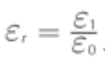
- 30What is another name for relative permittivity?The dielectric constant
- 31How can permittivity be explained?By the motion (or action) of the molecules inside a dielectric.
- 32Explain what happens in a dielectric and how this changes the capacitance.A dielectric is made up of lots of polar molecules. When no charge is being stored by a capacitor, no electric field is being generated so the molecules are aligned randomly. When charge is applied to the plates of a capacitor an electric field is generated between them. The negative ends of the molecules are attracted to the positively charged plate, and vice versa. This causes the molecules to align themselves anti-parallel to the electric field between the plates. The molecules each have their own electric field, which in this alignment now opposes the applied electric field of the capacitor. The larger the permittivity, the larger this opposing field is. This reduces the overall electric field between the parallel plates, which reduces the potential difference needed to transfer a given charge to the capacitor - so the capacitance increases.
- 33What does the capacitance depend on?The dimensions of the capacitor as well as the dielectric inside it.
- 34In the equation for capacitance, what does each symbol stand for?ε0 = permittivity of free space, Fm^-1
εr = relative permittivity
A = effective area of a plate, m^2
d = distance between the capacitor plates, m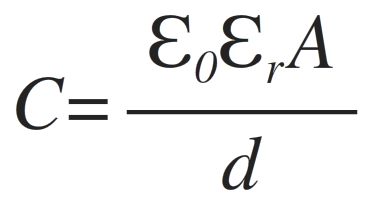
- 35How can you investigate how capacitance changes?By setting up two parallel plates separated by a dielectric and connecting the two plates to a capacitance meter. You can then alter how much the two plates overlap to change the effective area of the capacitor, or use different materials as the dielectric to vary the relative permittivity. Stacking multiple layers of the same material allows you to change the plate separation.
Informationen
- Beschreibung
- A2 Physics Karteikarten am Capacitors, erstellt von Jasmine Bayliss-Dagg am 23/10/2017.
- Erstellt von
- Jasmine Bayliss-Dagg
- Aufrufe
- 0
- Bewertung