
Karteikarten
Electric Fields
Karten in diesem Stapel (39)
- 1What is the main difference between electric and gravitational fields?Electric fields can be attractive or repulsive.
- 2What objects always have an electric field around them?Charged objects.
- 3What is an electric field around a charged particle?The region where it can attract or repel other charges.
- 4Is electric charge, Q, positive or negative?It can be either.
- 5What will a charged object in an electric field experience?A force.
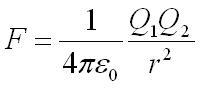
- 6What does Coulomb's law calculate?The force of attraction or repulsion between two point charges.
- 7What are the symbols in the following equation for the force between two point charges?F = force on the object, N
ε0 = the permittivity of free space = 8.85 x 10^-12 Fm^-1
Q1 and Q2 = charges on the two objects, C
r = distance between Q1 and Q2, m - 8What is the relation between the force on Q1 and Q2 in the equation shown?They are always equal and opposite.
- 9-If Q1 and Q2 have alike charges, will F be positive or negative? -If Q1 and Q2 have opposite charges, will F be positive or negative?The force will be repulsive so F will be positive.
The force will be attractive so F will be negative.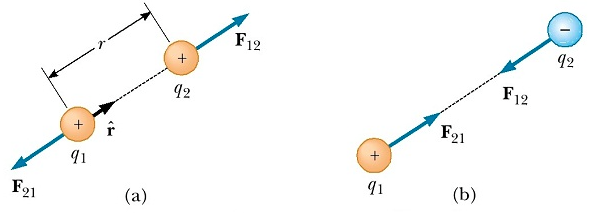
- 10What law is Coulomb's law another example of?An inverse square law, so F ∝1/r^2.
- 11If the point charges aren't in a vacuum in Coulomb's law what does the size of F also depend on? What do you do if the charges are in air?The permittivity of the material between them.
Air can be treated as a vacuum when using Coulomb's law so you can just keep using ε0. - 12What is electric field strength defined as?The force per unit positive charge experienced by a body in an electric field.
- 13What are the units of electric field strength, E?NC^-1, newtons per coulomb.
- 14What do the symbols in the equation E = F/Q stand for and what are there units?E = electric field strength, NC^-1
F = force on the charged object, N
Q = charge on the object, C - 15E is a vector so where does it point?It points in the direction that a positive charge would move.
- 16Why are electric field lines drawn?To show the direction of the force that would act on a positive charge.
- 17What type of field do point charges have?A radial field.
- 18Where do the field lines point for a positive point charge and where for a negative point charge?Positive - away from the point charge
Negative - towards the point charge - 19Where do the field lines point for parallel plates go?From the plate with the more positive voltage to the plate with the less positive voltage.
- 20What can conducting paper be used for?To map out the field lines of a 2D electric field.
- 21How does the experiment with conducting paper to map out the field lines for a 2D electric field work?The experiment is set up so that a positive charge is on one edge of the paper and a negative charge on the opposite edge.
A voltmeter is then used to measure the potential difference at different points on the paper. Points with the same voltage can be joined up to show equipotential lines. Equipotential lines are always perpendicular to field lines and so the field lines can also be mapped out. - 22What can be used to map out field lines of a 3D electric field?An electrolytic tank.
- 23How can an electrolytic tank be used to map out field lines of a 3D electric field?A tank of water with positive and negative ions dissolved in it is set up. Electrodes are put in the water to create a positive charge on one side of the tank and a negative charge on the other. A voltmeter is then used to find points within the water where the potential difference is the same. Equipotential and field lines can be mapped out from this.
- 24What type of fields is this equation for?Radial fields.
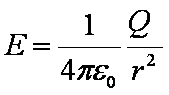
- 25What is a radial field?A field where all the field lines point towards or away from the central point.
- 26Which things have a radial field?A point charge or any body that behaves as if its charge is concentrated at the centre has one.
If you have a sphere that has charge evenly distributed across its surface, you can treat it as if it is a point charge acting at the centre of the sphere. - 27What type of relationship is this? If the charge isn't a point charge is this still the case?A case of the inverse square law E ∝ 1/r^2.
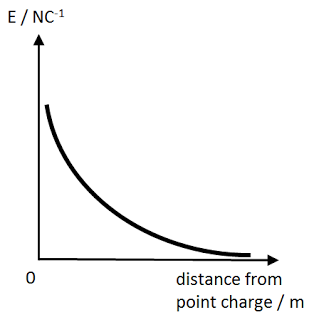
No, it doesn't have the same E ∝ 1/r^2 relation. - 28What does the graph of r on the x-axis against E look like for a point charge?
- 29What does the graph of r on the x-axis against E look like for a charged sphere?
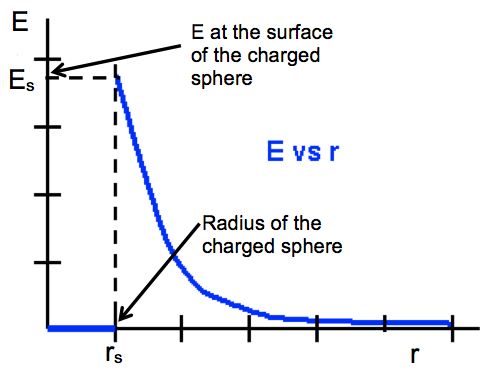
- 30How can you produce a uniform field?By connecting two parallel plates to the opposite poles of a battery.
- 31How does E vary at different points between the plates?It is the same at all points between the two plates.
- 32For the uniform field produced by connecting two parallel plates to the opposite poles of a battery, what is the equation for E?E = V/d.
V = potential difference between plates (V)
d = distance between plates (m) - 33If there were two parallel plates with a potential of 0V and +400V what would the potential difference be halfway and a quarter of the way between them?200V and 100V.
- 34What can be used to determine if a particle is charged?A uniform electric field.
- 35Explain what happens if a charged particle enters a uniform electric field at right angles to the field?The charged particle feels a constant force parallel to the electric field lines. If the particle is positively charged then the force acts in the same direction to the field lines. If it is negatively charged, the force acts in the opposite direction. This causes the particle to accelerate at right angles to the particles original motion so it follows a curved path (a parabola), as there are no other significant forces acting on the charged particle.
- 36What do all points in an electric field have?Absolute electric potential
- 37What is the absolute electric potential at a point in an electric field?The work done per unit charge on a positive test charge in moving the charge from infinity to that point.
- 38What does the absolute electric potential of a point depend on?How far it is from the charge creating the electric field and the size of that charge.
- 39—
Informationen
- Beschreibung
- Karteikarten am Electric Fields, erstellt von Jasmine Bayliss-Dagg am 26/10/2017.
- Erstellt von
- Jasmine Bayliss-Dagg
- Aufrufe
- 1
- Bewertung