
Karteikarten
Translocation
Karten in diesem Stapel (9)
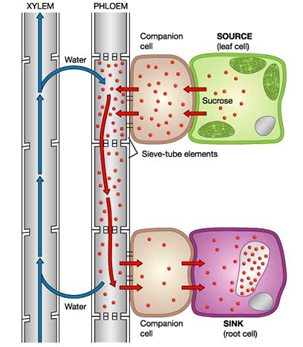
- 1What is translocation?The movement of dissolved substances (e.g. sucrose and amino acids), sometimes called assimilates
- 2What is a source?Where a substance is made (e.g. leaves)
- 3What is a sink?Where a substance is used up (e.g. roots, meristem)
- 4Complete the sentences: MASS FLOW HYPOTHESIS (1/3) Active transport loads _________ into sieve tubes at the ________. This lowers the Ψ inside sieve tubes so water enters sieve tubes by ________ from the _______ and __________ cells. This creates a high _________ inside the sieve tube at the source end of the phloemMASS FLOW HYPOTHESIS (1/3)
Active transport loads SOLUTES into sieve tubes at the SOURCE. This lowers the Ψ inside sieve tubes so water enters sieve tubes by OSMOSIS from the XYLEM and COMPANION cells. This creates a high PRESSURE inside the sieve tube at the source end of the phloem - 5Complete the sentences: MASS FLOW HYPOTHESIS (2/3) Solutes are removed from the ____________. This usually happens by __________ (passive) This increases Ψ inside sieve tubes so water leaves the tubes by ___________MASS FLOW HYPOTHESIS (2/3)
Solutes are removed from the PHLOEM. This usually happens by DIFFUSION (passive)
This increases Ψ inside sieve tubes so water leaves the tubes by OSMOSIS - 6Complete the sentences: MASS FLOW HYPOTHESIS (3/3) This results in a _________ gradient from the source to the sink. This gradient pushes ________ along sieve tubes. The higher the concentration of sucrose at the source, the _________ the rate of translocation.MASS FLOW HYPOTHESIS (3/3)
This results in a PRESSURE gradient from the source to the sink. This gradient pushes SOLUTES along sieve tubes. The higher the concentration of sucrose at the source, the HIGHER the rate of translocation. - 7TRUE OR FALSE: Translocation is a passive processFALSE
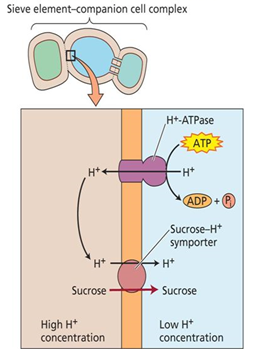
Translocation is an energy-requiring process transporting assimilates (e.g. sucrose) - 8Describe the process of active loading1. In the companion cell, ATP is used to actively transport H⁺ ions out of the cell and into surrounding tissue. This sets up a concentration gradient
2. An H⁺ ion binds to a co-transport protein in the companion cell membrane and re-enters the cell. A sucrose molecule binds to the co-transport protein at the same time. The movement of the H⁺ ion is used to move the sucrose molecule into the cell, against its concentration gradient
3. Sucrose molecules are then transported out of the companion cells and into the sieve tubes by the same process - 9—
Informationen
- Beschreibung
- Der Nutzer hat seine Fachbereichs-Information gelöscht. Karteikarten am Translocation, erstellt von Gelöschter Nutzer am 05/03/2018.
- Erstellt von
- Gelöschter Nutzer
- Aufrufe
- 21
- Verlauf
-
- Erstellt von Yinka F · 2 Feb 2018
- Kopiert von Yinka F · 5 Mär 2018
- Bewertung