
Karteikarten
ISCI 2002 Chapter 13
Karten in diesem Stapel (23)
- 1Radioactivityresults from radioactive decay, which is the process whereby unstable atomic nuclei transform and emit radiation
- 2Unstable atomic nuclei-have an imbalance of neutrons to protons
-are radioactive - 3Most radiation we encounter is:-natural background radiation that originates in Earth and space (cosmic rays from the Sun and stars)
-more intense at higher altitudes - 4Three Components of Radiation from RadionuclidesAlpha (α)
Beta (β)
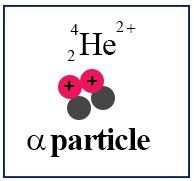
Gamma (γ) - 5Types of radiation:-alpha (α) +2 carries positive electrical charge
-beta (β) -1 carries negative electrical charge
-gamma (γ) carries no charge - 6Alpha particle:-consist of 2 protons and 2 neutrons (a helium nucleus)
-loses energy quickly during interaction
-can be stopped easily by a few pieces of paper due to its large mass and double positive charge
-is deflected in the presence of magnetic or electric fields - 7Alpha particle:-does not normally penetrate lightweight material (paper, clothing)
-causes significant damage to the surface of a material (living tissue) due to great kinetic energy
-picks up electrons and becomes harmless helium when traveling through air - 8Beta particle:-is an ejected electron
-has both a smaller mass and electric charge than an alpha particle, and moves faster
-loses energy at a slower rate in air and travels farther before stopping
-can be stopped by several sheets of aluminum foil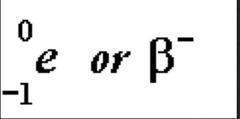
- 9Beta particle:-penetrates fairly deeply into skin (potential for harming or killing cells)
-once stopped, becomes an ordinary electron
-is deflected in the opposite direction to an alpha particle in the presence of magnetic and electric fields - 10Gamma rays:-are high-frequency electromagnetic radiation
-are emitted when a nucleus in an excited state moves to a lower energy state
-are more harmful than alpha or beta particles
-are most penetrating because they have no mass or charge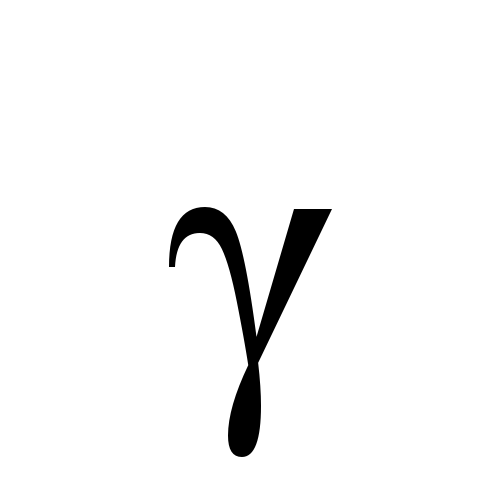
- 11Gamma rays:-are pure energy, greater per photon than in visible or ultraviolet light and x-rays
*are unaffected by magnetic and electric fields, and therefore interact via direct hit with an atom - 12Common Particles Encountered in Nuclear Reactions
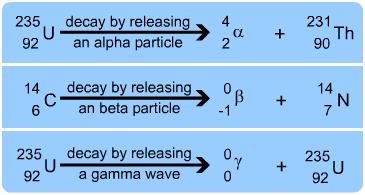
- 13alpha particle=nucleus of the helium atom
- 14—
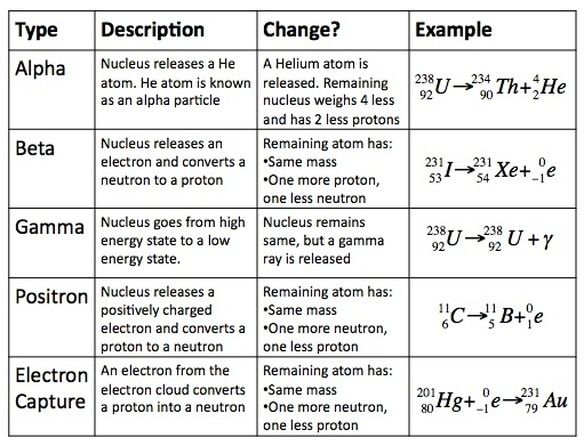
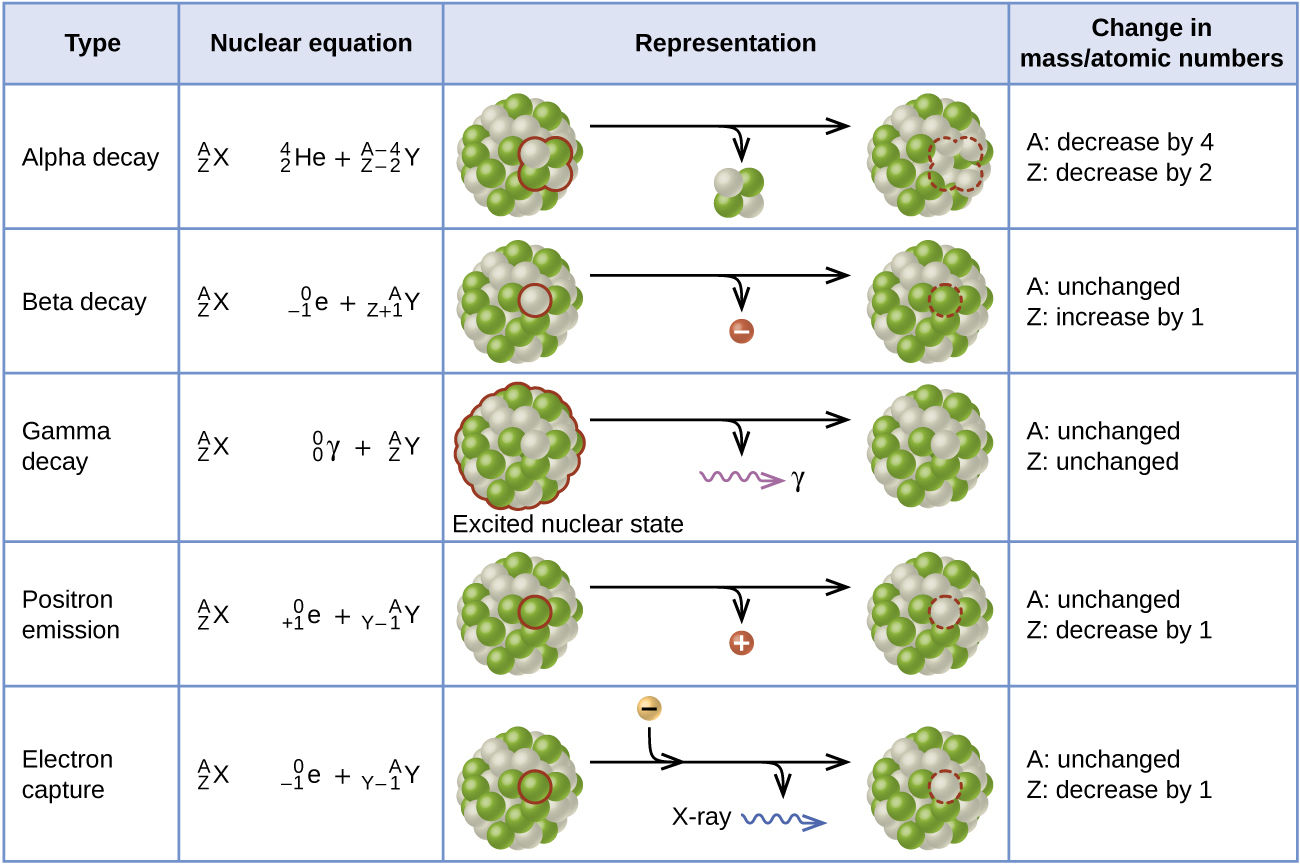
- 15In a nuclear decay equation, the sums of the mass numbers (A) and the sums of the atomic numbers (Z) will be equivalent on each side*
- 16when an atom undergoes radioactive decay, itturns into a completely different element
- 17The atomic nucleus and the strong number forcethe strong force is a force in the nucleus that holds nucleons together
- 18the strong force is only between close together nucleons. For far apart protons, the electric force is greater*
- 19—Alpha charge: 2+ mass: 4
Beta charge: 1- mass: 0
Gamma charge: 0 mass: 0
Positron charge: 1+ mass: 0
Neutron charge: 0 mass: 1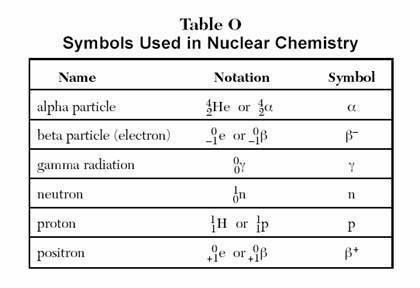
- 20Half-Life:-is the rate of decay for a radioactive isotope
-is the time required for half of an original quantity of an element to decay
-is constant and independent of any physical or chemical change the atom may undergo - 21Half-Life:can be calculated at any given moment by measuring the rate of deca of a known quantity using a radiation detector.
- 22Decay of Thorium234 over two half-lives Thorium234 has a half-life of 24 days.1000g of 234/90Th Day 0 100% Th (First half life) > 50g of other atoms - 50g of 234/90Th Day 24 50% Th (Second half life) > 75g of other atoms- 25g of 234/90Th Day 48 25% Th
- 23Finding the Elapsed TimeHow long would it take a sample of 14C to decay to one-fourth its original activity? (half life of 14C is 5730 years) 11,460
Informationen
- Beschreibung
- Integrated Sciences Karteikarten am ISCI 2002 Chapter 13, erstellt von Kyanna Jackson am 01/04/2018.
- Erstellt von
- Kyanna Jackson
- Aufrufe
- 21
- Bewertung