
Karteikarten
Organic Synthesis OCR Chemistry A
Karten in diesem Stapel (45)
- 1Homolytic fissioneach atom in a covalent bond gets one electron, producing free radicals
- 2Heterolytic fissionone atom gets both electrons when a covalent bond is broken.
- 3free radicalsreactive species which possesses an unpaired electron
- 4What type of reaction occurs between a halogen and an alkene?Free radical substitution
- 5Type of reaction, Reagents, conditions and stages of free radical substitution to form a haloalkaneType of reaction: Free Radical substitution
Reaction taking place: Halogenation
Reagents: Alkane + halogen (eg. Br2)
Conditions: UV light
Three stages: initiation reactions, propagation reactions, termination reactions - 6what is a double bond made up of?A sigma-bond and pi-bond.
- 7What makes alkenes more reactive?The pi-bond in the double bond is formed from the overlap of p-orbitals. These pi-bonds are much weaker than sigma-bonds due to the spread of electron density above and below the molecule, so there's weaker electrostatic attraction between the nuclei and electrons. This means that it is more likely to be attacked by electrophiles.
- 8Electrophileelectron-pair acceptor
- 9Type of reaction alkenes go throughElectrophilic addition reactions
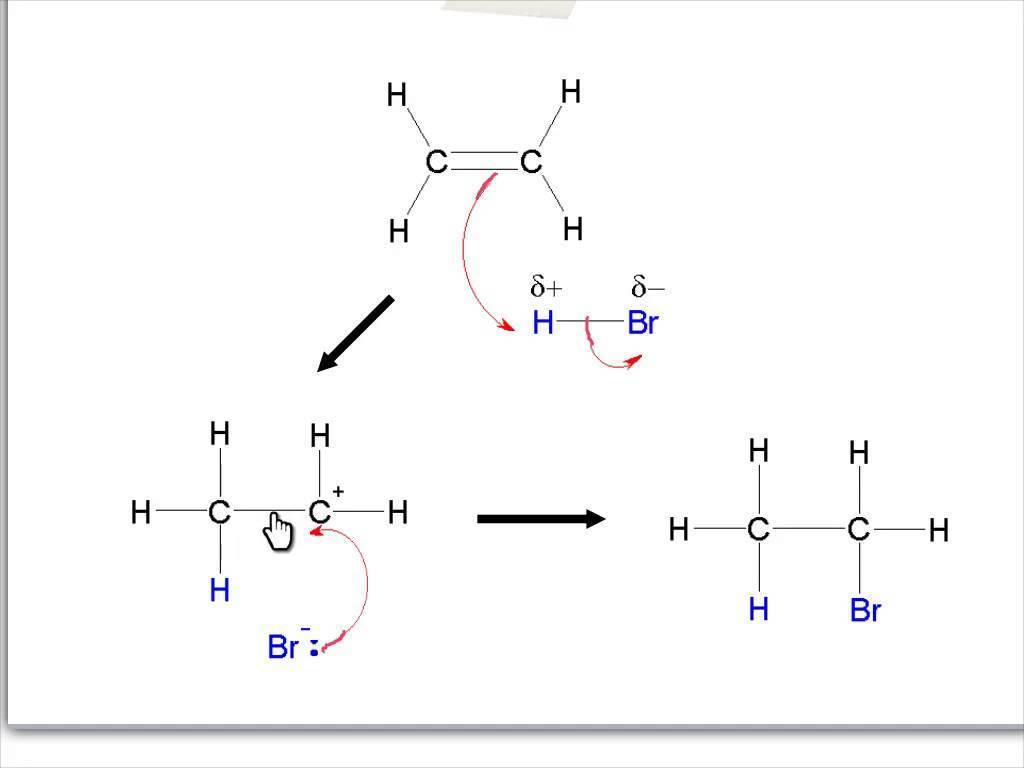
- 10Markownikoff's ruleH adds to the carbon with the most H atoms already attached as this is the more stable carbocation.
- 11What makes a carbocation more stable?more alkyl groups = more stable because the alkyl groups are electron releasing and reduce the charge on the positive carbon atom, stabilising it.
- 12Test for C=C double bondShake with orange bromine water.
positive = goes colourless
(because Br is added across the double bond to form a dibromoalkane) - 13production of alkanes from alkenesReagents: Alkene + Hydrogen
Conditions: Ni catalyst, 150 degrees Celcius
Reaction taking place: Hydrogenation - 14Formation of alcohol from an alkeneReagents: alkene, steam
Conditions: 300 degrees Celsius, 60-70 atm,
H3PO4 catalyst
Reaction taking place: Hydration
Type of reaction: electrophilic substitution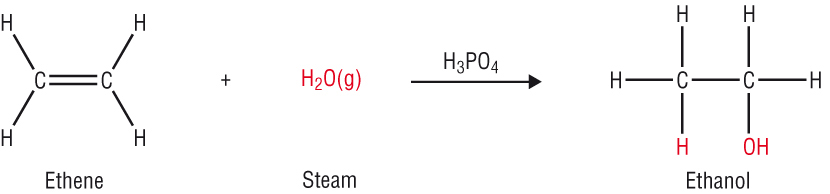
- 15products of complete combustion of alcoholscarbon dioxide and water
- 16Formation of haloalkanes from alcohols (reagents, conditions, type of reaction)Type of reaction: substitution reaction
Reaction taking place: Halogenation
Reagents: alcohol, halide ion
Conditions: acid catalyst (H2SO4) - 17Dehydration of alcoholsType of reaction: Elimination reaction
Reagents: alcohol, conc. H2SO4
Conditions: Heat under reflux
Products: Alkene and water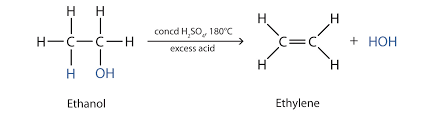
- 18Oxidation of Primary AlcoholsReagents: alcohol, potassium dichromate solution [O]
Conditions: Distil for aldehyde, reflux for carboxylic acid
Observation: orange dichromate(VI) ion is reduced to the green chromium(III) ion, Cr3+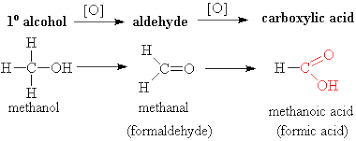
- 19Oxidation of Secondary AlcoholsReagents: alcohol, potassium dichromate solution [O]
Conditions: Distil for ketone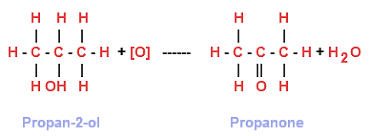
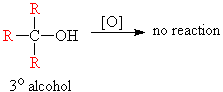
- 20Oxidation of Tertiary AlcoholsCannot be oxidised
- 21HaloalkaneAn alkane with halogen atoms
- 22Nucleophileelectron-pair donator
- 23Reactivity of haloalkanesHalogens are much more electronegative than C, so the C-X bond is polar. The delta+ C is electron deficient, so attracts nucleophiles to undergo nucleophilic substitution reactions.
- 24Hydrolysis of haloalkanesType of reaction: Nucleophilic Substitution
Reaction taking place: Hydrolysis
Reagents: haloalkane, NaOH
Conditions: warm aqueous alkali, reflux
Product: Alcohol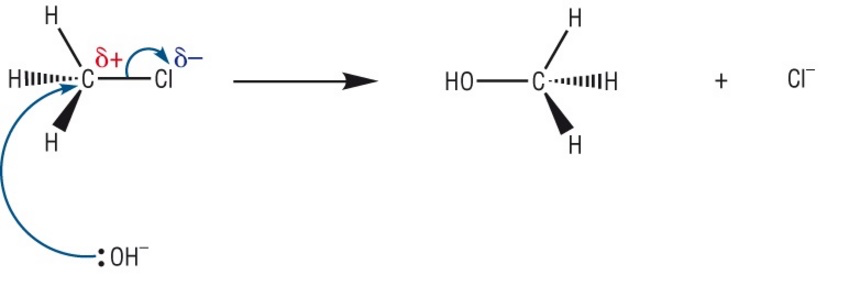
- 25Rate of substitution reactions with haloalkanesAs polarity of the halide decreases (down the group), C is less attracted to nucleophiles, so the rate decreases. However, as bond strength decreases (down the group), the bond breaks more easily, so rate increases.
overall order (fastest to slowest): iodoalkane, bromoalkane, chloroalkane, fluoroalkane. - 26Formula of benzeneC6H6
- 27Comparison of Kekule's model and the delocalised model for benzeneKekule:
Alternating single and double bonds.
P-orbitals overlap between two C atoms
Localised electron density in pi-bonds.
Delocalised:
P-orbitals of all 6 C atoms overlap to create a pi-system
Pi-system made up of two rings of delocalised electrons above and below the plane of the molecule.
Equal length C-C bonds - 28Evidence for the delocalised model of benzene1. Normally, the length of C-C bond is 154pm and C=C bond is 134pm, but in benzene, all C-C bonds are 140pm.
2. Enthalpy change of hydrogenation for cyclohexene is -120 kJ/mol so is Kekule was right, it would be 3 times this for benzene (-360 kJ/mol) but it is actually -208 kJ/mol. This is less exothermic than expected.
3. Benzene should react with bromine water at room temperature like alkenes, but it is actually only possible in the presence of a halogen carrier or high temp. So it is more stable than an alkene. - 29Aromatic compoundcompounds containing a benzene ring
- 30What makes benzene more stable than alkenes?In benzene, electrons are delocalised, in alkenes they are localised between two carbon atoms. This means that benzene has a lower electron density than alkenes, so benzene is unwilling to undergo addition reactions because it is too stable.
- 31What reactions to arenes undergo?Electrophilic substitution reactions.
(A hydrogen atom is replaced by an electrophile)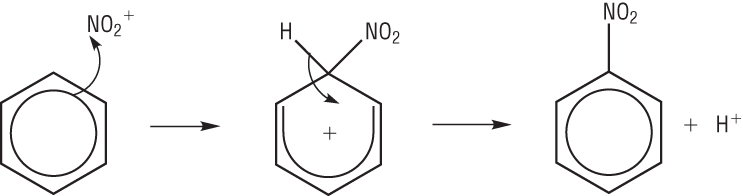
- 32Halogen CarrierThey make compounds into stronger electrophiles. They accept a lone pair of electrons from a halogen atom on an electrophile and as the lone pair is pulled away, polarisation in the molecule increases, forming a carbocation. This makes the electrophile stronger, allowing halogens to substitute into the benzene ring.
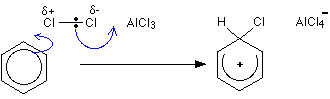
- 33Halogenation of BenzeneType of reaction: Electrophilic Substitution
Reaction taking place: Halogenation
Reagents: Halogen, halogen carrier
Conditions: halogen carrier catalyst (AlCl3)
Product: halobenzene - 34Friedel-Crafts alkylationForm C-C bonds by putting an alkyl group onto a benzene ring using a haloalkane and halogen carrier, and reflux.
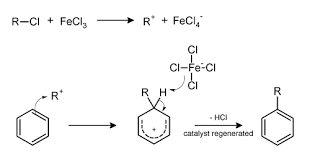
- 35Friedel-Crafts acylationSubstitutes an acyl (C=O) group for a H on benzene. Reflux benzene with an acyl chloride and halogen carrier to produce phenylketones.
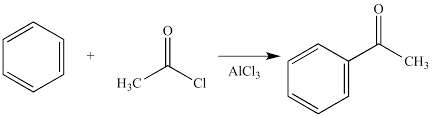
- 36Production of nitrobenzeneReagents: Conc. nitric acid, benzene
Conditions: warm, conc. H2SO4 catalyst, for mononitration temp needs to be below 55 degrees, otherwise multiple substitutions.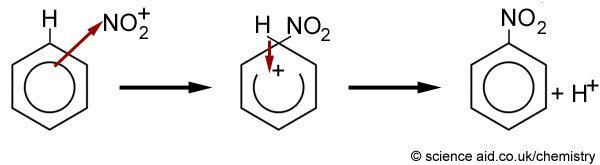
- 37PhenolC6H5OH
Benzene ring with alcohol group attached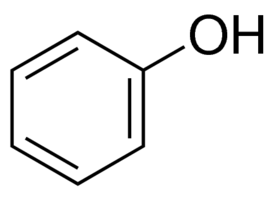
- 38Why is phenol more reactive than benzene?Lone pair of electrons from oxygen p-orbital overlap with the delocalised ring of electrons in the benzene ring, so it is partially delocalised into the pi-system. This increases electron density of the ring, making it more likely to be attacked by electrophiles.
- 39Where do electron donating groups direct substitution? Give examples of electron donating groups.Electron donating groups include -OH, and -NH2.
They direct substitution to the 2-, 4-, and 6- carbons. - 40Where do electron withdrawing groups direct substitution? Give examples of electron withdrawing groups.Electron withdrawing groups include -NO2.
They direct substitution to the 3- and 5- carbons because it withdraws electron density at the 2-, 4- and 6- carbons, so they can't react with electrophiles. - 41Reaction of phenol with bromine waterReagents: bromine water (Br3)
Type of reaction: electrophilic substitution
products: 2,4,6-tribromophenol and HBr
observation: orange to colourless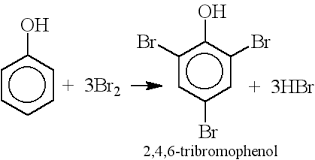
- 42Nitration of phenolReagents: dilute nitric acid
Type of reaction: electrophilic substitution
Products: 2-nitrophenol, 4-nitrophenol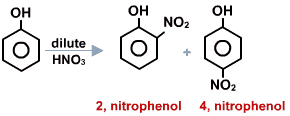
- 43Phenol with bases (NaOH)Phenol is weakly acidic so will undergo typical acid-base reactions.
Reagents: NaOH
Conditions: room temp
Products: sodium phenoxide and water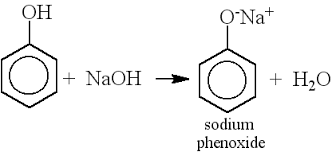
- 44Carbonyl compoundsAldehydes and ketones
Contain C=O group - 45Reduction of aldehydes and ketonesType of reaction: nucleophilic addition
Reagent: reducing agent [H] NaBH4 (sodium tetrahydriborate (III) or sodium borohydride), then water
Products: alcohol
Informationen
- Beschreibung
- All synthetic routes and reactions needed for OCR chemistry A exam for A level paper 2 and 3.
- Erstellt von
- Amelia Wilson
- Aufrufe
- 438
- Tags
- Bewertung