
Karteikarten
EDUC 8P19 - Behaviour/Classroom Management
Karten in diesem Stapel (71)
- 1CALM ModelConsider - Does the behaviour change, affect, or disrupt the classroom learning environment, teacher, or students?
Act - act when it has become distracting
Lessen - minimize distraction and lessen the use of invasive responses
Manage - get the situation to quickly return to an effective learning environment - 2Behavioural Problemin the opinion of the teacher, when a student interferes with the act of teaching or with the rights of others or causes psychological/physical harm, or destroys property.
- 3Classroom Managementa teacher's ability to establish and maintain an environment that is suited to teaching and learning. The teacher possesses a repertoire of procedures to ensure optimal learning for all students.
- 4Professional Knowledgepedagogical and practical knowledge related to teaching and learning
- 5Four Teacher Power Bases1. Referent Power
2. Expert Power
3. Legitimate Power
4. Reward and Coercive Power - 6Referent Powerstudents behave as the teacher wishes because they like the teacher as a person and feel that they care about them
useful for all levels - 7Expert Powerstudents view the teacher as a good, knowledgeable teacher who can help them to learn; power of professional competence
less useful at primary level, heavily dependent on student values - 8Legitimate Powerstudents behave because the teacher is the teacher; authority and power
useful at all levels, societal changes have lessened the usefulness of this power base - 9Reward / Coercive Powerstudents behave to avoid some form of punishment or to gain a predetermined reward
less useful at older levels, emphasizes extrinsic > intrinsic motivation - 10Theories of Classroom Management1. Student-Directed Management
2. Collaborative Management
3. Teacher-Directed Management - 11Student-Directed Managementprimary goal = prepare for life in a democracy; students are allowed to make many decisions in the classroom
individual conference, group problem solving, natural consequences
referent / expert power bases - 12Collaborative Managementbelief that the control of student behaviour in the classroom is the joint responsibility of the student and the teacher
coping skills, natural and logical consequences, anecdotal record keeping
expert / legitimate power base - 13Teacher-Directed Managementbelief that students become good decision-makers by internalizing rules and guidelines for behaviour that are provided by a responsible and caring teachers
clear communication, rewards/punishments, behaviour contracting
reward/coercive power base - 14Antecedentspreliminary courses of action that may increase the likelihood that appropriate behaviour will take place, or they may set the stage for the occurrence of misbehaviour
- 15Environmental Conditions- students must be physically comfortable
- lighting, temperature, dress, noise
- seating arrangements
- bulletin boards and display areas
- new technologies in the classroom - 16Classroom Routines- examples and demonstrations
- necessary for feedback and practice must be provided
- use of logical and natural consequences - 17Classroom Rules- focus on appropriate behaviour
- more complex / time consuming than routines
- should be directed at organizing > exerting control
- need to be fair, realistic, and rationalized
- developed in collaboration
- logical consequences - 18Natural Consequencesoutcomes of behaviour that occur without teacher intervention
- 19Logical Consequencesoutcomes that are directly related to the behaviour that require teacher intervention to occur
- 20Correction by Force"justified ... if the force does not exceed what is reasonable under the circumstances"
- removal of privileges is more logical
- doesn't have a lasting impact - 21Four Sets of Skills (Johnson, Johnson, and Holubec)1. Forming Skills
2. Functioning Skills
3. Formulating Skills
4. Fermenting Skills - 22Forming Skillsan initial set of management skills that are helpful in getting groups up and running smoothly and effectively
- 23Functioning Skillsgroup-management skills aimed at controlling the types of interactions that occur among group members
- 24Formulating Skillsa set of behaviours that help students to process material mentally
eg. summarizing key points, connecting ideas, memorization techniques - 25Fermenting Skillsset of skills needed to resolve cognitive conflicts that arise
eg. criticizing without deriding, asking for justification, extending others' ideas - 26Behavioural Probleman action that distracts from an effective learning environment
*should not be defined as a descriptor of a negative character trait - 27Teacher Interventionteacher actions, which may include verbal response, proximity, or silence, that lead to desired student behaviour
- 28Motivational Problems- occur because of low levels of self-confidence, low expectations for success, lack of interest, lost feelings of autonomy, achievement anxieties, fears of success/failure
- involves long-term individualized intervention (building confidence and interest) and/or referrals to professionals - 29Crimemust come under the control of the school administration and outside law-enforcement agencies
tends to be least frequent disturbance - 30BullyingFour kinds: verbal, social, physical, cyberbullying
- does not go away without direct intervention - 31Ripple Effectstudents learn misbehaviour from observing misbehaviour in other children
not limited to the initial misbehaviour - 32Maslow's Hierarchy of Needs1. physiological needs: hunger, thirst, breathing
2. safety and security needs: protection from injury, pain, extremes of heat and cold
3. belonging and affection needs: giving and receiving love, warmth, and affection
4. esteem and self-respect needs: feeling adequate, competent, worthy, appreciation
5. self-actualization needs: self-fulfilment by using one's talents and potential - 33Persistently disruptive students - home and family variables1. parental supervision & discipline = inadequate
2. parents = indifferent/hostile
3. family did not operate as a unit and marital relations were not close
4. parents couldn't talk about their children and believed they had little influence < other kids - 34Four Goals of Disruptive BehavioursAttention Getting
Power Seeking
Revenge Seeking
Display of Inadequacy - 35Cognitive Development (Jean Piaget)sensory-motor
preoperational
concrete operational
formal operational - 36Moral Development (Kohlberg)punishment-obedience
exchange of favours
good boy-nice girl
law and order
social contract
universal ethical principles - 37Resiliencyrisk factors; beyond the control of teachers and schools - include social and economic disadvantages
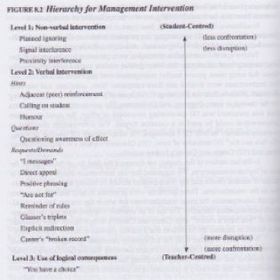
NEED: caring and supportive relationships, positive and high expectations, and opportunities for meaningful participation - 38Intervention Skills1. non-verbal intervention
2. verbal intervention
3. use of logical consequences - 39Prerequisites to Classroom Management1. The teacher is well-prepared to teach.
2. The teacher provides clear directions
3. The teacher ensures that students understand evaluation criteria
4. The teacher clearly communicates and enforces behavioural expectations
5. The teacher demonstrates enthusiasm
6. The teacher builds, positive, caring relationships with students - 40Surface Behavioursverbal interruptions
eg. talking, humming, laughing, whispering
off-task behaviours
eg. daydreaming, sleeping, doodling
physical movement intended to disrupt
eg. visiting, passing notes
disrespect
eg. arguing, vulgarity, talking back - 41Proactive Intervention Skills1. Change the pace of classroom activities
2. remove distracting objects
3. Boost interest of student who shows signs of off-task behaviour
4. Redirect the behaviour of off-task students
5. Provide a 'non-punitive' time out
6. Encourage the appropriate behaviour of other students
7. Provide cues for expected behaviours - 42Planned Ignoringif you ignore a behaviour, it will lessen and eventually disappear ... intentionally and completely ignores the behaviour
LIMITATIONS: short-term increase in the behaviour, students have to ignore as well, need to move to next step if not working - 43Signal Interferencenon-verbal response that communicates to the student without disturbing others that it is inappropriate
- must be clearly directed
- eg. head shaking, pointing
* when it does not work, they must move to proximity interference - 44Proximity Interferenceany movement toward the disruptive student, used when the teacher cannot send a signal
- 45Behaviour Modificationmethod that involves the use of stimuli through positive and negative reinforcement to change behaviours & reactions
B.F. Skinner - operant conditioning - 46Verbal Intervention1. use non-verbal first
2. keep private as possible
3. make brief
4. speak to the situation > person
5. set limits on behaviour > feelings
6. avoid sarcasm
7. use technique that fits the student
8. if the 1st intervention doesn't work, move to the next teacher-control technique
9. if more than one verbal intervention does not work, begin use of logical consequences - 47Adjacent (peer) reinforcementbased on the learning principle that reinforced behaviour is more likely to be repeated
use of peer reinforcement as a verbal intervention technique focuses class attention on appropriate behaviour rather than on inappropriate behaviour - 48Calling on the Student by Nameredirects the student to appropriate behaviour by calling on the student to answer a question or by inserting the student's name when observing off-task
use name first, question second to redirect rather than embarrass - 49Using Humourpowerful tool in establishing relationships and defusing confrontations
directed at teacher or situation
careful not to use sarcasm - 50Questioning Awareness of Effectforcing students to become aware of the positive/negative effects on other people
- 51Sending an "I Message"recognize the negative impact of the behaviour
description of behaviour + its effects + how it makes you feel
important for taking responsibility - 52Direct Appealcourteously requesting that a student stop the disruptive behaviour
- 53Positive Phrasingteacher states what the potential positive outcomes are for a student who exhibits appropriate behaviour - redirection to positive behaviour
- 54Reminding Students of Rulesreminding them of the rules they committed to
better for younger grades
if it doesn't work, may need to apply consequences - 55Glasser's Triplets1. What are you doing?
2. Is it against the rules?
3. What should you be doing?
to minimize extended negative confrontation, you may want to use statements > questions - 56Explicit Redirectionconsists of an order to stop the misbehaviour AND to return to acceptable behaviour
- 57Broken Record Strategy (Canter & Canter)repeating an instruction if the student does not do it the first time
good for avoiding verbal battles
*if used 3 times without results, teachers should move to logical consequences - 58Logical Consequenceswhen non-verbal and verbal interventions have not led to appropriate behaviour
forceful but not punitive manner
emphasize student changing behaviour > retribution
"You have a choice" technique: helps student realize they are responsible for positive and negative consequences of their behaviour
be assertive and willing to follow through
** should be as directly-related to the behaviour as possible - 59Hierarchy for Management Intervention
- 60Cycle of Discouragement
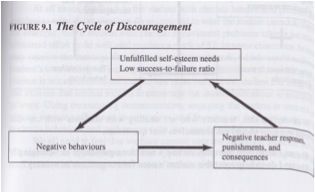
- 61The Cycle of Encouragement
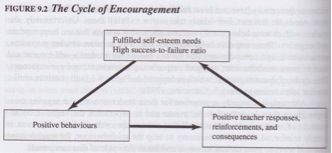
- 62Private Conferences - Receiving1. Use silence and non-verbal attending skills
2. Probe
3. Check perceptions
4. Check feelings - 63Private Conferences - Sending1. Deal in the here and now
2. May eye contact
3. Make statements > questions
4. Use "I" - take responsibility for feelings
5. Be brief
6. Talk directly to student
7. Give directions to correct problem
8. Check student understanding of your message - 64Self-Monitoringstudent-directed approach; effective with students who are trying to behave but seem to need assistance
usually for younger ages
instrument needs to be explained
wanting to eventually move away from self-monitoring - 65Anecdotal Record Keepingcollaborative approach; teacher records positive and negative classroom behaviour over a period of a few weeks
most appropriate for middle and secondary students for self-regulation - 66Functional Behaviour Assessmentteacher-directed strategy; someone skilled at observing behaviour tries to determine the intent
used most often with special needs students, needs team of professionals - 67Behaviour Contractingteacher directed strategy; written agreement between teacher and student offering a specified reward
encouraging self-discipline, more successful with younger grades
NEEDS: specific, gradual improvements, gradually lengthen time period, move from extrinsic to intrinsic rewards - 68Symptoms of Serious Problems1. changes in physical appearance
2. changes in activity level
3. changes in personality
4. changes in achievement status
5. changes in health / physical ability
6. changes in socialization - 69Basics of Effective TeachingLesson Design
Student Motivation
Teacher Expectations
Classroom Questioning
Maximizing Learning Time - 70Lesson DesignLESSON INSTRUCTION: making students aware of what they are supposed to learn, establishing clear goals
CLARITY: clear explanations of the content, step-by-step
CHECK FOR UNDERSTANDING: stopping to ask critical questions, encouraging commentary
COACHED PRACTICE: period of guided practice of new skill/knowledge through exercises, students receive frequent feedback, scaffolding (Vygotsky)
CLOSURE: good lesson summary, involving students
SOLITARY PRACTICE: lessons that include individual practice
REVIEW: periodic reviews to help consolidate learning - 71Student MotivationSTUDENT INTEREST: relating subjects to life outside of school
STUDENT NEEDS: making sure that basic needs are met first, allowing students to work together to build sense of belonging
NOVELTY AND VARIETY: planning activities that are no longer than 15-20 min
SUCCESS: important for teachers to creat success for students who are not usually successful - making adjustments
TENSION: moderate amount required to establish that they need to know how to demonstrate their learning, but it can't be too much
FEELING TONE: emotional atmosphere or climate of classroom needs to be positive
ASSESSMENT AND FEEDBACK: well-designed formative assessment identifies what they know and what misconceptions they may possess, feedback = most effective when it is given directly after
ENCOURAGEMENT: emphasizes positive behaviour, validates effort, positive expectations
Informationen
- Beschreibung
- Karteikarten am EDUC 8P19 - Behaviour/Classroom Management, erstellt von jessicamorris am 06/11/2014.
- Erstellt von
- jessicamorris
- Aufrufe
- 35
- Bewertung