
Karteikarten
Analysis of Human Performance Lecture Exam 2 Study Guide
Karten in diesem Stapel (75)
- 1Elbow Joint3 bones, 3 ligaments, 2 Joints, 1 capsule
3 bones = Humerus, Radius & Ulna - 2Elbow Joint = 2 Joints#1. Trochlea of Humerus + Trochlear Notch of Ulna
#2. Capitulum of Humerus + Head of Radius - 3Elbow Joint MotionsHinge Joint = Flexion & Extension
(0 - 150 degrees)
**NO hyperextension (blocked by olecranon process in olecranon fossa) - 4Radioulnar Joint2 bones, 2 articulations (proximal & distal)
- 5Radioulnar Joints = 2#1 Proximal = Head Radius pivot with Radial notch of Ulna
#2 Distal = Ulnar notch of Radius rotates around head of Ulna - 6Radioulnar Joint MotionPivot Joint = supination & pronation
*Radius moves around the Ulna
(0 - 90 degrees) - 7Wrist Joint2 Joints
1. Radiocarpal joint: distal radius + scaphoid, lunate & triquetrum)
2. Mid-carpal joint: between two rows of carpal bones - 8Wrist Carpal Bones
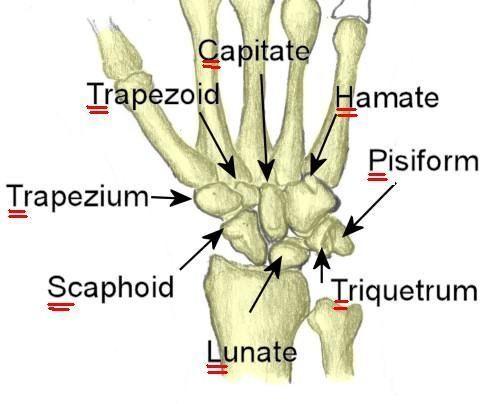
- 9Wrist Joint MovementMotions
Flexion (0-80 degrees)
Extension (0-70 degrees)
Radial deviation/wrist abduction (0-20)
Ulnar deviation/wrist adduction (0-30) - 10Hand bones
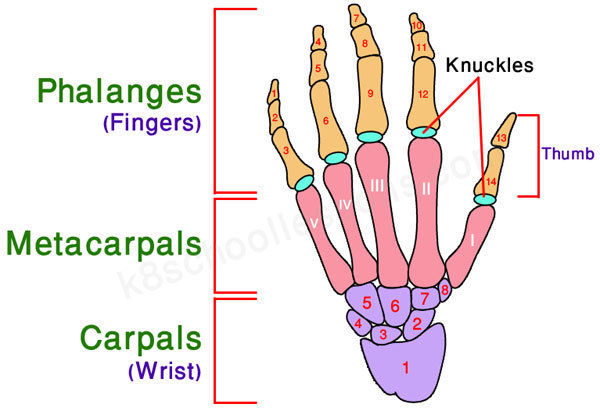
- 11Elbow Joint
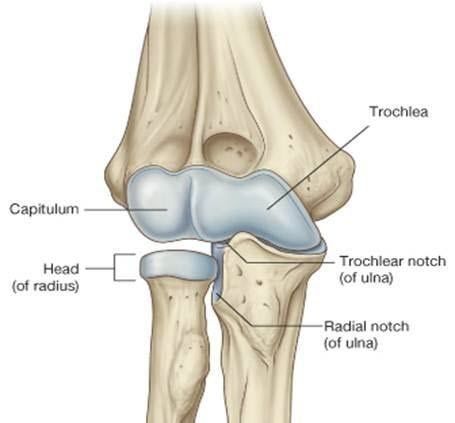
- 12Mid-carpal JointBetween the 2 rows of the carpals
Proximal: scaphoid, lunate triquetrum, pisiform
Distal: Trapezoid, trapezium, capitate, hamate - 13Carpo-Metacarpal JointVery Little Movement in 2-5
Joint helps shape hand for arches.
**Very Important Joint for THUMB (saddle) - 14Metacarpo-Phalangeal Joint (MCP)Knuckles
2-5 Movement = flexion/extension & abduction/adduction
* When fully flexed, abduction minimal
Thumb = digit 1 - 15Interphalangeal JointsProximal = base of head of proximal phalanx + base of middle phalanx
Distal = head of middle phalanx + base of distal phalanx
Motions = flexion & extension - 16Key Concept: Two Joint Principle MusclesCapacity to act on any joint it crosses.
Any muscle that crosses a joint can act on it. - 17Key Concept: Two Joint Principle Muscles continued....Position of one Joint can influence the action of another joint.
EX: position of shoulder can impact what it does on the elbow. - 18Two Joint Muscle ExamplesBiceps Brachii
Origin: scapula
Insertion: over elbow
Primary function: elbow flexion forearm supination
* can technically assist in shoulder flexion - 19Two Joint Muscle ExampleTricpes Brachii
Origin: scapula
Insertion: olecranon surface of ulna
Primary function: elbow extension
* can act on shoulder joint and elbow joint - 20Two Joint Muscle ExampleFlexor Digitorum Superficialis
* crosses the elbow joint & wrist joint
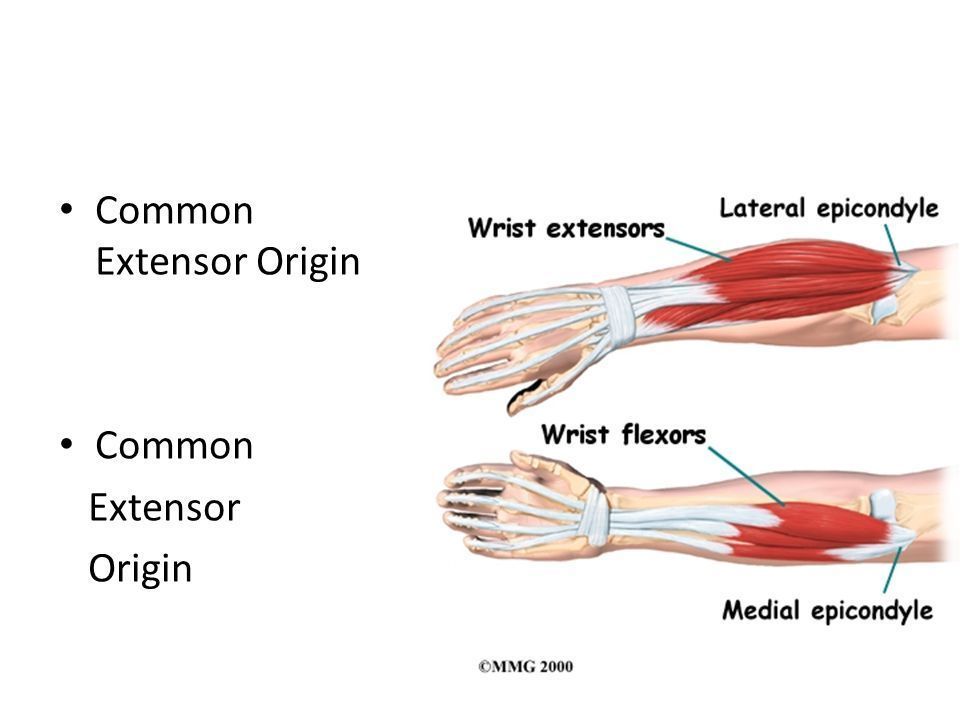
**can technically act on both joints - 21Wrist Flexors OriginMedial epicondyle of Humerus
- 22Wrist Extensors OriginLateral epicondyle of Humerus
- 23Wrist Flexors & Extensors Origin
- 24Muscle SynergistNon-specific term describing a muscle that works with one or more other muscles to enhance a particular motion.
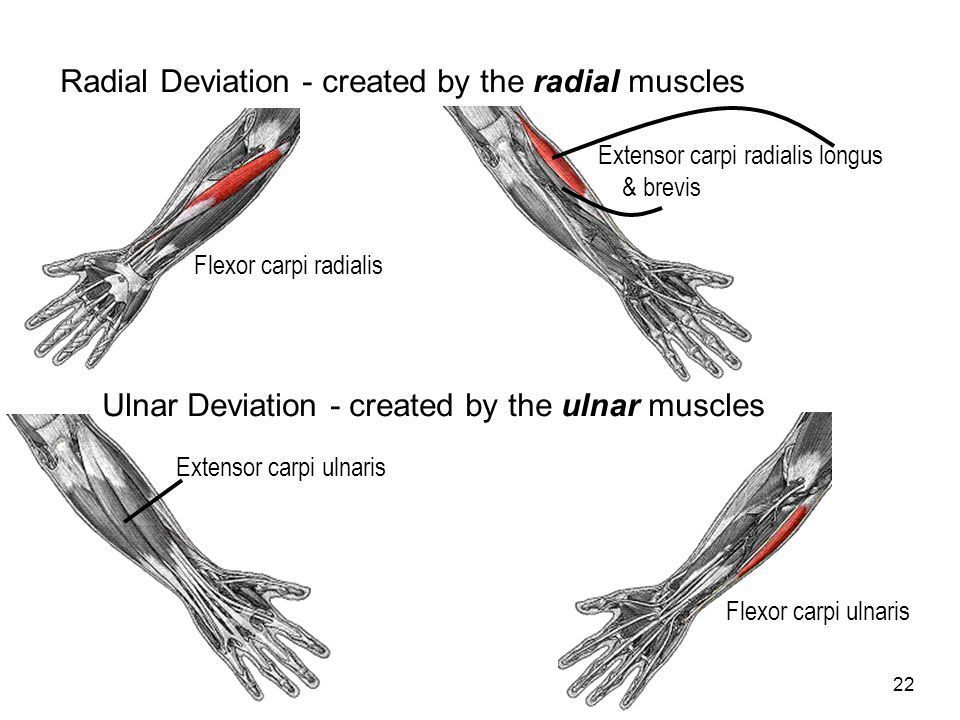
- 25Synergist ExampleFlexor Carpi Ulnaris + Extensor Carpi Ulnaris
** Work together to create the motion:
Ulnar Deviation - 26Synergist Examples
- 27Thenar EminenceNerve: Median Nerve
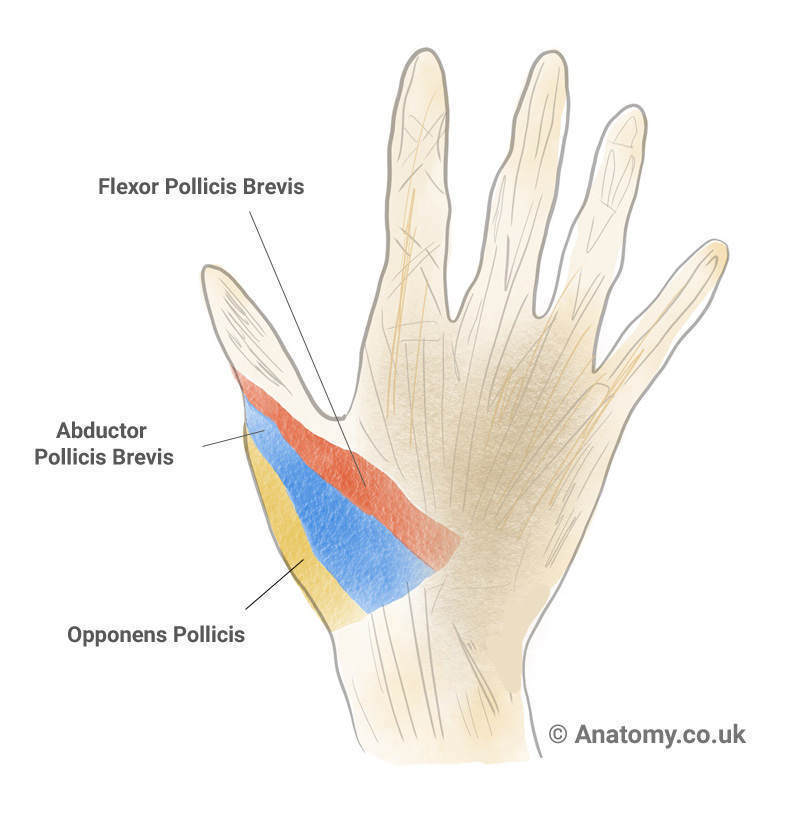
Muscles:
Flexor Pollicis brevis
Abductor Pollicis brevis
Opponens Pollicis
Thumb side - 28Thenar eminence
- 29Hypothenar eminenceNerve: Ulnar nerve
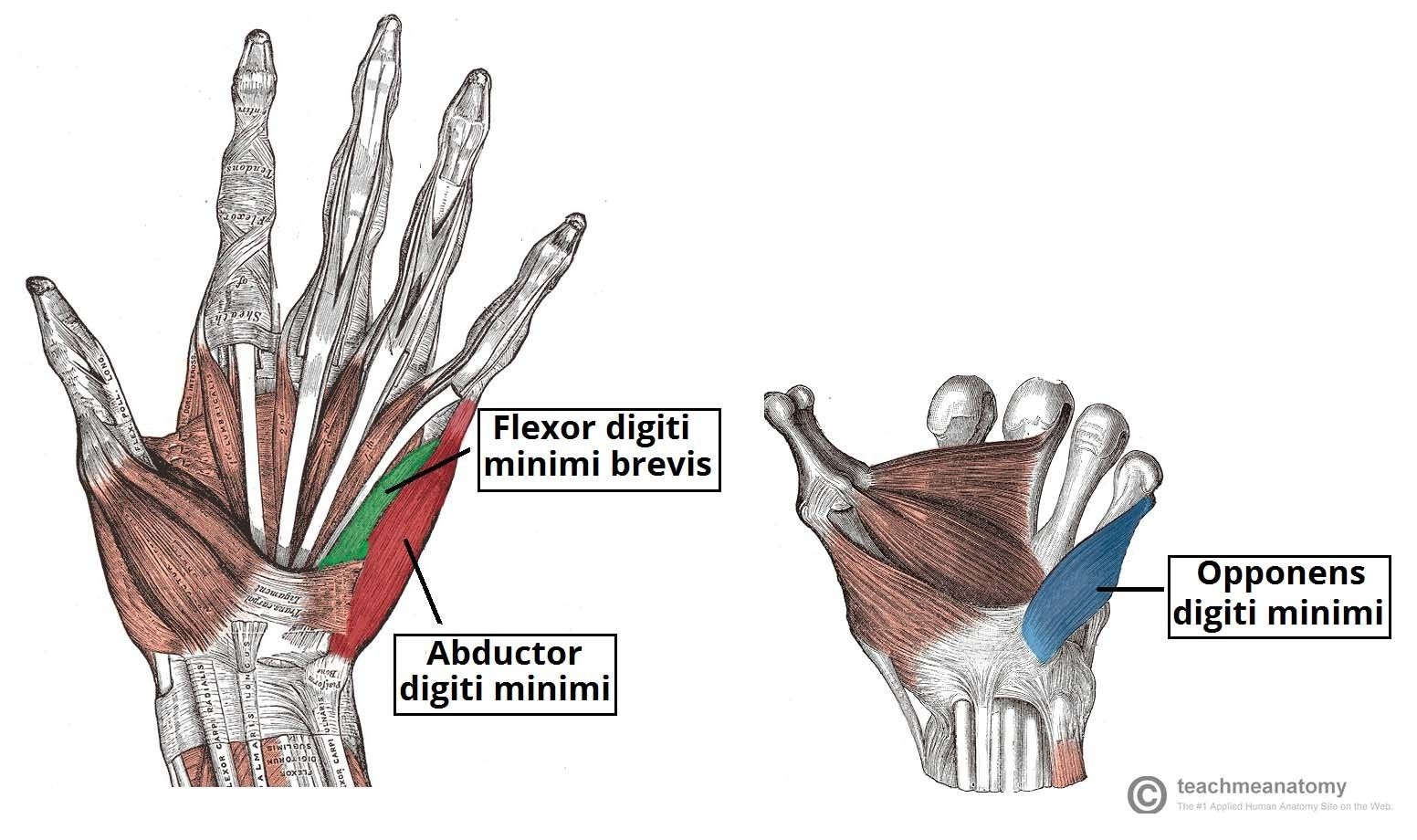
Muscles:
Abductor Digiti Minimi
Flexor digiti minimi brevis
Opponens digiti minimi
**Pinky side - 30Hypothenar Eminence
- 31Split Innervation MusclesFlexor Digitorum Profundus
2nd & 3rd = Median Nerve
4tth & 5th = Ulnar Nerve - 32Split Innervation MusclesLumbricals
#1 & #2 = Median Nerve
#3 & #4 = Ulnar Nerve - 33Interossei MusclesOrigin: Between Metacarpals
Insertion: Proximal Phalanx - 34Interossei MusclesDAB = 4
Dorsal Interossei Muscles
ABduct fingers @ MCP joint - 35Interossei MusclesPAD = 3
Palmar Interossei Muscles
ADduct finers @ MCP joint - 36Manual Muscle Testing GradingNone = 0 No visible or palpable contraction
Trace = 1 Visible or palpable contraction; no ROM
Poor = 2 Full ROM, gravity eliminated
Fair = 3 Full ROM against gravity
Good = 4 Full ROM against gravity, moderate resistance
Normal = 5 Normal, Maximal resistance - 37PrehensionUsing the hands for grasping, holding, and manipulating objects.
2 Types: Power & Precision - 38Prehension: Power GripObject held forcefully while being moved about by more proximal joint muscles.
Example: holding a hammer/knob - 39Prehension: Precision GripObject manipulated with a "finer type of movement"
- 40Prehension ComponentsReach: ability to approach an object in space.
Grasp: ability to position & close hand around object.
Manipulation: ability to move object while holding it.
Release: ability to let go of object when desired. - 41Types of Power Grips: Cylindrical Spherical Hook1. Cylindrical Grip: all fingers are flexed around an object & thumb is wrapped around the object in opposite directions.
Ex: holding hammer or wheelbarrel - 42Types of Power Grips2. Spherical Grasp: often involves palm in which all fingers & thumb are abducted.
Ex: holding a ball or apple - 43Types of Power Grips3. Hook Grip: involves 2nd - 5th fingers PIP & DIP flexed around object hook-like.
Ex: holding a brief case - 44Types of Precision Grips: Pincer Tripod Lateral Pinch Lumbrical1. Pincer Grasp: finger tips press against each other (tip to tip)
Ex: picking up a coin - 45Types of Precision Grips2. Tripod (3 Jaw Chuck): Thumb + 2nd and 3rd fingers
Ex: holding a pencil - 46Types of Precision Grips3. Lateral Grip (pad to side): pad of extended thumb pressing an object against radial side of index finger.
Ex: holding a key or money between 1st and 2nd fingers - 47Types of Precision Grips4. Pinch Grip: thumb and index finger
- 48Types of Precision Grips5. Lumbrical Grip: (plate grip) MCP flexed & PIP/DIP extended; object held in horizontal position.
Ex: holding a plate - 49Brachial PlexusNerve plexus that arises from C5 - T1.
Serves: shoulder, chest, & arm (upper extremity)
Both Motor & Sensory information
Key Nerves: axillary, radial, musculocutaneous, median, and ulnar - 50Hand Photo: Intrinsic Muscles
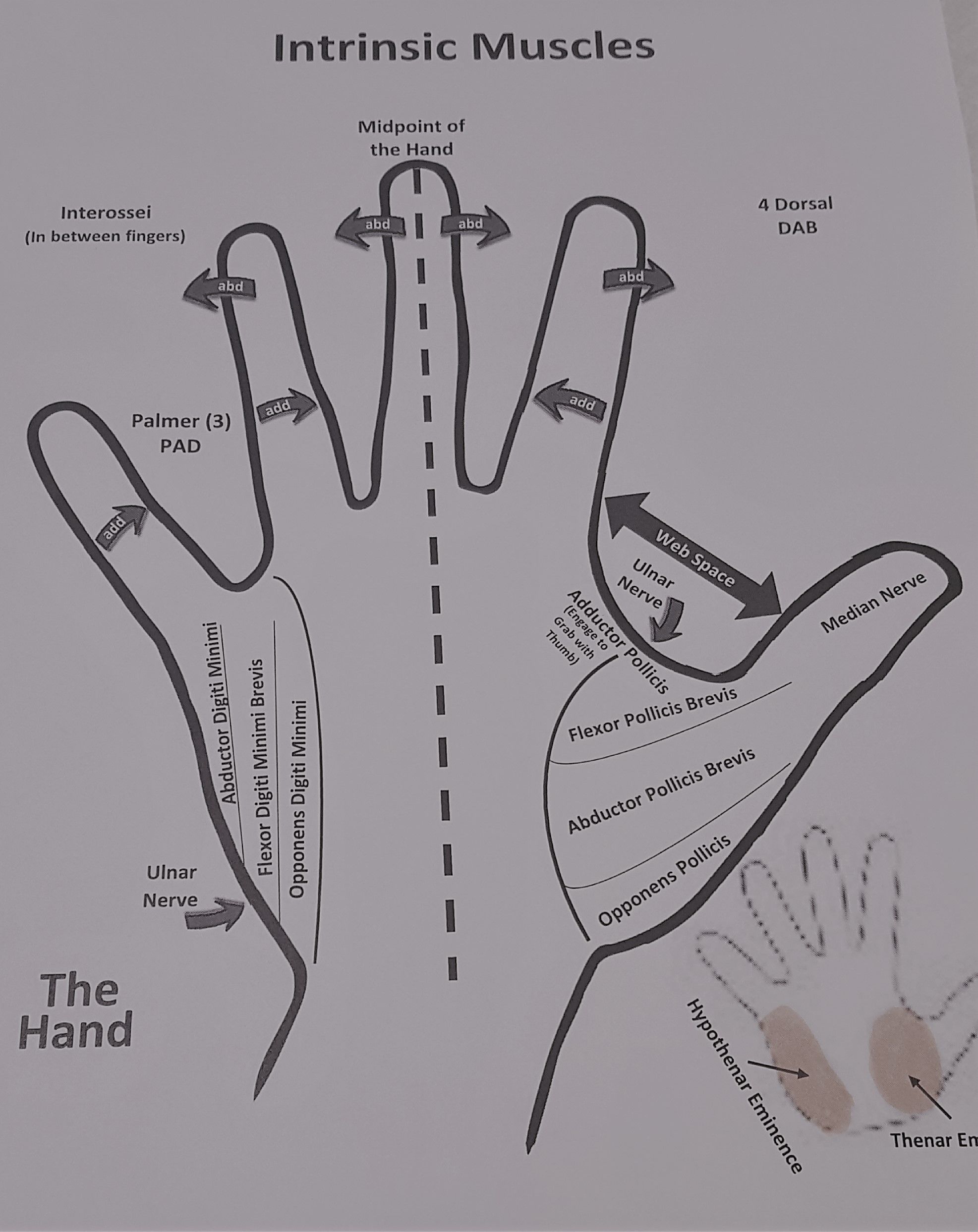
- 51Elbow Joint Ligaments = 3Medial & Lateral Collateral Ligaments
1. Stabilize elbow joint
2. Prevent abduction & adduction of elbow joint
Annular Ligament
Hold radius close to ulna & stabilizes joint during supination & pronation; forms ring around radial head/attaches to ulna - 52Carrying AngleLateral deviation of Ulna
* Allows us to carry objects in the hand, away from the body - 53Interosseous Membrane of Elbow JointHolds radioulnar articulations.
Prevents separation of bones.
Provides surface area for muscle attachments. - 54Elbow & Radioulnar Anterior Muscles1. Biceps Brachii (musculocutaneous N.)
2. Brachialis (musculocutaneous N.)
3. Brachioradialis (radial N.)
4. Pronator Teres (median N.)
5. Pronator Quadratus (median N.) - 55What do the Anterior Muscles have in common?1. biceps brachii & brachialis in anterior compartment.
2. biceps brachii, brachialis, & brachioradialis flex elbow
3. biceps brachii, brachialis & coracobrachialis innervated by musculocutaneous Nerve - 56Other details of anterior arm muscles1. Biceps brachii & Brachioradialis supinate forearm
2. Brachioradialis supinates/pronates from mid or neutral position
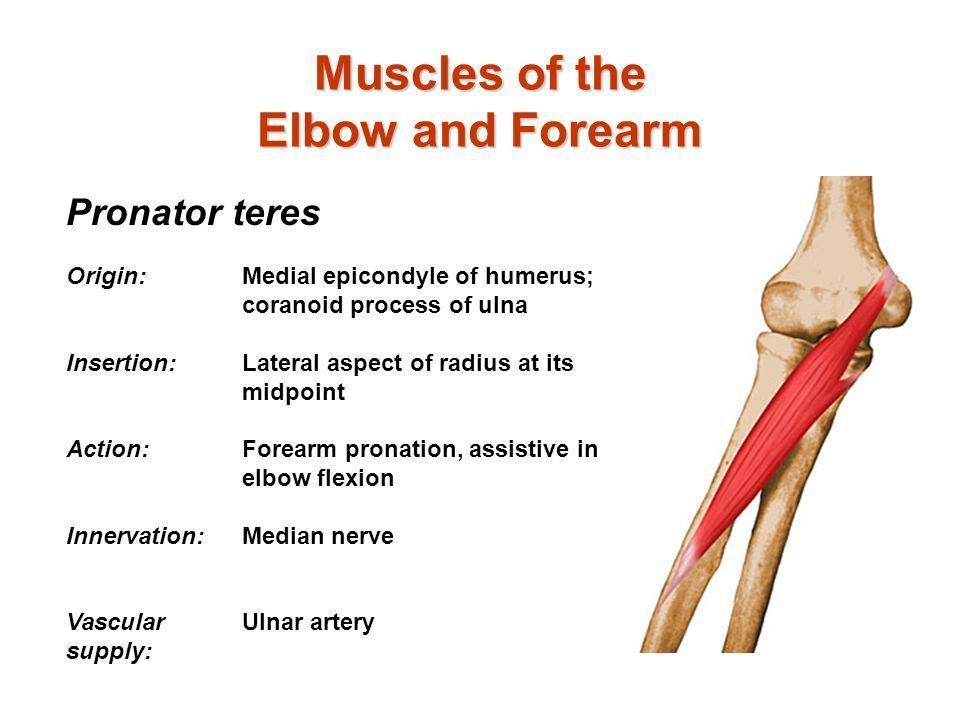
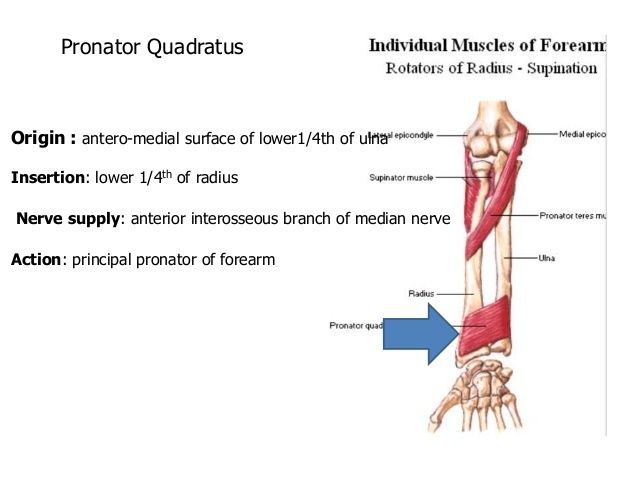
3. Both pronators pronate the forearm
4. Pronator teres is weak elbow flexor - 57Posterior Muscles Extension & Supination1. Triceps brachii - elbow extension, weak shoulder extensor, forearm supinator
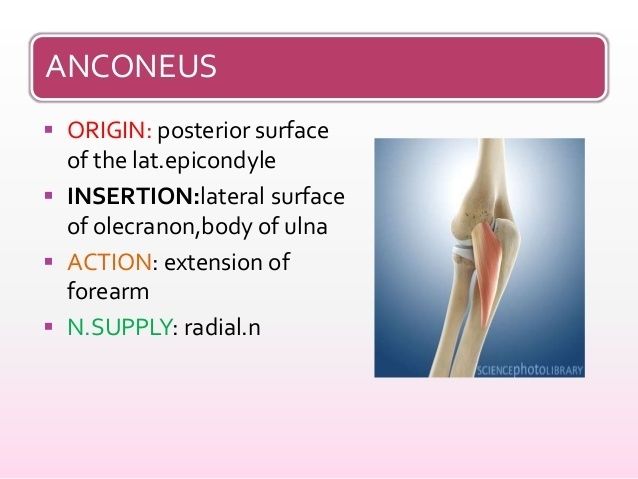
2. Anconeus - elbow extension
3. All posterior muscles innervated by radial nerve - 58Anconeus Muscle: Elbow Extension
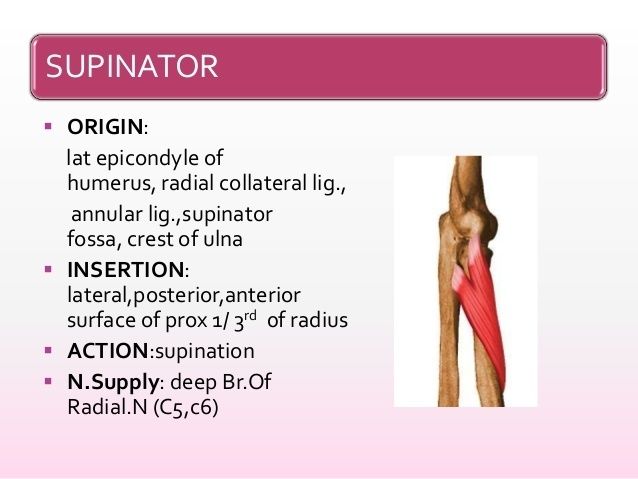
- 59Supinator Muscle Supination
- 60Pronator Teres Pronate forearm/weak elbow flexion
- 61Pronator Quadratus Pronate forearm
- 62Wrist Ligaments1. Radial Collateral Ligament
2. Ulnar Collateral Ligament
Both provide lateral/medial support of wrist joint. - 63Wrist Ligaments continued...3. Palmer Radiocarpal Ligament - limits wrist from over extension.
4. Dosral Radiocarpal Ligament - limits wrist from over flexion. - 64Wrist Flexors1. Flexor Carpi Radialis = wrist flexion/radial deviation; Median Nerve
2. Flexor Capri Ulnaris = wrist flexion/ulnar deviation; Ulnar Nerve
3. Palmaris Longus = wrist flexion; Median Nerve (12% population missing this muscle) - 65Wrist Extensors1. Extensor Carpi Radialis Longus & Brevis
2. Extensor Carpi Ulnaris
All innervated by Radial Nerve.
All have same origin on Lateral epicondyle of Humerus - 66Hand Ligaments (Palmer and Transverse Carpal Ligaments)Flexor Retinaculum - spans anterior surface of wrist.
Main function: hold tendons close to wrist; prevent from pulling away from wrist during wrist FLEXION.
Also keeps carpals from spreading apart. - 67Transverse Carpal Ligament **Hood for carpal tunnelArches over carpal bones forming tunnel through which MEDIAN nerve and NINE extrinsic flexor tendons, thumb, flexor digitorum profundus, and flexor pollicis longus pass through.
- 68Arches of HandProximal carpal arch
Distal carpal arch
Longitudinal arch
* responsible for cupped position of hand
* contribute to function of various hand grasps - 69Saddle Joint = Thumb Joint1st Metacarpal + Trapezium
- 70Thumb#1 Digit
3 Joints, not 4
1. CMC joint
2. MCP joint
3. IP joint - 71Thumb MotionsFlexion
Extension
Abduction
Adduction
Opposition - 72Intrinsic Hand MusclesOrigin/Insertion within hand.
Small
Fine motor movements.
Thenar/Hypothenar Eminence included - 73Lumbricles (Intrinsic)Flex MCP joint
Extend PIP Joints
Nerve innervation:
* index/middle = median n.
* ring/little = ulnar nerve - 74Sensory Distribution of HandMedian Nerve: palmar surface of thumb, index, middle and radial side of ring
Ulnar Nerve: palmar surface of ulnar side of ring and small fingers
Radial Nerve: mostly dorsal surface of hand - 75Carpal Tunnel SyndromeMedian Nerve entrapment
Informationen
- Beschreibung
- Der Nutzer hat seine Fachbereichs-Information gelöscht. Karteikarten am Analysis of Human Performance Lecture Exam 2 Study Guide, erstellt von Gelöschter Nutzer am 01/12/2018.
- Erstellt von
- Gelöschter Nutzer
- Aufrufe
- 17
- Verlauf
-
- Erstellt von Robin Decker · 28 Okt 2018
- Kopiert von Robin Decker · 1 Dez 2018
- Bewertung