
Karteikarten
Basics On Electricity
Karten in diesem Stapel (28)
- 1Define Current (I)Rate of flow of charge
(how many coulombs per second) - 2Define Charge (Q)Amount of charge that passes in 1 second when the current is 1 Ampere
- 3Charge carriers allow....An electric current via a passage
- 4What is the equation for finding ΔQ involving current and time?ΔQ = IΔt
- 5What is the charge on a electron (elementary charge)1.60 x 10^-19 C
- 6How do we find the number of electrons in 1 coulomb of charge?1/1.60x10^-19 = 6.25 x 10^18 electrons
- 7The area of a current-time graph = ....ΔQ
- 8The gradient (found using tangents) of a charge-time graph = ....Current
- 9Charge carries can be either positive or....Negative
- 10In metals, charge carriers are....Conduction electrons (free / delocalized electrons)
- 11Conduction electrons move about repeatedly and therefore.....Collide with each other and the fixed positive cations
- 12In solutions, current pass by.....Ions (charged atoms or molecules, e.g. Na+)
Note ion has gained or lost electrons to gain overall charge - 13How do we measure current at a point in a circuit?Use an ammeter in series
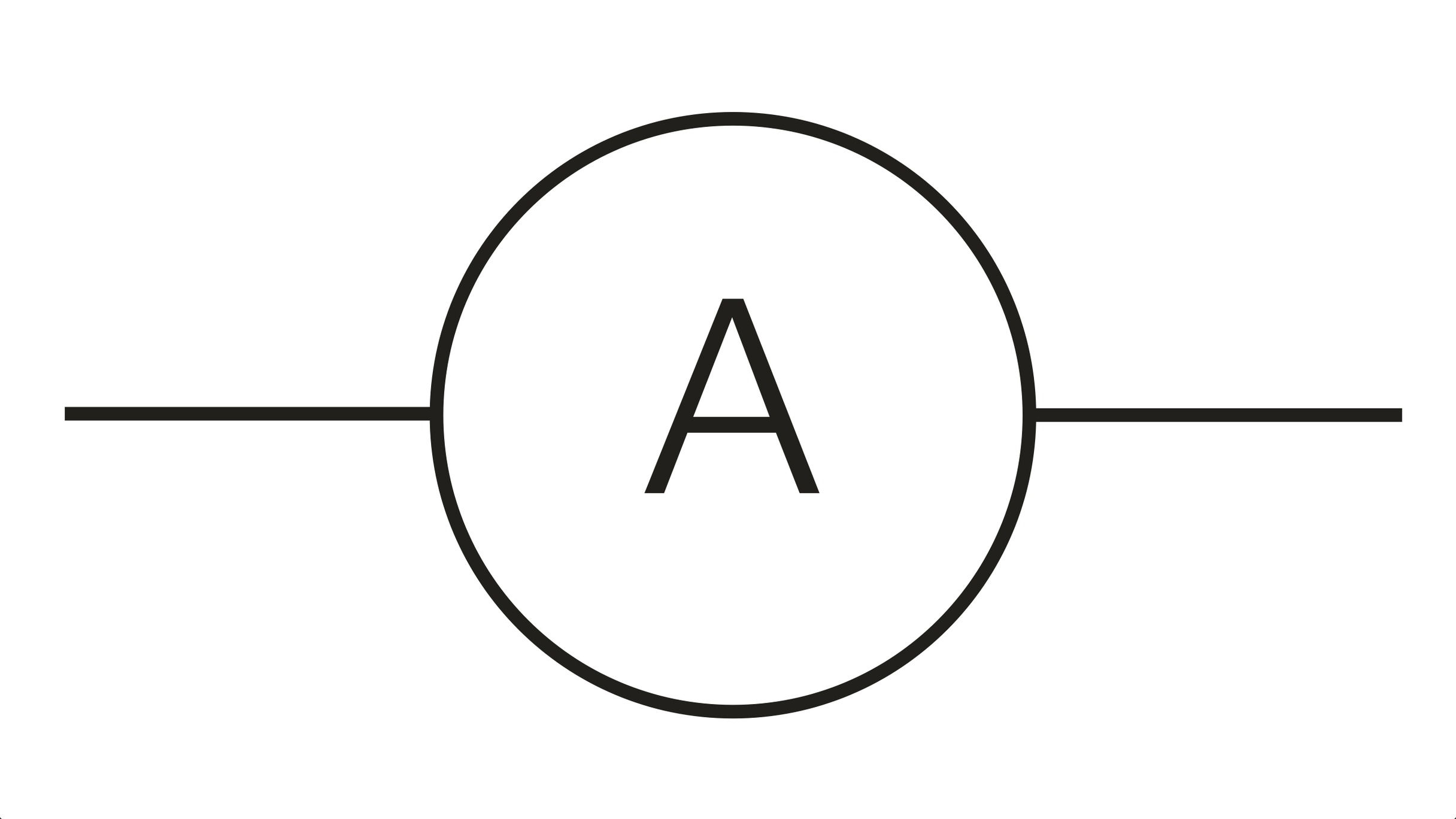
Assume ammeter has 0 resistance - 14Ammeter symbol:
- 15Define conventional currentRelative direction in which positive charges (or ions) flow in a circuit, and it's opposite to electron flow
- 16Which direction is conventional current?Positive terminal to negative terminal
- 17Which direction is actual current?Negative terminal to positive terminal
- 18What is Kirchhoff's first law?Sum of current entering a junction (or a point) = sum of current leaving the junction (or the point) , therefore charge is conserved.
- 19Current is series is.....Always the same at every point
- 20Current in parallel is.....Split equally between branches
- 21What are 2 advantages of a parallel circuit?1. Extra appliances can be added without affecting the output of the others
2. When one breaks they all don't fail - 22Define VoltageWork done per unit charge
(V=Wd/Q) - 23When voltage is supplied (e.g. from a battery) to a circuit, we call it....EMF (Electromotive force)
- 24When voltage is taken (e.g. from a component) from a circuit, we call it....P.D (Potential Difference)
- 25Kirchhoff's 2nd Law:Sum of EMF across closed loop = sum of p.d across components in that loop. Therefore energy is conserved
- 26If we have 5 batteries of 1.5V and the middle one is facing the wrong way, how would we find the total voltage?1.5 + 1.5 - 1.5 +1.5 + 1.5 = 4.5V
- 27How do we calculate resistance in a series circuit?rT = r1 + r2 + r3 .....
- 28How do we calculate resistance in a parallel circuit?1/rT = 1/r1 + 1/r2 + 1/r3 .....
(This should be less than the lowest resistors resistance)