
Karteikarten
Transcription and Translation in Bacteria and Eukaryotes
Karten in diesem Stapel (34)
- 1RNACentral Dogma followed to transcribe encoded genes into mRNA for protein translation
mRNA carries code
tRNA carries specific amino acid
rRNA forms ribosome with protein
Regulatory RNA - miRNA, siRNA, shRNA - 2DNA - dependent RNA polymerasesperform transcription - need a DNA template. No need for RNA primer, 5' to 3' synthesis
Transcription creates mRNA as template for translation
polymerase uses ribonucleoside triphosphate ATP, CTP, GTP, UTP - 3Bacterial TranscriptionE.Coli RNA polymerase contains 6 subunits in holoenzyme ~459kDa
Associates with sigma factor to produce active form - able to dissociate
Bacteriophage T7 ~99kDa
E.coli larger size as more complex - sensitive to environment and need for specific recognition of many binding sites and interaction with regulatory proteins whereas bacteriophage only few units - 4E.coli RNA polymerase subunits and functionsAlpha ~ 2 copies in holoenzyme for enzyme assembly and regulatory interactions
Beta ~ pincer with beta' that acts as DNA clamp. Target of rifampicin
Beta' ~ forms pincer with beta that calms DNA, conserved catalytic core, aspartates in core coordinate Mg2+ and used in phosphodiester bond formation
Omega ~ forms beta' subunit before requiting it to Alpha2beta
Sigma ~ DNA binding specificity - without = low level and non specific - 5Initiation of bacterial transcriptionOpen reading frame = DNA containing instruction for protein synthesis
Promoter region = upstream from ORF, RNA polymerase recognises. Mutations change efficiency. Contain specifically positioned nucleotides
Sigma factor makes specific contacts with -10 and -35 elements of DNA
RNA polymerase unwinds DNA fragments to act as template - 6Specific regions in bacterial promotersTranscription start site (+1) - 90% purine (A or G)
two 6 bp sequences -10 TATAAT and -35 TTGACA.
Helical DNA makes distances critical between -35 and -10 regions - usually 16-18 nucleotides. Too large, sigma factor won't bind hence no specificity
Promoter sequence variation from consensus at one or more points - 7FootprintingDNA containing promoter radioactively labelled at one end
Incubated with DNAses
Protein factor added to one and not the other
Gel electrophoresis to separate
That will protein factor with have a space with absence of fragments compared to that without protein factor - shows where the protein factor is bound as protects from the DNAses
How RNA polymerase site was found - 8Bacterial Sigma FactorsProvides specificity
Only in bacteria
Holoenzyme
Influences genes transcribed
Without, RNA polymerase bind randomly and loosely to DNA
Identifying promoter = 2D scanning, resulting in formation of "closed promoter complex" on DNA
Bacteria can have rapid change in DNA as multiple sigma factors - respond to environment or stimuli
Genes with similar or related function often have same or similar promoter region
E.coli has 7 sigma factors - 9E.coli sigma factors70 - primary for exponential growth. provides specific affinity for promoter region of housekeeping genes.
18 - iron isocitrate transport
24- respond to periplasmic stress
28- late flagellar gene expression
32- heat shock gene transcription
38- stationary phase gene expression
54- expressing genes for nitrogen metabolism - 10Elongation of bacterial transcriptionClosed promoter complex of RNA polymerase and DNA
Polymerase unwinds short piece (15-17bp) of dNA to create open promoter complex
Prepare DNA as template for mRNA and elongation
Rate of elongation varies and can pause - influenced by DNA sequences
Extended pausing induce premature termination of transcription - 11How elongation occursHoloenzyme non-specific binding to DNA and migrates to promoter
RNA polymerase docks with promoter to form closed promoter complex
15-17bp unwound to form open promoter complex - conformational change
B subunit of RNA polymerase synthesised RNA. Sigma factor dissociates after ~8 nucleotides and reused
Continues until termination signal
Elongation begins at +1 position. Requires continual DNA unwinding and processive movement of RNA polymerase with DNA
rNTPs covalently added to 3' end of mRNA chain
Once RNA polymerase moved on, DNA reassociates with complementary strand to reform helix - 12Termination of bacterial transcriptionRNA polymerase pause nad dissociate from DNA/RNA hybrid
in E.coli:
RHO DEPENDENT - Rho factor (hexametric helices) aids RNA polymerase dissociation by recognising unprotected DNA. Important role in premature termination e.g. rapid change in gene expression
RHO INDEPENDENT - GC rich, often followed by run of uracil, stem loops cause RNA polymerase to fall off DNA - 13Transcription in eukaryotes - differencesDifferent RNA polymerases used
Extensive post transcriptional modification of mRNA in eukaryotes- non in bacteria
Role of general and specific transcription factors
Impact of chromatin - interferes with access to DNA - 14Key terminology confusions+1 = Start of transcription
AUG= start of translation
Promoter where sigma and RNA polymerase recruited
Shine Dalgarno sequence = part of RNA base pairing with ribosome - 15RNA polymeraseEukaryotes have different polymerase for different RNA (mRNA = pol 2, tRNA= pol 3, rRNA =pol 3)
Core regions structural homology
Promoter regions for RNA pol 1 multiple functional sites
TATA box -> 20-30 upstream +1
CCAAT box -> -50 to -70
GC boxes -> -90
Enhancer elements in dNA aid initiation of transcription
RNA pol 2 highly sensitive to alpha amatin - binds to RNA pol 2 and stops it working - 16Post-transcription modificationBacterial mRNA only modified though poly(A) tail - signal for degredation
Possible as transcription and translation in separate locations, but in prokaryotes, coupled process occurring simultaneously
Addition of 5' capping structure]Addition of 3' poly(A) tail
Removal of non-coding introns in splicing - 175' cappingRNA polymerase 2 pauses 30 nucleotides in to add structure
In mammals, facilitated by guanylyl-transferase enzyme.
Cap is 7-methylguanine molecule linke din 5'-5' manner with terminal phosphate to terminal base of mRNA
Recognition of cap important in splicing and translation initiation
Also stops rapid degradation by 5'-3' exonuclease
Some viruses, e.g. polio, have specific enzymes targeting cap and help virus take over host - 18Poly(A) tail addition - polyadenylationAAUAAA recognised in mRNA for cleavage to create 3' end compatible for polyadenylation
In eukaryotes, this stabilises mRNA (unlike bacteria)
Multiprotein complex involved, including specificity factor, endonuclease and poly(A) polymerase - 19SplicingContains introns and axons
Essential to generate functional mRNA template
Occurs in nucleus at spliceosome and removes introns
Specific nucleotides recognised at exon/ intron boundaries by snRNPs which loop RNA and excise introns
mRNA has axons spliced together to form cohesive template for translation
Alternative splicing process where different axons excluded or included from final mRNA - means one gene can produce multiple proteins - 20TranslationFinal stage of central dogma
Occurs in ribosome
mRNA used as template for protein production
Without this, no proteins
Most control of protein expression occurs at transcription phase - 21Translation and the ORFORF contains information to produce protein
Each amino acid coded for by codon of 3 nucleotides
Changes in 3rd nucleotide minimises mutation impact due to degenerate nature - wobble base
Universal - near identical in all species, though different ones have different preference for which codons they use most frequently
Few Tryptophan and Methionine as these only coded for by 1 specific codon - no safety if altered
Initiator codon AUG- multiple same bit of DNA hence multiple reading frames
Stop codon ends transmission as no tRNA pairs up - 22Determining the genetic codeCodons shown to be 3 nucleotides long by Crick and Brenner
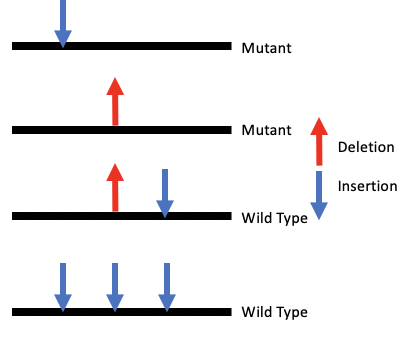
Mutant of rII locus of T4 bacteriophage. series of mutations proved codons in 3
Point mutation adn amino acid sequencing showed genetic code didn't overlap - 23Translation needs 3 different RNAsmRNA template
rRNA - combines with protein to form ribosome. RNA most abundant in ribosome
tRNA- brings specific amino acid - 24rRNA2/3 mass of ribosome
Ribozyme - RNA is catalytic
High levels of primary and secondary structure conservation between species- often used in bacterial identification
5s, 16s, 23s rRNA
23s provides core peptide transferase activity
A site where amino acid enters, P site where catalysis occurs - 25tRNACloverleaf structure
Amino acid binding site in CCA motif- attached to site through aminoacyl-tRNA synthesise enzyme - ester bond between carboxyl on amino acid and hydroxyl group on 3' terminal adenosine on tRNA- "charged" with amino acid bound
Anticodon - 3 nucleotides complementary bp with mRNA to ensure correct amino acid. Contains modified bases e.g. pseudouridine and inosine - 26Structures and functions of tRNAAcceptor Arm - 7 base pairs, last 4 unpaired and contain CCA motif, conserved at 3' end of all tRNA. A is site of amino acid attachment
TΨC loop- contains TΨC where Ψ represents a pseudouridine
Variable Arm - 4-21 bases. Main cause of size difference in tRNAs
Anticodon - stem loop opposite acceptor stem. Contains anticodon specifically base pairs with codon in mRNA
D arm - contains one or more dihydrouridine group - 27Mechanics of protein translationPerformed by ribosome - in eukaryotes in ER or free in cytosol. Final ribosome from small and large subunit
Eukaryotic made of 40s and 60s (contain more/ larger RNA) subunits, forming 80s.
5s, 5.8s, 18s, 28s rNAs; 83 proteins
Bacteria made from 50s and 30s subunit, making 70s ribosome
5s, 16s, 23s rRNAs; 52 proteins
S is the sedimentary component - 28Prolaryotic translation initiationmRNA polycistronic and contain more that 1 ORF- each recognised simultaneously hence multiple proteins translated from different ORFs on single mRNA
Shine Dalgarno sequence 6-8 nucleotides before AUG initiator codon and binds to 16S bacterial rRNA
Bacterial transcription can occur before transcription finishes - process is couples - 29Eukaryotic translationEach mRNA has only one ORF - monocistronic
Transcription of mRNA in nucleus prior to export to cytoplasm
Transcription and translation cannot be coupled - 30Shine Dalgarno SequenceEnables translation of subsequent ORF of polysaccharide mRNA - multiple areas synthesised simultaneously
Important step in formation of translational initiation complex and positions 30S ribosomal subunit to bind initiation codon AUG, further helped by initiation factor 3
Additional IFs recruited along initiator tRNA, formulated Met-tRNA (aids recognition process)
Recruitment of 50S subunit results in GTP hydrolysis by IF2 and release of IF3 - 31Eukaryote interactionSmall ribosomal unit 40S interacts with various eukaryotic initiation factors
Recognise and be recruited to 5' capping structure on mRNA. Complex scans initiating AUG - no Shine Dalgarno- releases initiation factors, binds large subunit and proceeds with elongation of polypeptide chain
Additional cap-dependent mechanism for some RNAs. Ribosome recruited to specific structures in 5' untranslated region of mRNA - 32ElongationCyclical- same for all amino acids
Virtually identical in prokaryotes and eukaryotes
Main ribosome catalytic sites = A site (amino acid enters ribosome), P site (site of catalysing protein formation- peptides transferase activity), E site (site of exit)
Elongation helped by accessory protein - elongation factors (EF in bacteria, eEf in eukaryote)
Stop codon recognised by release factors, dissociating ribosome - 33Bacterial elongation processTernary complex of EF-Tu:GTP:aminoacyl-tRNA enters ribosome in A site. If codon:anticodon recognition doesn't occur, it leaves. If recognition takes place, ribosome changes conformation and GTP hydrolysis activity of EF-Tu is stimulated
EF-Tu undergoes large conformational change, releasing A site bound aminoacyl-tRNA and dissociating from ribosome
Free aminoacyl end of tRNA moves into peptide transferase centre of large ribosome
Peptidyltransferase activity of rRNA (ribozyme) catalyses peptide bond formation between aminoacyl components of tRNAs in A and P sites
EF-G:GTP recruited and aids translocation of ribosome and release tRNA from P site after GTP hydrolysis - 34TerminationSignal to terminate translation provided by entry of termination codon e.g. UAA in A site
Release factors RF 1 and 2 recognise termination code and stimulate dislocation of ribosome
Ribosomal components can reassemble to initiate another round of translation
Informationen
- Beschreibung
- Biology of Cells IA (Genes in Action) Karteikarten am Transcription and Translation in Bacteria and Eukaryotes, erstellt von Alice Hathaway am 11/02/2019.
- Erstellt von
- Alice Hathaway
- Aufrufe
- 13
- Bewertung