
Karteikarten
Science Exam Review gr. 9
Karten in diesem Stapel (81)
- 1What does WHMIS stand for?Workplace Hazardous Materials Information System
- 2What is Atomic mass?The mass of an atom
- 3What is and Atomic Number?The number of protons and electrons in an atom
- 4what is a compound?a pure substance composed of two or more different elements
- 5what is a molecule?two or more atoms of the same or different elements that are chemically joined
- 6what is a mixture?a substance made of at least two different particules
- 7what is a Diatomic Molecule?Element that cant exist on its own
- 8what is a pure substance?a substance that is made of one type of particule
- 9what is an element?cannot be broken into a simpler substance
- 10what is a chemical family?elements that share similar properties
- 11what is a period?a row on the periodic table
- 12what is a metal?is lustrous, malleable, ductile and conducts heat and electricity
- 13what is a non- metal?usually a gas or a dull powdery solid that does not conduct heat or electricity
- 14what is a metalloid?has properties of both metals and non-metals
- 15what is a heterogeneous mixture?combination of two or more pure substances (i.e. Pizza)
- 16What is a homogeneous mixture?A mixture that you can see the different componants
- 17what is ionic bonding?the process of losing or gaining an atom
- 18What is covalent bonding?when two non-metals share electrons
- 19what is a molecular formula?Water (H20)
- 20what are examples of Physical properties?Colour, Texture, lustre, brittleness, hardness
- 21what are examples of Physical Changes?A changed state (liquid to gas), diluted colour change
- 22what are examples of Chemical Properties?Fizzing, Bubbling, light produce
- 23what are examples of Chemical change?New substance is formed, distinct colour or odour change
- 24What does an atom consist of?Protons, Electrons and Neutrons
- 25what is an Isotopes?it is when there is a different amount of protons and neutrons
- 26why is an atom neutral?it is neutral because there is an equal amount of protons and eletrons
- 27what is the particle theory?1.) all matter is made up of small particles
2.) different substances are made up of different kids of particles
3.) particles are always moving
4.) the particles move faster as temp. increases
5.) particles attract each other - 28what are the families of the periodic table?-alkali metals
-alkaline earth metals
-transitional metals
-halogen metals
-noble gases - 29where are Valence electrons located?they're located in the outer shell
- 30what is a cation?a positively charged ion
- 31what is an anion?a negatively charged ion
- 32what is an autotroph?a producer
- 33what is a heterotroph?a consumer
- 34what is a trophic level?the level of an organism in an ecosystem
- 35what is Earth's atmosphere made up of?78% nitrogen, 21% oxygen and 1% argon, water vapour and carbon dioxide
- 36what is the word equation for cellular respiration?= - light energy
Sugar + Oxygen= Carbon Dioxide + Water + Energy - 37what is the word equation for Photosynthesis?= - Light energy
Carbon Dioxide + Water = Sugar + Water - 38why is cellular respiration and photosynthesis considered to be complimentary processes?Because Photosynthesis takes Carbon Dioxide and releases Oxygen, whereas Cellular Respiration takes Oxygen and releases Carbon Dioxide
- 39what is bioaccumulation?the concentration of a substance in an organism
- 40what is Bioamplification?the increase of a substance as it moves higher up a food web
- 41Why do some pesticides become resistant?Because after a long time, the 'pests' get used to the pesticide and after a few generations, the population can become highly resistant, now you either have to use a new pesticide or a stronger one.
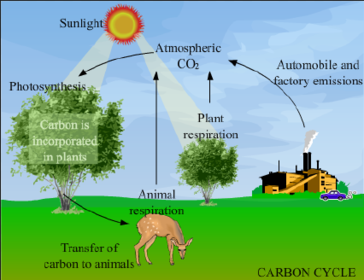
- 42what are the 3 major biogeochemical cycles?The Water cycle, the Carbon cycle and the Nitrogen cycle
- 43summarize the events of the carbon cycleIt is the long term and short term storage of carbon.
- 44label the carbon cycle
- 45what are key abiotic factors in a terrestrial ecosystem?Light availability, water availability, nutrient availability and temperature
- 46what are key biotic factors?Competition, disease agents
- 47how much energy does each level receive?each level receives ten %
- 48how does fertilizer help grow plants?fertilizers help give needed nutrients to the plants.
- 49what are negative effects of using fertilizer?it could attract unwanted visitors.
- 50explain the difference between natural and synthetic fertilizersnatural fertilizers are made from plant and animal waste, while synthetic fertilizers are manufactured.
- 51how do humans control 'pests'?-crop rotation
-confuse mating
-harvesting at certain times
-introduction of natural predators. - 52what happens when you have run-off from farms that enter nearby streams?Fertilizers can enter aquatic ecosystems and create algal blooms
- 53what is sustainability?the ability to maintain an ecological balance
- 54what is a conductor?a material that lets electrons flow easily
- 55what is an isolator?a material that does not let electrons flow easily
- 56what is an electron?a negitively charged particle
- 57what is voltage?potential difference expressed in volts.
- 58what is electric current (I)?the rate of flow past a given point in a circuit. measured in amperes
- 59what is electrical resistance (R)?the ability to oppose the flow of current. measured in ohms (omega sign)
- 60what is a series circuit?a circuit where the current follows one path and the loads come after each other.
- 61what is a parallel circuit?a circuit where the current is divided up to two or more paths before recombining to complete the circuit.
- 62what is potential difference?the difference in potential energy. measured in volts
- 63what is a charged object?an object that exerts force.
- 64what is the law of electric charges?-like charges repel
-opposite charges attract - 65what particle moves when discussing electricity?electrons
- 66what is the difference between static electricity and current electricity?static electricity is the study of charges at rest and current electricity is the study of the flow of electric charge.
- 67what is a short circuit? how is it prevented?it is when there is too much current and can be prevent with circuit breakers or a fuse.
- 68what are the four parts that make up a circuit?-an energy source
-a switch
-a load
- conducting wires - 69in what direction do the electrons flow in a circuit?from the negative end to the positive end
- 70what are some ways power is produced?Hydro electricity, Wind, Light, Nuclear
- 71what is an astronomical unit?the average distance from the earth to the sun
- 72what is a nebula?the beginning of a star
- 73what is a meteor?a meteor enters the earth's atmosphere and sometimes burn completely
- 74what is a meteorite?a meteor that has crashed to the ground.
- 75what is a comet?a chunk of ice and dust that travels in a long orbit around the sun
- 76what is the difference between a lunar and solar eclipse?a solar eclipse is when the moon is between the earth and the sun; a lunar eclipse is when the earth is between the sun and the moon.
- 77how are seasons created?seasons are created when the earth's hemispheres are tilted away or towards the sun.
- 78what planets are larger than earth?Venus, Jupiter, Saturn, Uranus and Neptune
- 79what is the life cycle of a star?the star starts of as a nebula and then a star is born, when it dies, it becomes either a black whole or a white dwarf
- 80how does the sun create energy?high temperatures cause the particles to collide and cause them to fuse which gives off enormous amounts of energy
- 81how does star colour relate to it's temperature?a hot star is blue and a cold star is red.
Informationen
- Beschreibung
- Intro, Chemistry, Ecology, Electricity and Space review for grade 9 science exame
- Erstellt von
- Dibbles
- Aufrufe
- 86
- Bewertung