
Karteikarten
lesson 4
Karten in diesem Stapel (21)
- 1Lesson 4Designing Productive and Satisfying Work
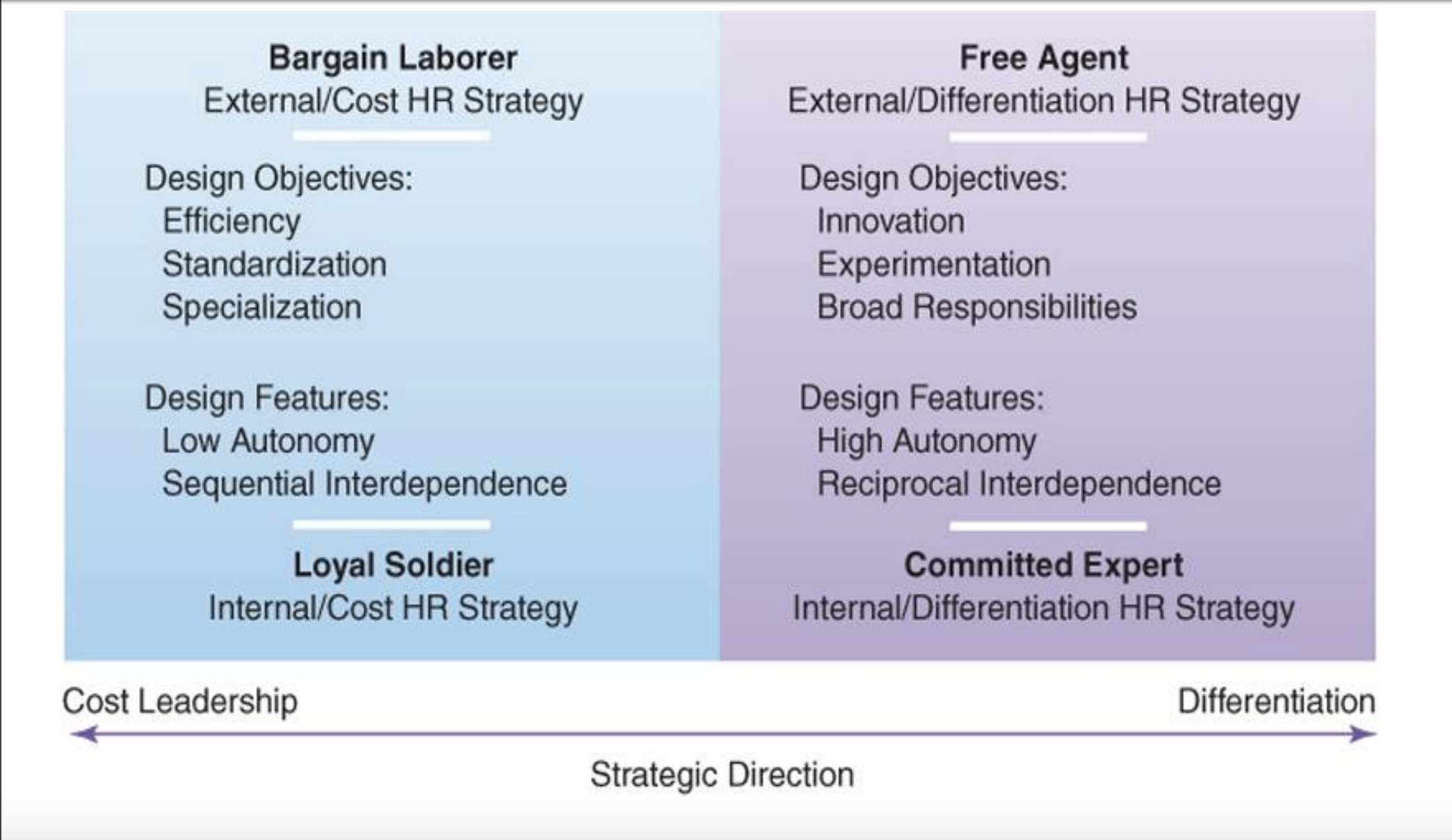
- 2How can strategic design of work tasks improve an organization?Differentiation <-> Integration
Centralization <-> Decentralization
Standardization <-> Mutual adjustment - 3How can strategic design of work tasks improve an organization?<> Through the process of assigning and coordinating work tasks called Work design
<> Two key principles of work design are:
-Differentiation: the assignment of different tasks so that they can specialize in doing things well
-Integration: the coordination of the efforts of the employees
<> When differentiation and integration are
aligned, they help organizations to increase productivity and to improve customer satisfaction. - 4Two Elements of Work Design Autonomy is the extent to which individual workers are given the freedom and independence to plan and perform assigned tasks.
Interdependence is the extent to which an individual’s work actions and outcomes are influenced by other people (accumulation, serial, and reciprocal interdependence). - 5Linking Autonomy and Interdependence to HR Strategy focused on Cost leadership Organizations using cost HR strategies—either Bargain Laborer or Loyal Soldier focus on efficiency.
With cost strategies, one objective is to
standardize jobs so that employees can
quickly learn a set of relatively easy tasks.
-> Efficiency is created by combining low
autonomy and sequential processing. - 6Linking Autonomy and Interdependence to HR Strategy focused on Differentiation Organizations that use differentiation HR
strategies—either Committed Expert or Free Agent—focus on innovation.
With differentiation, the goal is to create new products and services that are better than those offered by competitors.
-> High autonomy and reciprocal processes
encourage innovation. - 7Strategic Framework for Work Design
- 8How do employees know what they are supposed to do? Employees are hired into a Job.
-> Job = a collection of tasks that a person is required to perform at work.
Job are identified through a process known as Job Analysis. - 9Job Analysis (1/2) Steps in the Job Analysis Process
1. Determine who will do the analysis and get top management buy in the process.
2. Choose jobs that are critical to the success of the company and have a sufficient number of employees in them.
3. Review what has already been written about the job. - 10Job Analysis (2/2)4. Select job agents, people who will provide job information, such as incumbents (people currently doing the job), supervisors or job analysts (experts).
5. Collect job information through interviews, questionnaires and observations
6. Create a job description that identifies tasks, responsibilities, and working conditions of the job:
a) Task Analysis Inventory
b) Critical-incidents technique
c) Position Analysis Questionnaire
7. Add a job specification to the job description, that identifies the knowledge and skills, experiences, and abilities that workers need to perform the tasks listed in the job description. - 11Comparing Job Descriptions and Job Specifications.
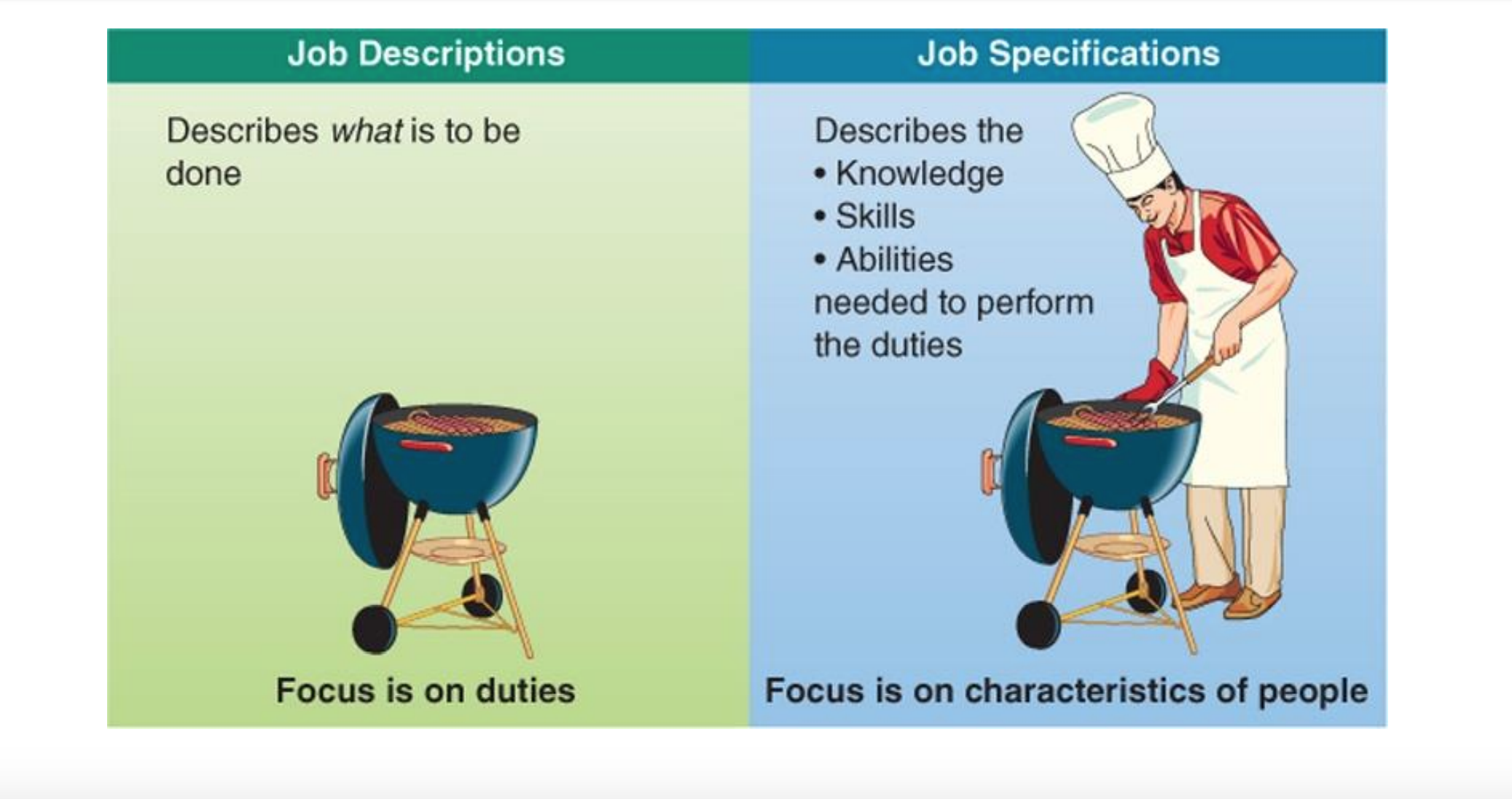
- 12Job Analysis - Methods 1/3 Task Analysis Inventory
-> The job agents provide ratings concerning a large number of
tasks.
-->Most analyses require responses for at least 100 different task
statements.
-->These task statements usually begin with an action verb that describes a specific activity—for example, “explains company policies to newly hired workers” and “analyzes data to determine
the cost of hiring each new employee.”
->One rating is for frequency or time spent, and the other is for importance.
-->Ratings for frequency of performing the task range from “never performed” to “performed most of the time.” Ratings might also be made for time spent on the task. However, ratings of frequency and time spent essentially measure the same thing.
-->Ratings for task importance usually range from “not important”
to “extremely important. - 13Job Analysis – Methods 2/3 Critical-incidents technique identifies
good and bad on-the-job behaviors.
>Job agents are asked to generate a number of statements that describe behaviors they consider particularly helpful or harmful for accomplishing work.
>Each statement includes a description of the situation and the actions that determined whether the outcome was desirable or undesirable. - 14Job Analysis – Methods 3/3 Position Analysis Questionnaire (PAQ) is a structured questionnaire that assesses the work behaviors required for a job. Such as:
> Information input—where and how a worker obtains needed information such as education and/or experience.
>Mental processes—reasoning and decision-making activities.
> Work output—physical actions required for the job, as well as tools or devices used.
> Relationships with other persons—the interactions and social connections that a worker forms with others.
>Job context—the physical and social surroundings where work activities are performed.
> Other job characteristics—activities, conditions, or characteristics that are important, but not contained in the other five dimensions. - 15Job Descriptions and Job Specifications The PAQ, which consists of multiple pages is then transcribed into smaller document called a Job Description by the job analysts.
The Job Description consist of two parts:
> The description of the of the tasks and responsibilities related with a organizational position.
> The Job Specification
The Job Description is used in multiple human resources processes such as recruiting, compensation and training.
The Job Specification focus attention on knowledge and skills, experiences, and abilities needed to do the job. - 16Competency Modeling As work activities have become more
knowledge based Competency Modeling
(CM) has emerged as a new method.
>CM describes the work activities in terms of competencies needed to perform the job.
> Competencies include knowledge and skills, experiences, and abilities, but CM also seek to capture such things as motivation, values, and interests.
>Factors thus that add at the “
can-do” characteristics of people also the “will-do”ones. - 17Job Design The process of job design focuses on
determining what tasks will be grouped
together to form employee jobs
There are four general approaches to
grouping work tasks: mechanistic,
motivational, perceptual, and biological. - 18Mechanistic Approach Job design is viewed from the perspective of creating an efficient machine that transforms labor inputs into goods and services.
Industrial engineers often use analyses
designed to find the work methods that take the least time. Such as Time and Motion studies. - 19Motivational Approach The motivational approach is aimed at increasing employees’ enjoyment of their work and thus increasing their effort.
Jobs are designed not simply to get work done as quickly as possible, but also to provide workers with tasks they find meaningful and enjoyable.
A model of motivational job design is the job characteristics model, which focuses on building intrinsic motivation.
> Intrinsic motivation exists when employees do work because they enjoy it, not necessarily because they receive pay and other rewards. - 20Perceptual Approach The basic objective of the perceptual
approach is to simplify mental demands
on workers and thereby decrease errors.
Safety and prevention of accidents are
critical.
The perceptual approach to job design
usually results in work characterized by
sequential processing and low autonomy. - 21Biological Approach This approach is associated with ergonomics, which concerns methods of designing work to prevent discomfort and physical injury.
Job tasks are assessed in terms of strength, endurance, and stress put on joints.
Work processes are then designed to
eliminate movements that can lead to physical injury or excessive fatigue.
Informationen
- Beschreibung
- Business/Economics Karteikarten am lesson 4, erstellt von Ladi Dadi am 30/10/2019.
- Erstellt von
- Ladi Dadi
- Aufrufe
- 16
- Bewertung