
Karteikarten
AP Macroeconomics: Chapter 15 - Inflation & Unemployment

Karten in diesem Stapel (15)
- 1Who measures CPI and how often?Every month, the Bureau of Labor Statistics measures CPI
- 2What does CPI measure?CPI measures the average change over time in the prices paid by urban consumers for a market basket of consumer goods and service.
- 3What is the formula for CPI?
- 4What is the formula to measure the inflation rates from one period to the next?

- 5Is the CPI over or understated? Why?The CPI is thought of as overstated, because it does not adjust for any quality improvements. If a product’s quality increases from one period to the next, it would make sense that its price increases as well. However, CPI only monitors the price increase. Many
- 6What is the formula for the GDP deflator?
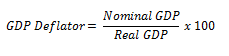
- 7What is one notable difference between CPI and GDP deflator?One notable difference between CPI and GDP deflator is that if an imported good’s price increases, CPI accounts for the price change while GDP deflator does not
- 8What are the four costs of inflation?1. Households receive higher incomes.
2. Inflation discourages savings.
3. Inflation causes resource misallocation.
4. Inflation shifts wealth from the lenders to the borrowers - 9What is the Fisher's Hypothesis?Nominal Interest Rate=Real Interest Rate+Expected Inflation
- 10What are the two ways unemployment is calculated?Two broad surveys: one to businesses regarding employment levels at various business establishments, and the other to households.
- 11What are the five categories of unemployment?1. Hidden work force or discouraged workers
2. Structural unemployment
3. Cyclical unemployment
4. Seasonal unemployment
5. Frictional unemployment - 12What is the NAIRU?Since the majority of people counted as unemployed are frictionally unemployed, when the unemployment rate is around 4-6%, it is also known to economists as full employment. NAIRU stands for the nonaccelerating inflation rate of unemployment.
- 13What happens when unemployment goes under 4-6%?Inflation
- 142. If the CPI goes to 150 from 120, then prices haveRisen 25%
- 15FRQ Inflation exerts signifcant costs on the economy. Specifically, explain how inflation I. causes a misallocation of resourcesResources are spent dealing with rising prices and the repercussions of rising prices. Instead, these resources could have been spent producing more goods and services for the economy.
Informationen
- Beschreibung
- Karteikarten am AP Macroeconomics: Chapter 15 - Inflation & Unemployment, erstellt von bxyp am 09/03/2015.
- Erstellt von
- bxyp
- Aufrufe
- 41
- Bewertung