
Karteikarten
week 3
Karten in diesem Stapel (111)
- 1for greeks the concept of gender was...binary, and seen as ridigly and associated with specific characteristics and roles
- 2acting outside of the binary categories left one open to...criticism and social marginalization
- 3Greek men are seen asactive, self-controlled, rational, and dominant
- 4what does enkrateia meanpower or self-control
- 5what does andreia meancourage or literally manliness
- 6men are generally associated with the..public sphere, the world outside of politics, work, the polis
- 7greek women are seen aspassive, lacking in self-control, irrational, and submissive
- 8what does sophrosyne meantemperance
- 9women are generally associated withthe private or domestic sphere, the world of the family, the oikos
- 10what do the writers Thucydides, Plato, Xenophon, Plutarch have in common* all men
*all adults from upper-class and free - 11it is important to ask yourself what questions about a source* who wrote it
* what kind of text is it
*where was it written, or where the author was from
* when it was written
*why was it written or made - 12our evidence of women is ratherathenocentric
- 13what were the roles of women in the housecooking, cleaning, get/organize/divvy out supplies for the home/budget, caring for elderly family members, religious duties, funeral duties
- 14what were the sexual expectations of women and menwomen had to remain a virgin until marriage and stay faithful
mean were permitted to other sexual partners (prostitutes, slaves, available individuals (gender wasn't an issue)).
Men couldn't be with another man's wife or unwed daughter - 15most ancient Greek women were supposed to have a ...kurios (male guardian, father or closest/eldest male relative)
- 16what was the primary purpose of marriageto provide to the next generation
- 17what is a ekdosisa wedding
- 18describe a wedding* 3 day celebration
* 1st a feast/offering to Artemis
* 2nd a ritual bath for both and procession at night (torches, gifts, songs)
* 3rd another party - 19what was the most popular month for marriage and whyGamelion, due to it being associated with Hera
- 20when was a woman ready to marryas soon as she could bear children (14-15)
- 21when did men generally marry20-30s
- 22when was a husband required to divorce the wifeif she committed adultery
- 23what were some female-centered jobswet-nurse
midwife
entertainer
prostitution - 24what is a hetairasimilar to modern girls or Japanese Geisha, they were well-educated, charming, talented (musically), worldly and beautiful
- 25Pericles is associated with a hetaira namedAspasia
- 26what was the difference between spartan women and Greek womenthey could inherit property, too powerful and have too much control over the men
- 27ancient Spartan girls and women were encouraged to ...exercise
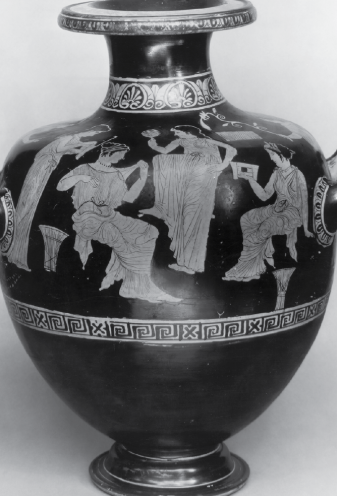
- 28what is thisattic red-figure showing a domestic scene set outdoors
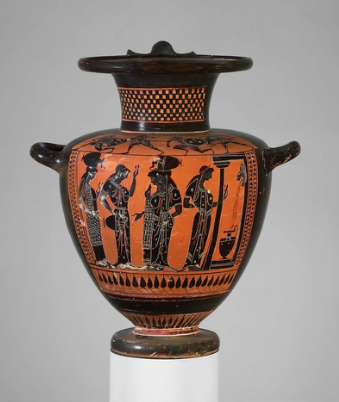
- 29what is thisattic water jar with women drawing water at the fountain house
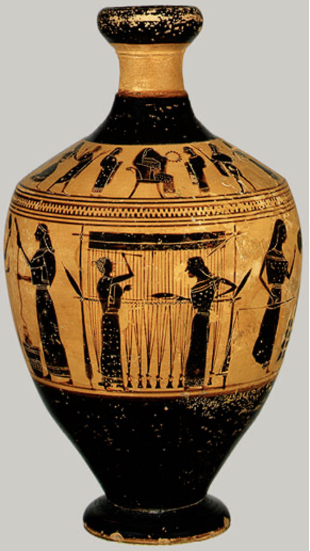
- 30what is thisattic black-figure lekthos, one side has women spinning wool and folding fabric, otherwise women are weaving on upright loom
- 31what is thisred-figure vessel, 430-420 BCE, attributed to the Washing Painter, scenes of bridal preparation and their attendants
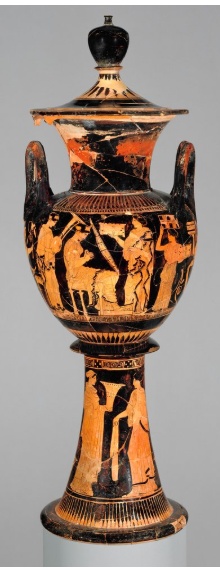
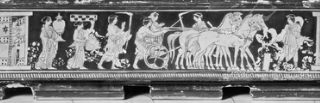
- 32what is thispyxis (cosmetic box) - typical gift for a bride, the pyxis bears appropriate for the owner, a wedding procession leaving the bride's house, groom mounts the chariot and lifts his bride onto
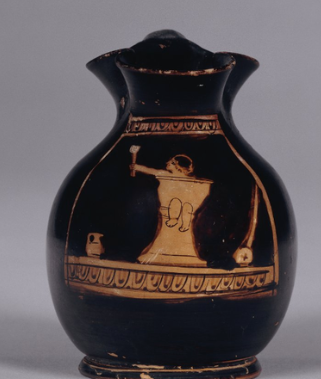
- 33what is thisminiature chous (wine-jug) showing an infant sitting on a potty
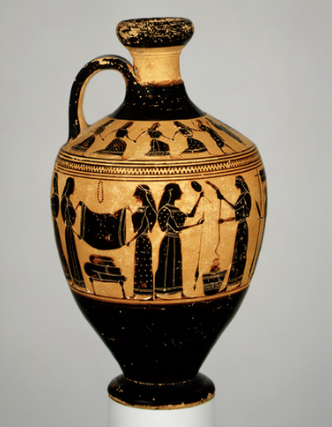
- 34what is thiswomen spinning wool and folding fabric, weaving on upright loom
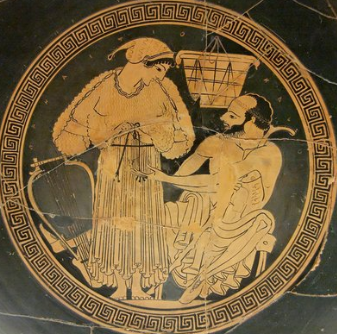
- 35what is thisbanquet musician reties her himation (long garment) as her client watches
- 36what is thisbronze figure of a running girl 520-500 BCE sparta
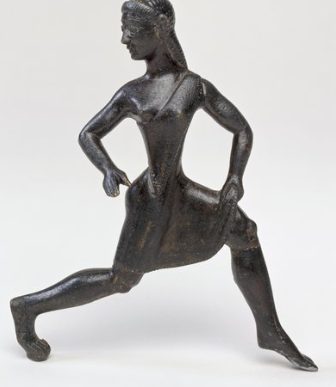
- 37what was one really popular form of entertainmenttheatre
- 38theatre includedmusic, dance, singing
all male and wore costumes
a chorus - a homogenous group with a single voice - 39Dionysus was the god ofwine and theatre
- 40what was the city Dionysiaa religious festival, but also a competition
- 41what is a satyrhalf man/half goat
- 42what were the types of playstragedy and comedy
- 43describe tragediesusually based on common myths
usually explored ideas important to contemporary society through mythic re-tellings - 44describe comediessatirized contemporary people and events
- 45who is the earliest tragedianAeschylus
- 46describe Aeschylus and his plays* tragedian
* Orestia; Agamemnon, The libation bearers, the eumenides
* battle of salamis in the Persians
* he fought at marathon and salamis - 47what is a choregosa sponser
- 48who was a chorego for the PersiansPericles
- 49describe Sophocles and his plays*tragedian
* Oedipus Tyrannus
*antigone - 50describe Euripides and his plays*tragedian
*trojan women
* lost at the city Dinoysia - 51what was old comedy5th century BCE
satire, slap-stick, bodly humor - 52describe Aristophanes and his plays* liked to make fun of current events and people
* The clouds - made fun of Socrates and sophist of Athens
* Lysistrata - women who try to end the Peloponnesian war by a sex strike
* the Birds - satire of Athenian politics set in Cloudcoocooland, an imaginary bird city in the sky - 53when did new comedy ariseafter the Peloponnesian war
- 54what is thistheatre of Dinoysus
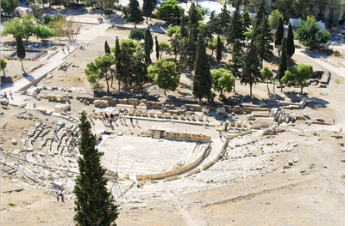
- 55what is thisrelief of a seated poet (Menander) with masks of new comedy
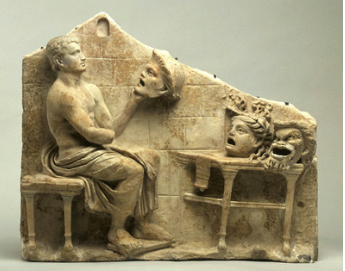
- 56who is thisAeschylus
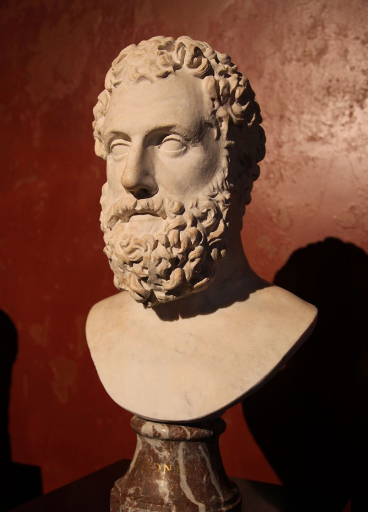
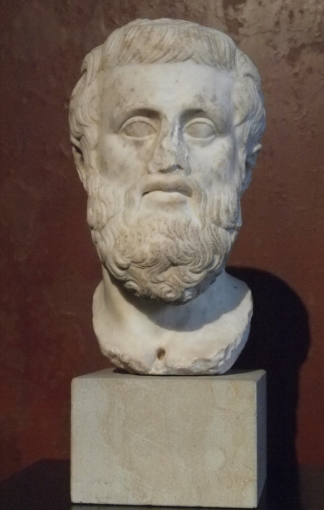
- 57who is thisSophocles
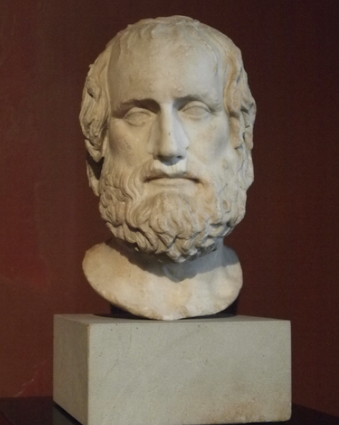
- 58who is thisEuripides
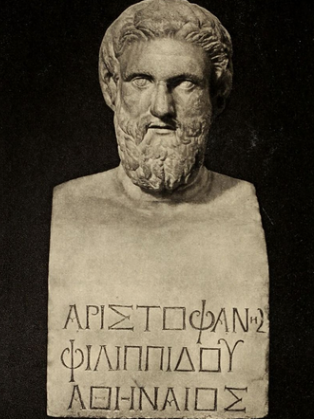
- 59who is thisAristophanes
- 60what does anthropos and morphe meananthropos - human being
morphe - shape - 61what does polytheistic meanbelief in many gods
- 62describe polytheistic religionsassign roles to particular deities
- 63what does anthropomorphic meanto look like a human being
- 64what is the traditional home of the OlympiansMount Olympus on the Peloponnese
- 65what are the first generation godsHestia, Demeter, Poseidon, Hera, Hades, Zeus
- 66what are the second generation godsHermes, Ares, Aphrodite, Hephaestus, Artemis, Apollo, Athena
- 67who does Hestia sometimes get swapped out forDionysus
- 68describe Hestia, goddess of the hearth and the domestic sphere, looking suitably modest, holding a bowl;
- 69describe Hermesgod of travelers, thieves and merchants, wearing his traveling hat and holding his staff, the caduceus;
- 70describe Aphroditegoddess of beauty and sexual attraction, standing next to her lover...
- 71describe Aresgod of war, in his helmet and carrying his spear;
- 72describe Demetergoddess of the harvest, holding a shaft of wheat and a sceptre;
- 73describe Hephaestsusthe blacksmith god, holding his walking cane to help with his lameness;
- 74describe Heraqueen of the gods and wife of Zeus, wearing a crown and holding a sceptre;
- 75describe Poseidongod of the sea and horses, holding his trident;
- 76describe Athenagoddess of wisdom, handicrafts, and war, wearing her helmet and holding her owl;
- 77describe Zeus, king of the gods, weather god, and god associated with justice and oaths, holding his thunderbolt and sceptre;
- 78describe Artemisgoddess of the hunt, with her bow and arrows,
- 79describe Apollotwin brother of Artemis and god of music, the sun and prophecy, holding his lyre.
- 80define mythtraditional stories with collective importance
- 81what does mythos meanstory, word, or authoritative speech
- 82what is public religionstate religion - the worship of gods important to the polis ( Athena, Poseidon, Hephaestus) and festivals
- 83what is private religionthe worship practiced by individuals to whichever gods they needed
- 84what is orthopraxycorrect behaviour
- 85what is orthodoxycorrect belief
- 86were the greeks more concerned with orthodoxy or orthopraxyorthopraxy
- 87the standard religious architecture istemple and alter
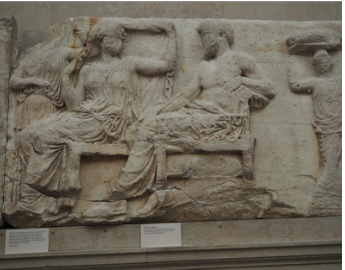
- 88who is portrayed hereZeus and Hera
- 89what does gymnasium translate tonaked place
- 90what is an aryballosan oil flask that carried olive oil
- 91what is a strigilsomething to scrape the oil and sand off men's bodies
- 92what were the main sports of ancient Greece*foot races- most prestigious race
*hoplitdromos
*discus throw
*javelin throw
*long jump
*wrestling
*boxing
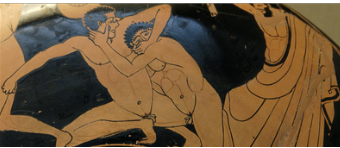
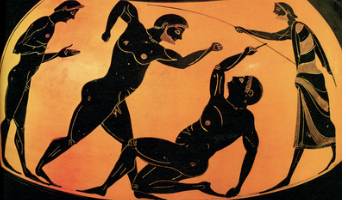
*pankration - mix of wresting/boxing (no eye gouging or biting)
* pentathlon - long jump, javeling, discus, stadion, wrestling
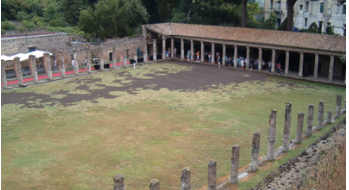
*chariot race (4 horse, 2 wheeled) - 93what was a Palaestraa place for wrestling and boxing training
- 94what is a hippodromea track for chariot racing (roman circus is the same thing)
- 95describe the Olympicsbegan in 776 BCE
ran on a 4 year cycle
received olive wreath as prize
no 2nd or 3rd place
ended in 393 BCE when Christian emperor, Theodosius banned them as a pagan festival - 96what were some of the other gamesIsthmian - honour of Poseidon at Sicyon every 2 years, received pine wreath
Nemean - honour of Heracles and Zeus every 2 years at Nemea, received celery wreath
Pythian- honour of Apollo at Delphi every 4 years, received laurel wreath
Panathenaic- at Athens every 4 years - 97what does arete meanexcellence
- 98what does athlon meancontest, prize of contest, conflict/struggle
- 99what is thisan oil flask
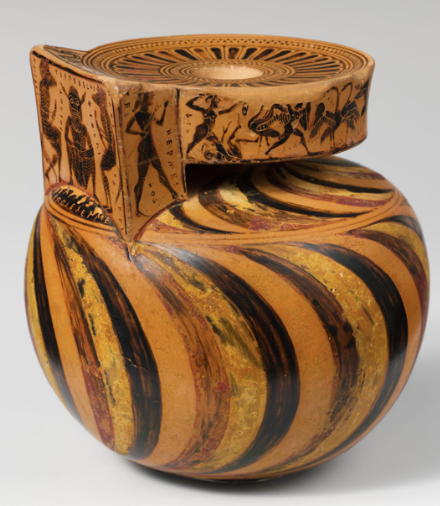
- 100what is thisstrigil
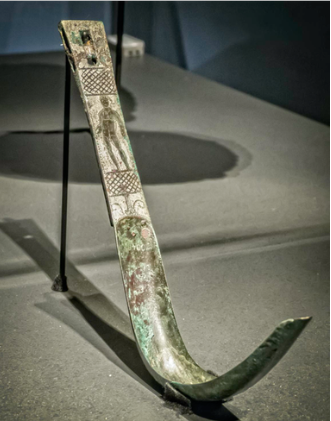
- 101what is represented herea stadion race
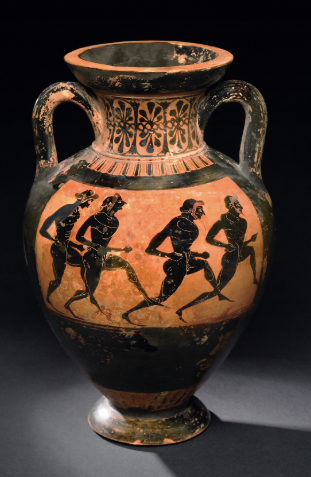
- 102what is represented herediscus
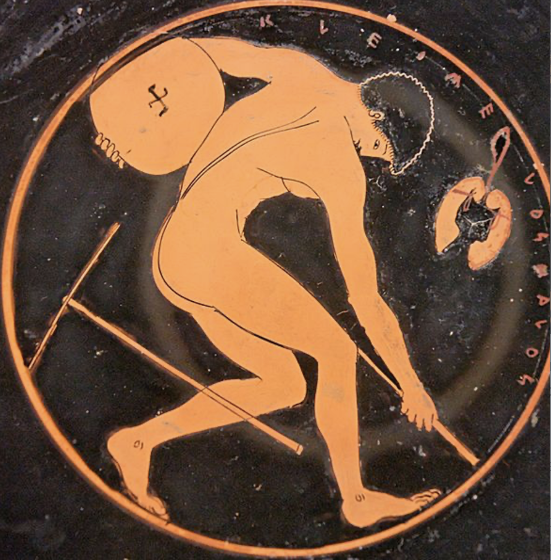
- 103what is represented herepankration
- 104what is represented herepankration
- 105what is thispalaestra
- 106describe what occurred in 6th century BCE* new ideas and thoughts
* arise of philosophy
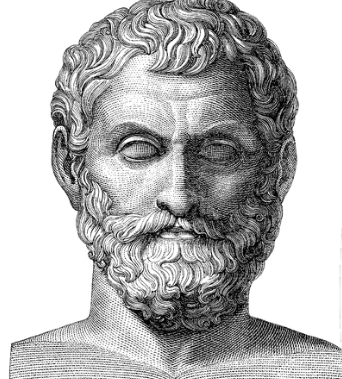
* Ionian Intellectual Revolution or Ionian Enlightment ( Milesian School) - 107describe Thales624 -546 BCE
Thales of Miletus, founder of natural philosophy
rely on his students
searched for the arkhe - the origin of everything, he believed it was water - 108describe Anaximander610 - 546 BCE
student of Thales
oldest author of philosophical writing
said Thales belief of water as the arkhe was aperion (has no bounds) - 109describe Anaximenes585 - 528 BCE
student of Anaximander
his arkhe was air - 110describe Eratosthenes276 - 195 BCE
mathematician, geographer, poet, astronomer, music theorist
chief librarian at the Library of Alexandria
first person to find the circumference of the earth - 111who is thisThales
Informationen
- Beschreibung
- GRST 205 Karteikarten am week 3, erstellt von Chelsea Scheck am 26/05/2020.
- Erstellt von
- Chelsea Scheck
- Aufrufe
- 2
- Bewertung