
Karteikarten
Unit 5 Turning Points
Karten in diesem Stapel (30)
- 1What are cathode rays?Electrons
- 2What is thermionic emission?Electrons emitted from a heated cathode
- 3How much energy does an electron gain when accelerated by a p.d. VThe product of the electron's charge and the accelerating p.d. (eV)
- 4A fine beam tube is used to confine electrons to a circular path. Why do the electrons not spiral inwards?Magnetic force is perpendicular to the velocity of the electron, so does no work on it in the direction of the centripetal force
- 5Give the 3 factors that affect the frictional force in Stokes' Lawviscosity
speed
radius (of droplet) - 6What did Milikan's oil droplet experiment discover?The charge of the electron
- 7Describe Newton's ideas about lightLight is a particle
Travels faster in denser materials (attracted to them)
Couldn't explain interference - 8Describe Huygen's ideas about lightLight is a wave
Light is longitudinal
Light travels slower in more dense materials
Polarisation can't be explained - 9What is wave-particle duality?Waves can behave like particles and particles can behave like waves in particular situations
- 10How did Einstein explain the photoelectric effect?Light is a particle (called a photon), with energy E = hf
Photons interact with electrons in 1:1 interactions
Electrons are only liberated when the photon has energy greater than the work function - 11Describe one experiment where particles behave like wavesElectron diffraction through a thin slice of crystal
Electrons produce an interference pattern
(or electron microscope description) - 12Describe one experiment where light behaves like a particlePhotoelectric effect, light above a certain frequency liberates electrons from a metal surface
- 13Describe one experiment where light behaves like a waveYoung's double slit experiment
Two coherent light sources interfere and produce an interference pattern - 14Describe one experiment where electrons behave like particlesDeflection by electric or magnetic fields
- 15Describe the functions of the 3 lenses in a Transmission Electron MicroscopeCondenser Lens - controls beam width
Objective Lens - magnifies
Magnifier Lens - Magnifies and focusses - 16Describe how a Scanning Tunnelling Microscope worksElectrons have a wave-like nature
Small probability that an electron can tunnel across the gap
Tunnelling current is inversely proportional to the separation
Distance controlled to give an image of the surface. Transfer is from – to + only - 17Describe an electromagnetic waveOscillating electric and magnetic fields
Electric component and magnetic component are in phase and
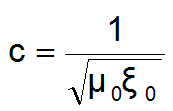
at 90 degrees to each other and to the direction of propagation - 18How does this equation show that light is an electromagnetic wave?Values of permittivity and permeability of free space determined experimentally. Solving the equation gives
c = 300 000 000 m/s which is the
speed of light - 19Explain how a radio wave induces an alternating EMF in a metal loopRadio wave has an electric component that oscillates parallel to the electrons in the loop
The electric field is alternating so the EMF is alternating too - 20What was the Michelson-Morley interferometer experiment designed to prove?The existence of the aether
- 21In the Michelson-Morley experiment what caused the fringe pattern?The distance travelled by the two light beams meant that a phase difference existed
Bright fringes when constructive interference occurred and vice-versa - 22In the Michelson-Morley experiment a fringe shift was expected. Explain why.The motion of the Earth through the aether was supposed to affect the speed of light. The rotation of the apparatus meant that the light beams would be swapped causing the fringe shift due to the difference in the speed of light.
- 23What are the 2 postulates for Einstein's theory of special relativity?1. Physical laws have the same form in all inertial reference frames
2. The speed of light in free space is invariant - 24What is an inertial reference frame?A frame of reference that moves at constant velocity with no acceleration
- 25How does time dilation account for the detection of muons on mountain-tops?Muons travel close to the speed of light so experience time dilation, they exist for longer than their half-life in a stationary reference frame
- 26Length contraction affects muons as they travel at relativistic speeds. Explain how.The distance they travel is contracted from the muons' point of view.
From a stationary reference frame, their half life is longer. - 27What quantity does this equation represent?The kinetic energy of a relativistic particle
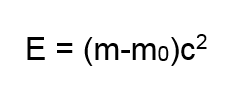
- 28What quantity does this equation represent?The relativistic mass of a particle
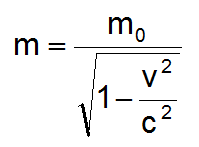
- 29What does this equation represent?The total relativistic energy (both rest mass energy and kinetic energy) of a particle
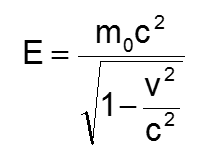
- 30It is impossible for a particle to travel at the speed of light. Explain why.As v approaches c, the mass of a particle increases and tends towards infinity, which is impossible
Informationen
- Beschreibung
- AQA Unit 5 Turning Points Flashcards
- Erstellt von
- Michael Priest
- Aufrufe
- 127
- Tags
- Bewertung